Security-Constrained Adaptive Control for Satellite QKD Systems under Feasibility-Aware Operation
Wibby Aldryani Astuti Praditasari1,2,*, Hyejin Yoon3, Seunghwan Yun4, Changuk Jang4, Okyeon Yi1
1 Department of Cyber Security, Kookmin University, Seoul, Republic of Korea
2 Department of Electrical Engineering, Universitas Pertahanan Republik Indonesia, Sentul, Indonesia
3 Department of Financial Information Security, Kookmin University, Seoul, Republic of Korea
4 Industry-Academia Cooperation Foundation, Kookmin University, Seoul, Republic of Korea
* Corresponding Author: Wibby Aldryani Astuti Praditasari. Email:  ,
, 
(This article belongs to the Special Issue: Advanced Security and Privacy for Future Mobile Internet and Convergence Applications: A Computer Modeling Approach)
Computer Modeling in Engineering & Sciences https://doi.org/10.32604/cmes.2026.084050
Received 15 April 2026; Accepted 31 August 2026; Published online 14 September 2026
Abstract
Satellite-based Quantum Key Distribution (QKD) provides a foundation for achieving information-theoretic security in long-distance communication systems. In practical satellite-to-ground scenarios, however, dynamic channel conditions significantly affect key validity, availability, and the stability of rekeying processes at higher communication layers. This work proposes a feasibility-aware adaptive control framework that enforces operation only within conditions where secure key generation remains valid, thereby preventing the use of cryptographically unreliable keys. The control mechanism is formulated as a constrained decision process and implemented using a Deep Q-Network (DQN), which dynamically adjusts basis selection in response to time-varying channel conditions. Unlike conventional approaches that focus solely on performance optimization, the proposed framework explicitly incorporates feasibility constraints into the control objective, ensuring that adaptive behavior remains aligned with the underlying security requirements of QKD. The framework is evaluated using a satellite-to-ground analytical channel model with parameters derived from representative experimental studies, capturing the expected behavior under representative satellite QKD conditions. Results show that, within the valid operating region, the proposed approach improves key availability, reduces key depletion events, and stabilizes rekeying behavior. At the system level, this enables the VPN layer to maintain AES-256 encryption for approximately 85% of the communication duration under typical conditions, with peak performance reaching up to 97% under favorable channel realizations. These values represent averaged performance across simulation runs, with higher values observed under optimal channel conditions. Overall, the results demonstrate that feasibility-aware adaptive control enhances both performance and security consistency by preventing operation in non-valid regimes while maintaining stable key availability under dynamic channel conditions. This work establishes a practical connection between quantum-layer constraints and system-level security outcomes, supporting more reliable deployment of quantum-enabled communication systems.
Graphical Abstract
Keywords
Satellite QKD security enforcement; feasibility-constrained reinforcement learning; cryptographic key availability; BB84 adaptive basis selection; QKD-VPN integration; denial-of-service prevention
 Open Access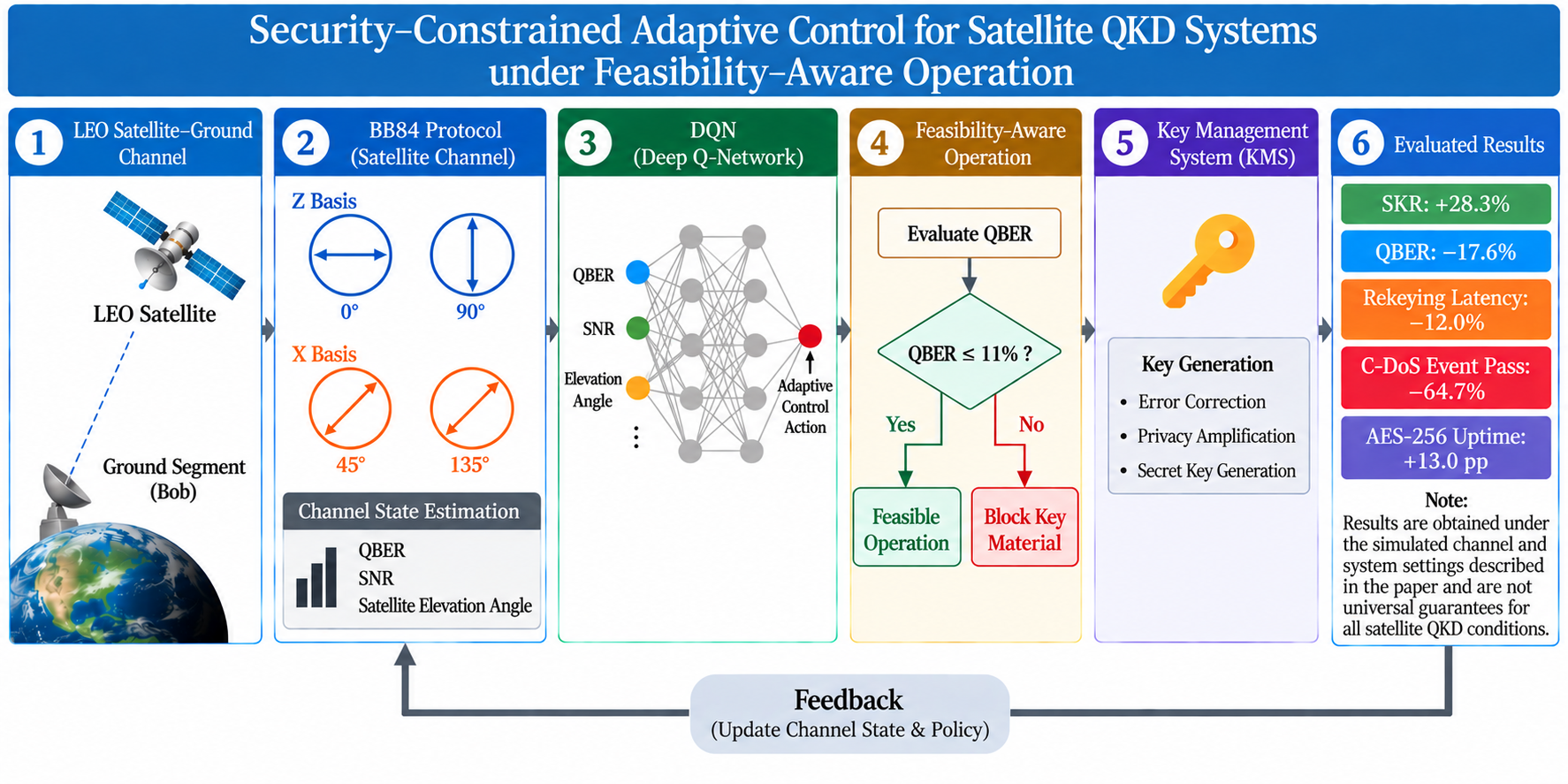

 Login
Login Register
 Submit a Paper
 Propose a Special lssue
 Download PDF
 Downloads
 Citation Tools
