Submission Deadline: 31 July 2027 View: 454 Submit to Special Issue
Assoc. Prof. Alexandra Galhano
Email: alexandra.galhano@ulusofona.pt
Affiliation: Faculdade de Ciências Naturais, Engenharias e Tecnologias, Universidade Lusófona – Centro Universitário do Porto, Porto, Portugal
Research Interests: complex systems, fractional calculus, and fractional-order systems

Prof. António Mendes Lopes
Email: aml@fe.up.pt
Affiliation: Faculty of Engineering, University of Porto, Porto, Portugal
Research Interests: automation, robotics, complex systems, and fractional-order systems

Prof. Behrouz Parsa Moghaddam
Email: bparsa@iau.ac.ir
Affiliation: Department of Mathematics, Islamic Azad University, Lahijan, Iran
Research Interests: fractional dynamics, stochastic mechanics, fractional differential equations, stochastic differential equations, stochastic dynamical systems, numerical methods, computational modeling in engineering, fractional calculus applications

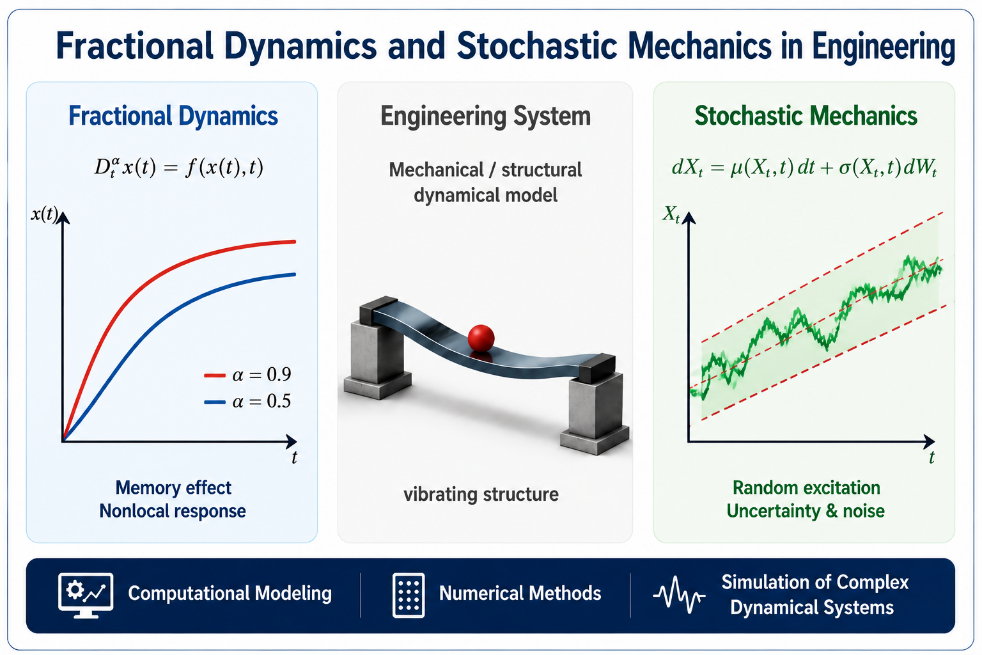
Fractional dynamics and stochastic mechanics are rapidly advancing fields that are transforming the modeling, analysis, and simulation of complex engineering systems. As modern engineering problems increasingly involve memory-dependent behavior, nonlocal interactions, random perturbations, multiple sources of uncertainty, and growing volumes of heterogeneous data, conventional deterministic and integer-order models often fail to provide sufficiently accurate or robust descriptions. This has created a growing demand for innovative mathematical, computational, and data-driven approaches capable of capturing fractional-order effects and stochastic dynamics in realistic engineering environments.
This Special Issue provides a forum for high-quality contributions on theoretical developments, numerical methods, and engineering applications involving fractional differential equations, stochastic dynamical systems, coupled fractional-stochastic formulations, uncertainty quantification, reliability analysis, random vibration, anomalous transport, and computational mechanics under uncertainty. Particular emphasis is placed on hybrid physics-based and data-driven methodologies, including artificial intelligence and machine learning, physics-informed neural networks (PINNs), surrogate and reduced-order modeling, digital twins, smart structural health monitoring, intelligent software, and advanced computational frameworks for simulation, prediction, optimization, and control. Original research and authoritative reviews demonstrating methodological innovation and practical impact across structural, mechanical, civil, aerospace, materials, fluid, energy, and interdisciplinary engineering are particularly encouraged.


 Login
Login Register
 Submit a Paper
 Propose a Special lssue