Submission Deadline: 30 September 2027 View: 582 Submit to Special Issue
Dr. Van-Tu Nguyen
Email: vtnguyen@hcmut.edu.vn
Affiliation: Faculty of Applied Science, Ho Chi Minh City University of Technology (HCMUT), Ho Chi Minh City, Vietnam.; Vietnam National University Ho Chi Minh City, Ho Chi Minh City, Vietnam
Research Interests: computational fluid dynamics: numerical methods, numerical algorithms, numerical programming; fluid dynamics: multiphase flows, shock capturing, free surface flows, water entry/ water exit, cavitation, bubble dynamics, cavitation erosion, droplet, heat and mass transfer, gas dynamics and industrial gas flows, supercavitation, high-speed subsonic-supersonic flows; mechanical systems: energy system, mechanical system design, control automated system, nuclear energy system

Prof. Dr. Ould el Moctar
Email: ould.el-moctar@uni-due.de
Affiliation: Department of Autonomous and Energy-Efficient Maritime Technologies, Technische Universität Berlin, Berlin, 10623, Germany
Research Interests: multiphase flows, fluid-structure-interaction

Assoc. Prof. Dr. Anh Dinh Le
Email: anh.ld@vnu.edu.vn
Affiliation: School of Aerospace Engineering, VNU University of Engineering and Technology, Hanoi, Viet Nam
Research Interests: computational fluid dynamics: numerical methods, numerical algorithms; fluid dynamics: multiphase flows, cavitation, heat and mass transfer, drag reduction; renewable energy: wind- and hydrokinetic turbine

Assist. Prof. Hemant J. Sagar
Email: hemant.sagar@hre.iitr.ac.in
Affiliation: Hydro and Renewable Energy Department, Indian Institute of Technology Roorkee, Uttrakhkand, India
Research Interests: CFD and FEM, turbines and rotating machinery, experimental methods, hydropower, fluid-structure interaction, multiphase flows, quantitative analysis of flow, cavitation, cavitation-erosion, cavitation-silt erosion, erosion resistive coatings, hydrodynamics supercavitation, offshore wind turbines (floating anf fixed), acoustics, cavitation based biomedical technology, hydrodynamics, bubble dynamics, laser induced cavitation bubbles, cavitation bubble dynamics

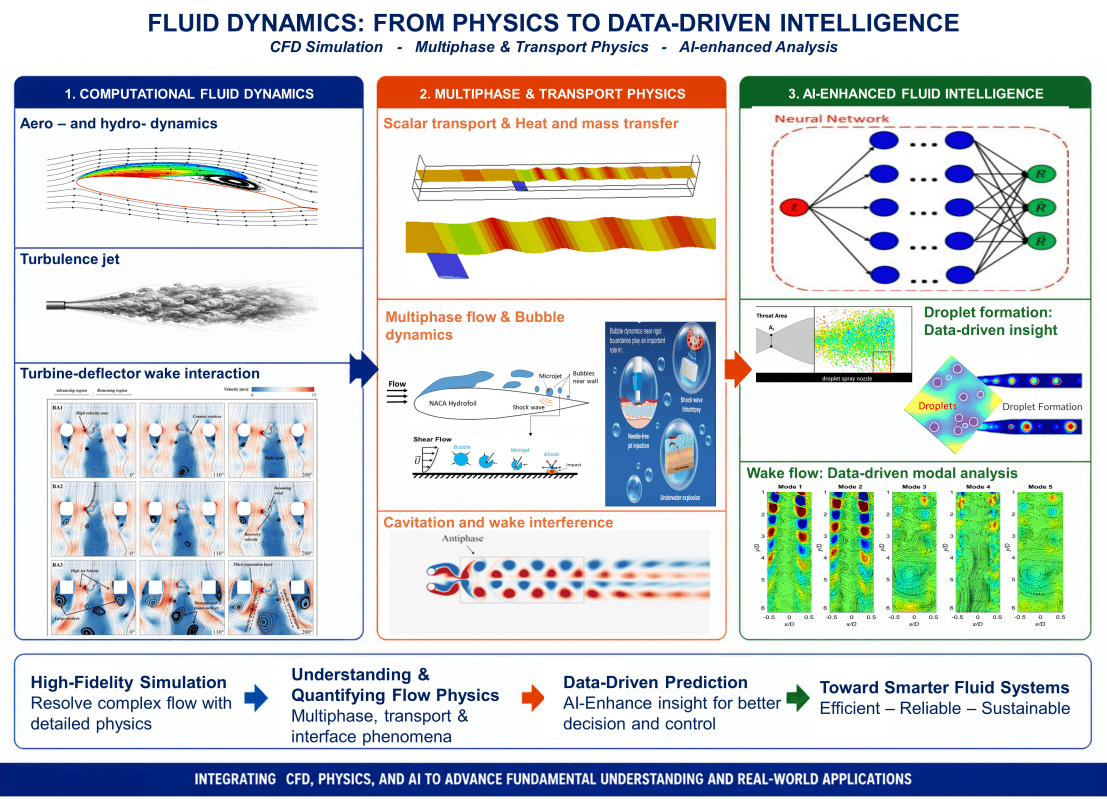
Fluid flow phenomena are fundamental to numerous natural processes and engineering systems, ranging from aerospace, marine, energy, environmental, and biomedical engineering to chemical processing, microfluidics, and advanced manufacturing. The increasing demand for accurate prediction and optimization of complex flow behaviors has driven rapid developments in mathematical modeling, numerical algorithms, high-performance computing, data-driven methodologies, and experimental diagnostics. These advances enable researchers to investigate increasingly challenging problems involving turbulence, compressible and incompressible flows, multiphase systems, heat and mass transfer, fluid-structure interaction, reactive flows, and transport phenomena across multiple spatial and temporal scales.
This Special Issue aims to provide a comprehensive forum for presenting recent advances in the modeling, numerical simulation, experimental validation, and practical applications of fluid flows. We welcome contributions that develop innovative theoretical models, computational methods, numerical algorithms, and experimental techniques for understanding complex flow physics and addressing multidisciplinary engineering challenges. Particular emphasis is placed on high-fidelity simulations, multiscale and multiphysics modeling, artificial intelligence and machine learning for computational fluid dynamics, uncertainty quantification, reduced-order modeling, and digital-twin technologies for fluid systems.
Topics of interest include, but are not limited to:
Fundamental Areas
· Mathematical modeling of fluid flows
· Computational Fluid Dynamics (CFD)
· Numerical methods and algorithms for fluid flow simulation
· Compressible and incompressible flows
· Laminar and turbulent flows (RANS, LES, DNS, hybrid methods)
· Multiphase and multicomponent flows
· Bubble and droplet dynamics
· Cavitation and supercavitation
· Free-surface and interfacial flows
· Boiling, condensation, evaporation, and phase-change phenomena
· Heat and mass transfer
· Fluid–structure interaction (FSI)
· Reactive and combustion flows
· Particle-laden, granular, and porous media flows
· Microfluidics and nanofluidics
· Lattice Boltzmann, SPH, VOF, level-set, phase-field, immersed boundary, and particle-based methods
· High-performance computing, GPU acceleration, and parallel computing
· Reduced-order modeling and surrogate modeling
· Artificial intelligence and machine learning for fluid mechanics
· Physics-informed neural networks (PINNs) and scientific machine learning
· Data assimilation, digital twins, optimization, and uncertainty quantification
· Experimental techniques for model validation and flow diagnostics
Applications
· Aerospace and high-speed aerodynamics
· Marine, offshore, and underwater hydrodynamics
· Naval engineering and ship hydrodynamics
· Hydraulic machinery and turbomachinery
· Energy systems and renewable energy
· Hydrogen production, storage, and transportation
· Nuclear engineering and thermal hydraulics
· Chemical and process engineering
· Biomedical and physiological flows
· Environmental and geophysical flows
· Atmospheric and oceanic flows
· Water resources and hydraulic engineering
· Microfluidic devices and lab-on-a-chip systems
· Additive manufacturing and advanced manufacturing processes
· Electronics cooling and thermal management
· Automotive and transportation systems
· Oil, gas, and multiphase pipeline transport
· Industrial mixing and process optimization
· Flow-induced noise and vibration
· Multiphysics engineering systems involving fluid flow


 Login
Login Register
 Submit a Paper
 Propose a Special lssue