Staged Pressure Reduction and Cavitation Suppression in Multi-Stage Sleeve-Type Valves Using Perforated Plates
Xiuyang Fan1, Fuqiang Chen1,2,3,*, Haicang Wang1, Jingjing Liu1
1 Beijing Key Laboratory of Health Monitoring and Self-Recovery for High-End Mechanical Equipment, Beijing University of Chemical Technology, Beijing, China
2 State Key Laboratory of Fluid Power and Mechatronic Systems, Zhejiang University, Hangzhou, China
3 State Key Laboratory of High-End Compressor and System Technology, Beijing University of Chemical Technology, Beijing, China
* Corresponding Author: Fuqiang Chen. Email: 
(This article belongs to the Special Issue: Multiphase Flow in Fluid Machinery)
Fluid Dynamics & Materials Processing https://doi.org/10.32604/fdmp.2026.087295
Received 14 June 2026; Accepted 02 September 2026; Published online 07 September 2026
Abstract
This study develops a numerical framework to elucidate how staged perforated plates regulate flow and suppress cavitation in a multi-stage sleeve-type pressure-reducing valve (MSPRV) for nuclear feedwater systems under high-pressure-drop conditions. Steady Reynolds-averaged Navier–Stokes (RANS) simulations, coupled with the standard
k–
ω turbulence model and the Zwart–Gerber–Belamri cavitation model, were conducted at an inlet pressure of 2 MPa. The effects of outlet back pressure, perforated-plate hole radius, and inter-plate spacing were systematically examined through comparisons of a baseline valve without a perforated plate, single-stage configurations, and two-stage configurations. Lower outlet back pressure was found to concentrate the pressure drop across the secondary sleeve, intensify downstream high-velocity jets, promote the coalescence of low-pressure regions, and substantially increase vapor formation. A single perforated plate alleviated sleeve cavitation by increasing downstream back pressure, but smaller holes shifted the dominant pressure drop and cavitation toward the plate itself, limiting the overall mitigation effect. In contrast, staged pressure reduction in the two-plate configuration progressively attenuated the jets, enhanced inter-plate pressure recovery, and disrupted the continuity of persistent low-pressure regions. An inter-plate spacing of 15 mm provided a favorable balance between jet attenuation, flow conditioning, and structural compactness. Within the investigated design space, the two-stage configuration with a 3.0 mm hole radius exhibited the most favorable overall flow and cavitation characteristics. At an outlet pressure of 0.1 MPa, this configuration reduced the maximum velocity, maximum turbulent kinetic energy, maximum vapor volume fraction, and equivalent vapor volume by 26.6%, 64.9%, 72.8%, and approximately 99.6%, respectively, relative to the no-plate configuration. Overall, the results demonstrate that coordinated control of plate number, hole size, and inter-plate spacing can redistribute the pressure drop, reshape jet development, and disrupt sustained low-pressure connectivity, providing an effective strategy for reducing time-averaged cavitation in high-pressure-drop MSPRVs.
Graphical Abstract
Keywords
Nuclear feedwater system; multi-stage sleeve-type pressure-reducing valve; cavitation migration; staged perforated plates; pressure-drop distribution
 Open Access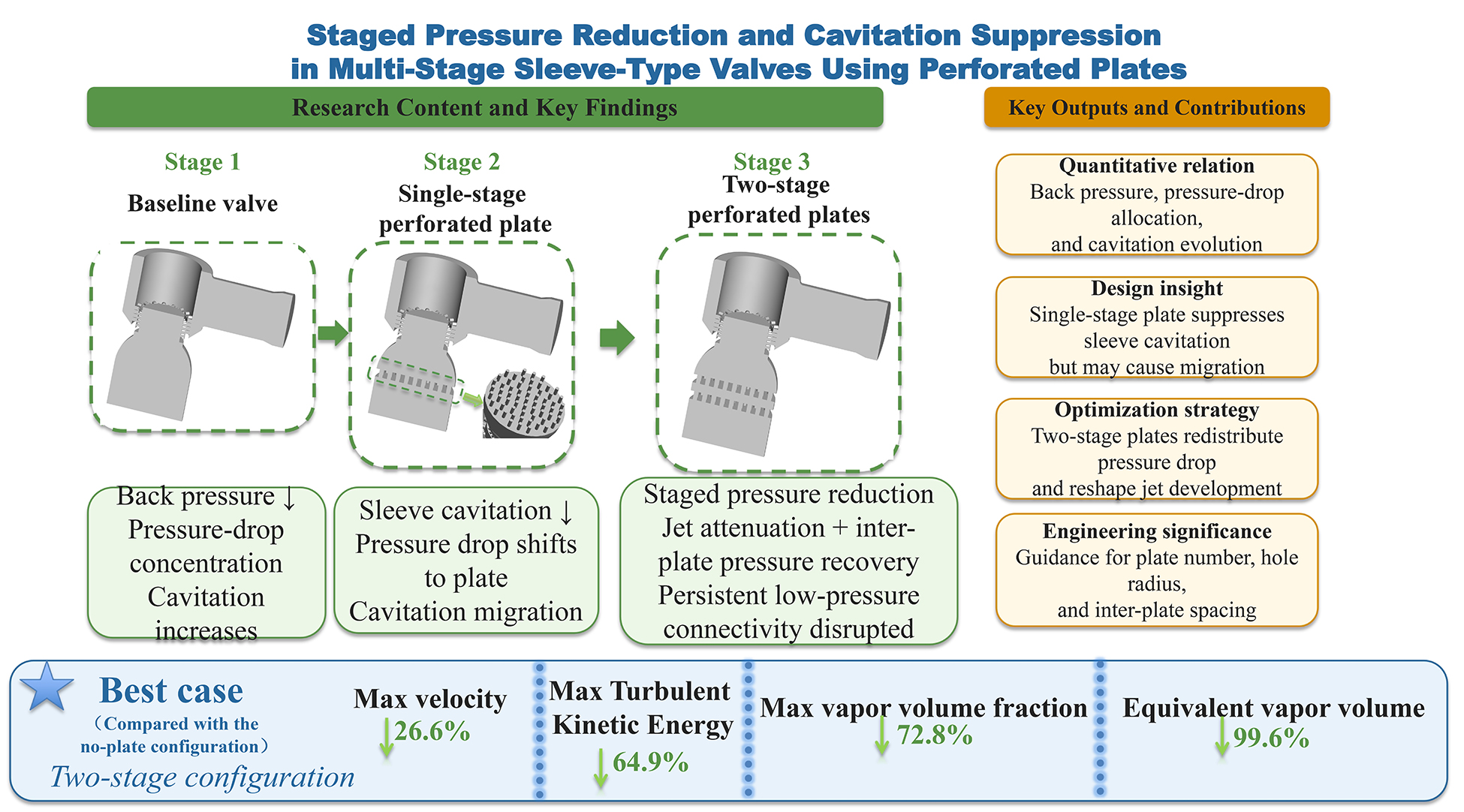

 Login
Login Register
 Submit a Paper
 Propose a Special lssue
 Download PDF
 Downloads
 Citation Tools
