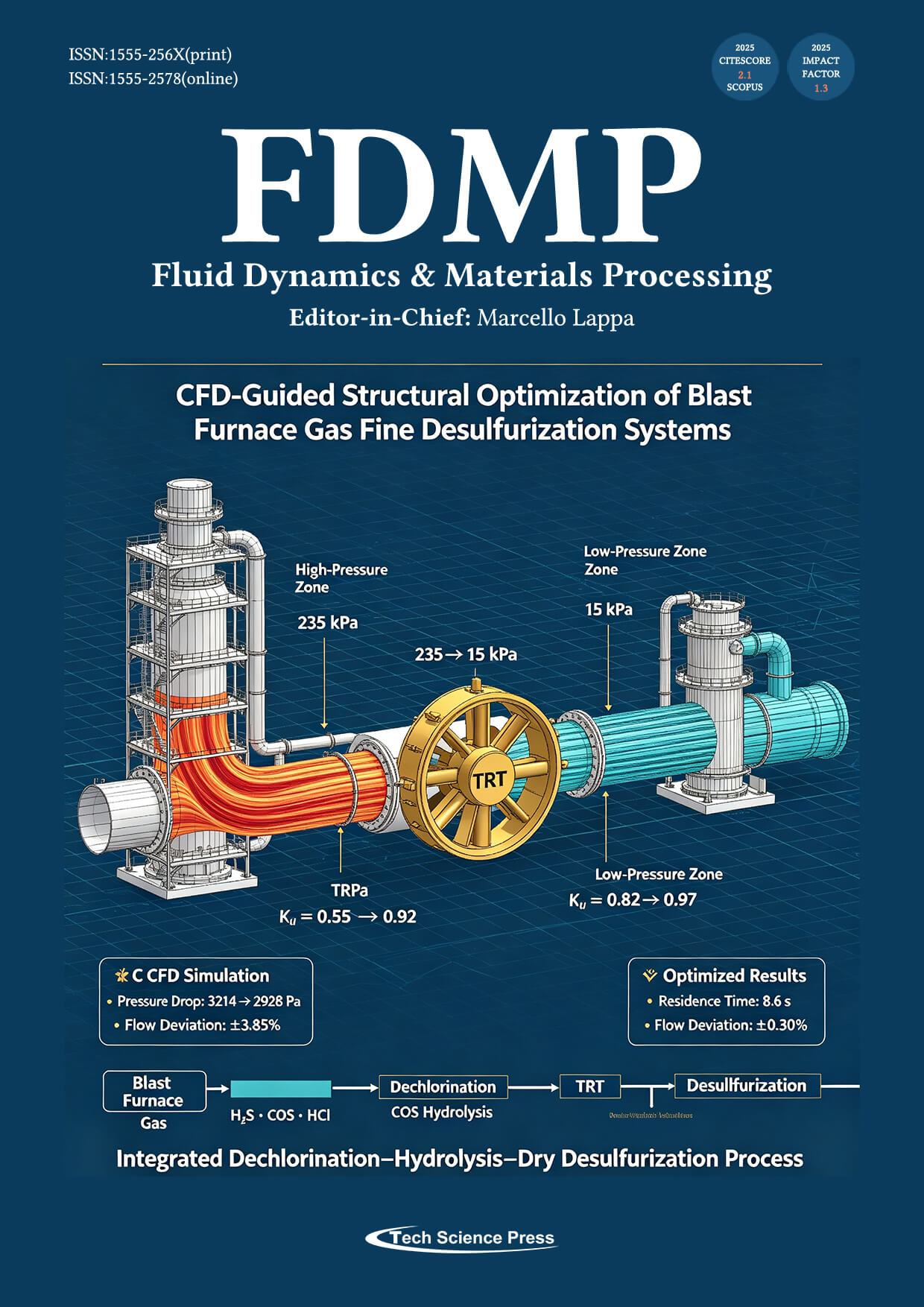
Blast furnace gas fine desulfurization depends on the efficient passage of gas through complex reactor networks, yet pressure-driven flow variations can generate severe maldistribution, localized jet impingement, and preferential flow paths, compromising gas-solid contact and purification efficiency. This cover illustrates a three-dimensional CFD investigation revealing how operating pressure shapes the internal flow field and governs the emergence of non-uniform flow structures. Guided by these insights, an integrated structural optimization strategy combines inlet deflector plates with selective sealing of perforated plates near partition regions. The deflectors gently redirect and stabilize the incoming gas, suppressing secondary motion and impingement, while the sealed regions eliminate short-circuiting and promote uniform permeation through the reactive packing. Together, these complementary mechanisms reshape the flow into a stable and homogeneous distribution across the system, enhancing gas-solid interaction and creating more favorable conditions for sulfur removal. This study highlights how pressure-aware structural design can transform complex internal flow behavior into a controllable process, offering a rational pathway toward efficient, low-resistance gas purification and more sustainable steelmaking.
View this paper

 Login
Login Register
 Submit a Paper
 Propose a Special lssue