Home / Journals / FDMP / Online First / doi:10.32604/fdmp.2026.087496
Special Issues
Table of Content

Open Access

ARTICLE

Numerical Study of a Novel C-Type Groove for Enhanced Torque Transmission in Hydro-Viscous Clutches

Xiangping Liao*, Ye Xu, Ying Zhao, Langxin Sun
School of Mechanical Engineering, Jiangsu University of Technology, Changzhou, China
* Corresponding Author: Xiangping Liao. Email: email
(This article belongs to the Special Issue: Advances in Hydraulic Systems: Integrating Hydrostatic, Hydrodynamic, and Hydro-viscous Transmission Technologies)

Fluid Dynamics & Materials Processing https://doi.org/10.32604/fdmp.2026.087496

Received 17 June 2026; Accepted 02 September 2026; Published online 07 September 2026
Abstract

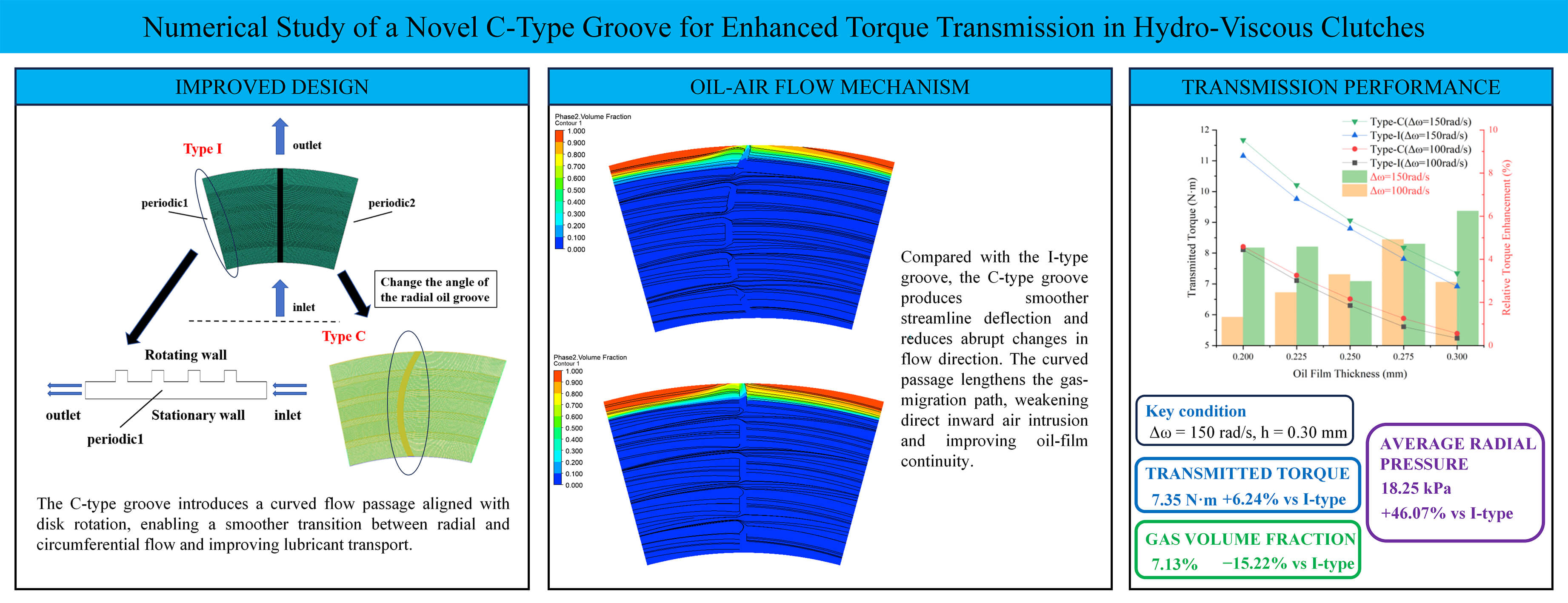
This study investigates the oil-groove configuration of composite friction pairs in hydro-viscous clutches (HVCs), with particular emphasis on the effects of gas content and pressure within the oil film on torque transmission under high-slip conditions. A novel C-type composite groove is proposed to improve oil-film distribution and pressure within the friction interface. A three-dimensional gas–liquid two-phase CFD model is developed to account for the effects of radial groove geometry under prescribed flow-rate and slip conditions. The coupled gas-liquid two-phase Navier–Stokes equations are solved numerically to examine the oil-phase distribution and its influence on torque transmission for different groove geometries, oil-film thicknesses, and slip speeds. The results show that, at a given slip speed and oil-film thickness, the C-type groove maintains a higher average circumferential pressure without changing the groove cross-sectional profile, while increasing oil-film coverage and suppressing negative-pressure regions. At a slip speed of 150 rad/s and an oil-film thickness of 0.3 mm, the C-type groove increases the transmitted torque by 6.24%, reduces the gas volume fraction by 15.22%, and increases the average radial pressure by 46.07% compared with the I-type groove. Under the same operating conditions, the average circumferential pressure remains positive for the C-type groove, whereas it becomes negative for the I-type groove. Moreover, the reduction in transmitted torque associated with gas–liquid two-phase flow is 12.42% lower for the C-type groove than for the I-type groove. These results demonstrate that groove geometry directly affects gas–liquid distribution, pressure within the oil film, and torque transmission at the friction interface. The C-type groove therefore provides a promising approach for improving torque transmission in HVC friction pairs and offers useful numerical guidance for groove design and optimization.

Graphical Abstract

Numerical Study of a Novel C-Type Groove for Enhanced Torque Transmission in Hydro-Viscous Clutches

Keywords

Hydro viscous transmission; CFD; two-phase flow; C-type composite groove; torque characteristics
  • 121

    View

  • 21

    Download

  • 0

    Like

Share Link