Cancer-Associated Fibroblasts-Orchestrated Immune Remodeling as a Key Driver in Liver Cancer
Nunzia Porro1, Silvia Marri2, Francesca Salani2, Fabio Marra1, Laura Gragnani2,*, Alessandra Gentilini1,*
1 Department of Experimental and Clinical Medicine, University of Florence, Florence, Italy
2 Department of Translational Research and New Surgical and Medical Technologies, University of Pisa, Pisa, Italy
* Corresponding Author: Laura Gragnani. Email:  ; Alessandra Gentilini. Email:
Oncology Research https://doi.org/10.32604/or.2026.083633
Received 07 April 2026; Accepted 12 August 2026; Published online 17 August 2026
Abstract
Hepatocellular carcinoma (HCC) and intrahepatic cholangiocarcinoma (iCCA) develop within a highly immunosuppressive tumor microenvironment (TME) characterized by chronic inflammation, extensive stromal remodeling, and impaired antitumor immunity. Among stromal components, cancer-associated fibroblasts (CAFs) have emerged as key regulators of tumor progression and immune homeostasis. This review provides an overview of CAF-mediated immune remodeling in primary liver cancers, with particular emphasis on CAF heterogeneity, CAF–immune cell interactions, and their impact on disease progression and therapeutic response. Increasing evidence indicates that CAFs orchestrate multiple aspects of the tumor immune microenvironment through the secretion of cytokines, chemokines, growth factors, and extracellular matrix components. These signals promote immune exclusion, suppress cytotoxic T-cell activity, and favor the accumulation of immunosuppressive cell populations, including regulatory T cells, myeloid-derived suppressor cells, and tumor-associated macrophages. Advances in single-cell and spatial transcriptomic technologies have revealed substantial CAF heterogeneity and identified distinct CAF subsets with specialized immunomodulatory functions. These findings have uncovered novel therapeutic opportunities, including CAF-targeted approaches, extracellular matrix normalization, and strategies aimed at reprogramming CAF plasticity. Overall, CAFs are central orchestrators of immune remodeling in liver cancer and contribute to the establishment of an immunosuppressive microenvironment that supports tumor progression and therapeutic resistance. Targeting CAF-driven stromal–immune interactions may enhance antitumor immunity and improve the efficacy of current and emerging immunotherapies in HCC and iCCA.
Graphical Abstract
Keywords
Hepatocellular carcinoma; intrahepatic cholangiocarcinoma; cancer-associated fibroblasts; liver immunology; immune remodeling; immunotherapy
 Open Access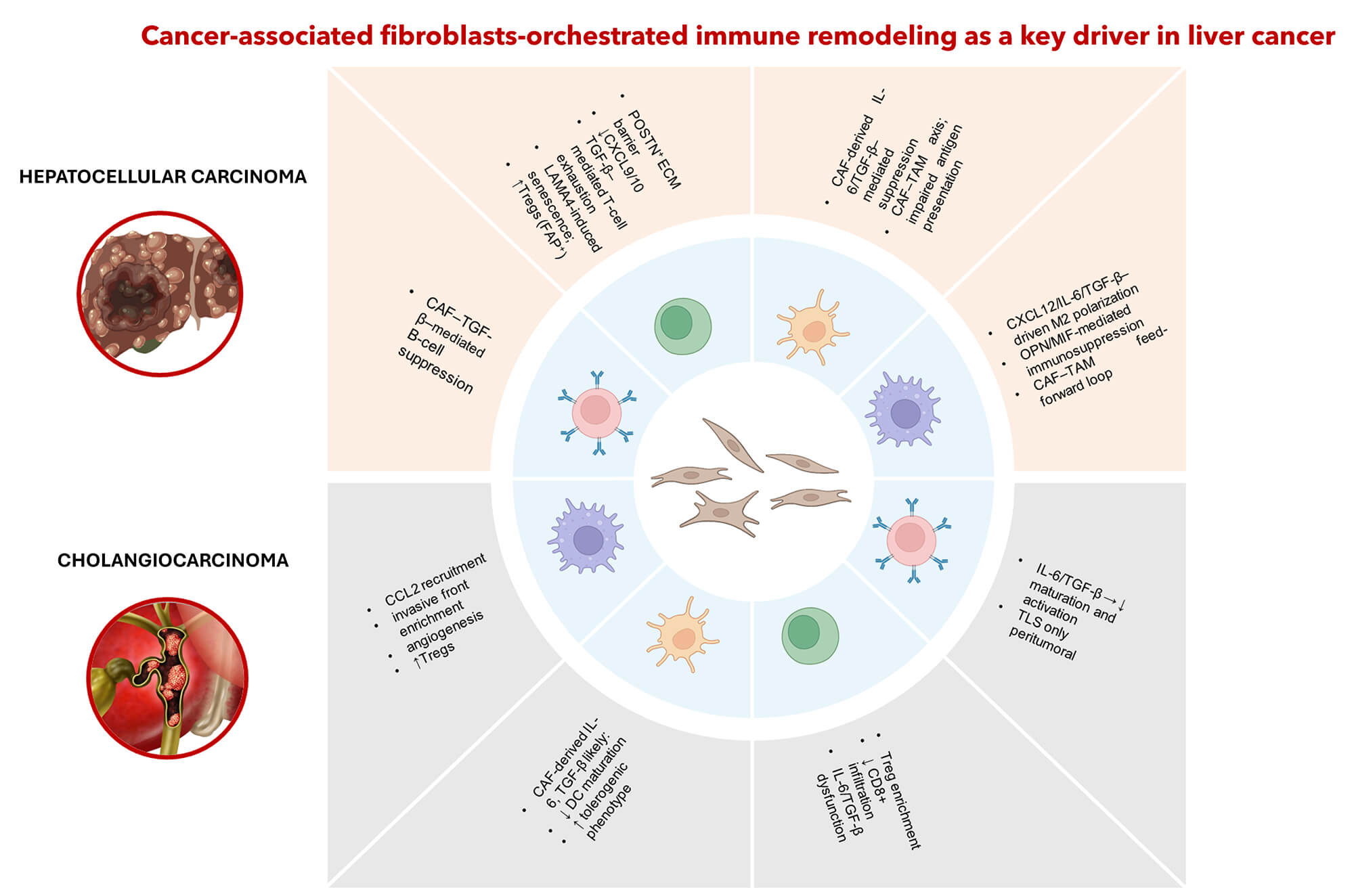

 Login
Login Register
 Submit a Paper
 Propose a Special lssue
 Download PDF
 Downloads
 Citation Tools
