
Home / Journals / OR / Online First / doi:10.32604/or.2026.086172
Special Issues
Table of Content

Open Access

REVIEW

Modeling the Melanoma Tumor Microenvironment: From 3D Cultures to Predictive 4D In Vitro Platforms

Immacolata Belviso1, Filomena Mazzeo2, Maria Letizia Motti3,*
1 UniCamillus-Saint Camillus International University of Health Sciences, Rome, Italy
2 Department of Law, Economics and Human Sciences (DiGiES), Mediterranea University of Reggio Calabria, Via dell’Università, 25, Reggio Calabria, Italy
3 Department of Medical, Human Movement and Well-Being Sciences, University of Naples Parthenope, Naples, Italy
* Corresponding Author: Maria Letizia Motti. Email: email
(This article belongs to the Special Issue: Exploring Cancer Biology through the Tumor Microenvironment and Advanced Experimental Model)

Oncology Research https://doi.org/10.32604/or.2026.086172

Received 25 May 2026; Accepted 23 July 2026; Published online 15 September 2026
Abstract

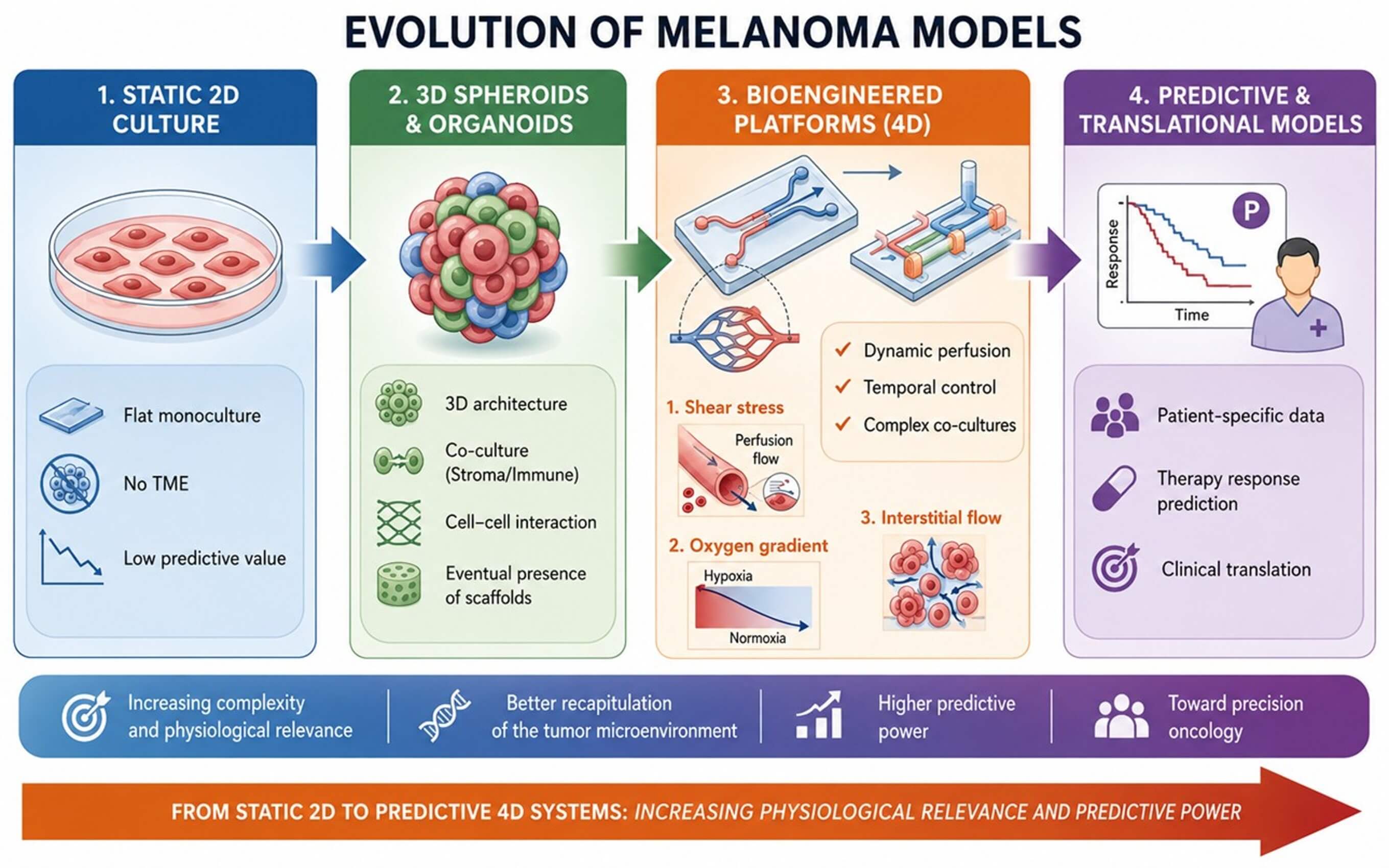
Melanoma is an aggressive skin cancer characterized by marked cellular heterogeneity and complex, dynamic interactions with the surrounding tumor microenvironment, which comprises fibroblasts, immune and endothelial cells, and the extracellular matrix. These interactions critically influence tumor progression, invasion, immune evasion, and the frequent emergence of resistance to targeted therapies and immunotherapies, underscoring the need for preclinical models that faithfully reproduce the complexity of human melanoma. Conventional two-dimensional (2D) culture systems, although still widely used, fail to recapitulate the structural architecture, cellular heterogeneity, and dynamic biochemical and mechanical cues of the tumor microenvironment, which limits their predictive value for therapeutic responses. Advanced three-dimensional (3D) and four-dimensional (4D) in vitro platforms have therefore emerged as more physiologically relevant alternatives capable of reproducing tissue-like organization and temporal tumor dynamics. The aim of this narrative review is to provide a critical overview of these advanced melanoma modeling platforms, including scaffold-free and scaffold-based 3D systems, spheroids, patient-derived organoids, assembloids, bioprinted constructs, and microfluidic tumor-on-chip devices, together with 4D time-resolved approaches. The review further examines the integration of high-resolution imaging, spatial omics, computational modeling, and artificial intelligence (AI)-based analysis as complementary tools for the quantitative, spatial, and temporal characterization of melanoma. By outlining the biological rationale and the technological landscape underlying these systems, this work aims to frame their potential contribution to more predictive, physiologically relevant, and translational melanoma research.

Graphical Abstract

Modeling the Melanoma Tumor Microenvironment: From 3D Cultures to Predictive 4D <i>In Vitro</i> Platforms

Keywords

Melanoma; 3D culture; tumor-on-chip; 4D models; artificial intelligence; tumor microenvironment (TME)
  • 214

    View

  • 27

    Download

  • 0

    Like

Share Link



