
Home / Journals / CMES / Online First / doi:10.32604/cmes.2026.087493
Special Issues
Table of Content

Open Access

ARTICLE

AMASA-YOLO: Adaptive Spectral Mamba-Inspired and Sparse-Guided Attention for MRI Brain Tumor Detection

Bao Quoc Vuong1,2, Kien Dinh Vu1,2, Kien Trang1,2,*, An Hoang Nguyen1,2
1 School of Electrical Engineering, International University, Ho Chi Minh City, Vietnam
2 Vietnam National University, Ho Chi Minh City, Vietnam
* Corresponding Author: Kien Trang. Email: email
(This article belongs to the Special Issue: Recent Advances in Signal Processing and Computer Vision, 2nd Edition)

Computer Modeling in Engineering & Sciences https://doi.org/10.32604/cmes.2026.087493

Received 17 June 2026; Accepted 27 August 2026; Published online 11 September 2026
Abstract

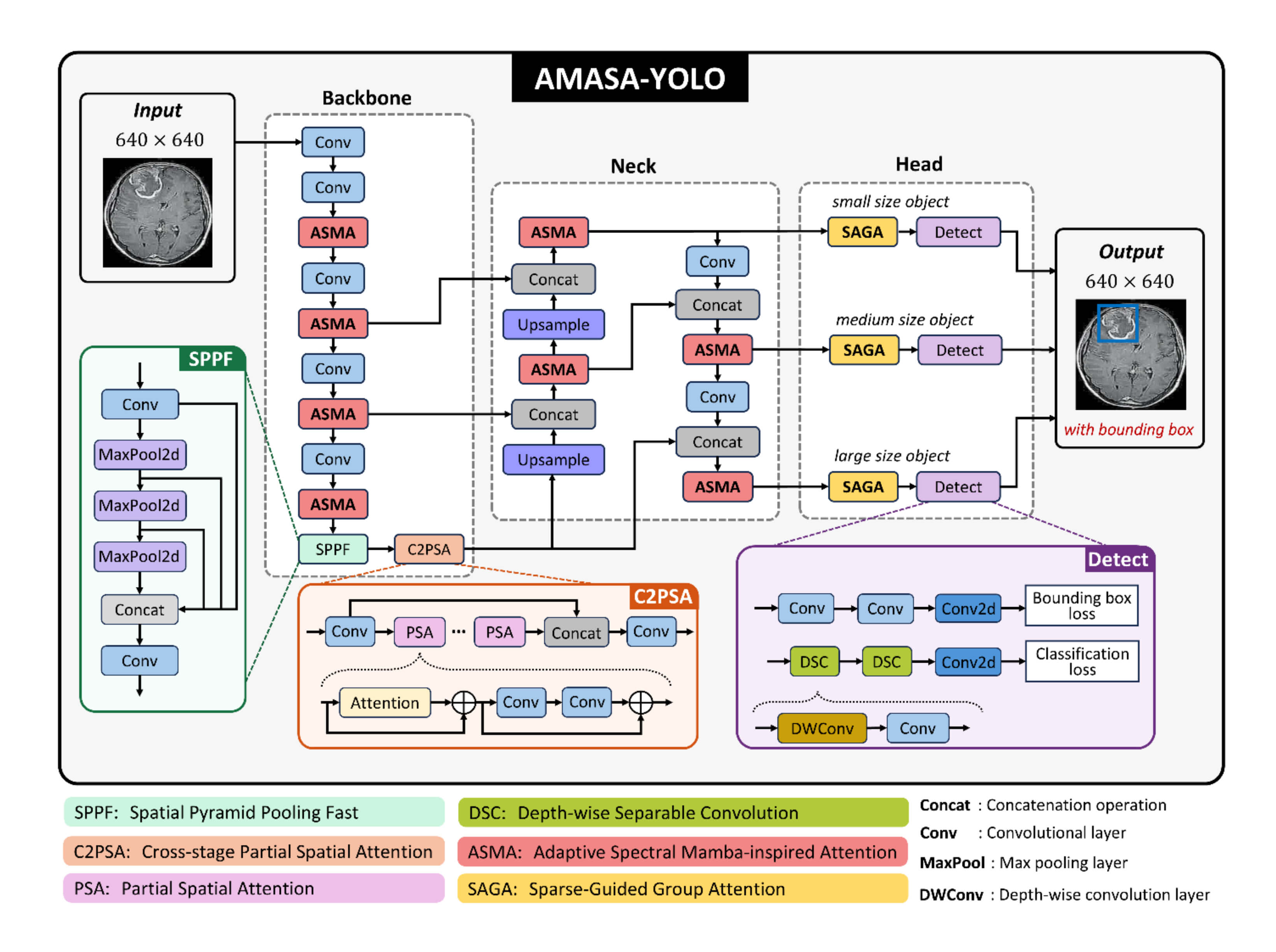
Brain tumor detection from magnetic resonance imaging (MRI) is an important task for supporting early diagnosis and treatment planning. However, accurate detection is still challenging because tumor regions often have weak boundaries, variety of sizes, and similar intensity. To address these issues, we propose AMASA-YOLO, which is an adaptive spectral and sparse-guided attention framework for MRI brain tumor detection. Our model is built on a YOLO-based architecture and introduces two main modules. First, the Adaptive Spectral Mamba-Inspired Attention (ASMA) block is used to improve feature extraction by combining spatial attention with spectral feature refinement. This allows the model to capture long-range information while preserving texture and boundary-related details. Second, the Sparse-Guided Group Attention (SAGA) block is added before the detection head to strengthen multi-scale feature representation through sparse self-attention and cascaded group attention. The proposed method is evaluated on the BraTS20 and Br35H datasets and compared with several recent detection models. Experimental results show that AMASA-YOLO achieves strong performance in several key metrics on both datasets. It reaches 0.9545 recall, 0.9579 mAP50, and 0.7198 mAP50-95 on the BraTS20, and 0.9557 mAP50 on the Br35H. The ablation studies and qualitative results further demonstrate that ASMA and SAGA improve tumor localization and detection robustness, indicating that the proposed model can provide a promising MRI-based brain tumor localization framework with moderate computational complexity.

Graphical Abstract

AMASA-YOLO: Adaptive Spectral Mamba-Inspired and Sparse-Guided Attention for MRI Brain Tumor Detection

Keywords

Brain tumor detection; magnetic resonance imaging; YOLO; Mamba; spectral attention; sparse-guided
  • 153

    View

  • 34

    Download

  • 0

    Like

Share Link



