Sevoflurane Inhibits Colon Cancer Progression by Inducing Cell Autophagy and Apoptosis through the ROS/Nrf2/P62 Pathway
Xiangui Liu1,#, Jianhua Liu2,#, Qingbin Meng1,*, Yongsheng Shao1
1 Department of Gastrointestinal Surgery, Traditional Chinese and Westemm Medicine Hospital of Wuhan, Tongji Medical College, Huazhong University of Science and Technology, Wuhan, China
2 Department of Thyroid and Breast Surgery, Traditional Chinese and Westemm Medicine Hospital of Wuhan, Tongji Medical College, Huazhong University of Science and Technology, Wuhan, China
* Corresponding Author: Qingbin Meng. Email: 
# These authors contributed equally to this work as the first author
Oncology Research https://doi.org/10.32604/or.2026.082954
Received 26 March 2026; Accepted 26 June 2026; Published online 10 August 2026
Abstract
Objectives: There is debate over the effect of sevoflurane (SEV) on different cancers. This study aims to explore SEV’s role in colon cancer (CC) progression.
Methods: The CC cell lines were treated with SEV at concentrations of 1.7%, 3.4%, and 5.1%. Cell proliferation, apoptosis, migration, and invasion were assessed using Cell Counting Kit-8 (CCK-8), 5-ethynyl-2′-deoxyuridine (EdU) incorporation, colony formation assay, flow cytometry, Western blot, scratch assay, and Transwell assay. A xenograft tumor model was established to evaluate the effect of SEV
in vivo. Expression levels of nuclear factor erythroid 2-related factor 2 (Nrf2), p62 (sequestosome-1), microtubule-associated protein 1 light chain 3 isoform II to I ratio (LC3-II/I), Beclin-1, Bcl-2-associated X protein (Bax), and B-cell lymphoma 2 (Bcl-2) were measured. N-acetyl-L-cysteine (NAC), a ROS scavenger, was applied to determine whether ROS-dependent Nrf2/p62 signaling participated in this process.
Results: SEV inhibited CC cell proliferation, colony formation, migration, and invasion. At 5.1% SEV, cell proliferation was reduced by 54.0% (
p < 0.001); colony formation decreased by 55.0% (
p < 0.001); and wound closure rates dropped from 78.3% to 24.6% (
p < 0.001) in HCT116 cells. Similar trends were observed in SW480 cells. Invaded cells were also significantly reduced in both cell lines (
p < 0.001). SEV also induced CC apoptosis. In the xenograft model, treatment with SEV significantly suppressed tumor progression, as evidenced by reductions in both tumor volume and weight (
p < 0.001). Mechanistically, SEV increased the LC3-II/I ratio and Beclin-1 expression, while decreasing Nrf2 and p62 expression both
in vitro and
in vivo. Moreover, NAC reversed the SEV-induced effects
in vitro.
Conclusion: SEV inhibits CC progression by inducing autophagy and apoptosis via the ROS/Nrf2/p62 pathway.
Graphical Abstract
Keywords
Sevoflurane; ROS/Nrf2/p62; autophagy; apoptosis; colon cancer; colorectal cancer
 Open Access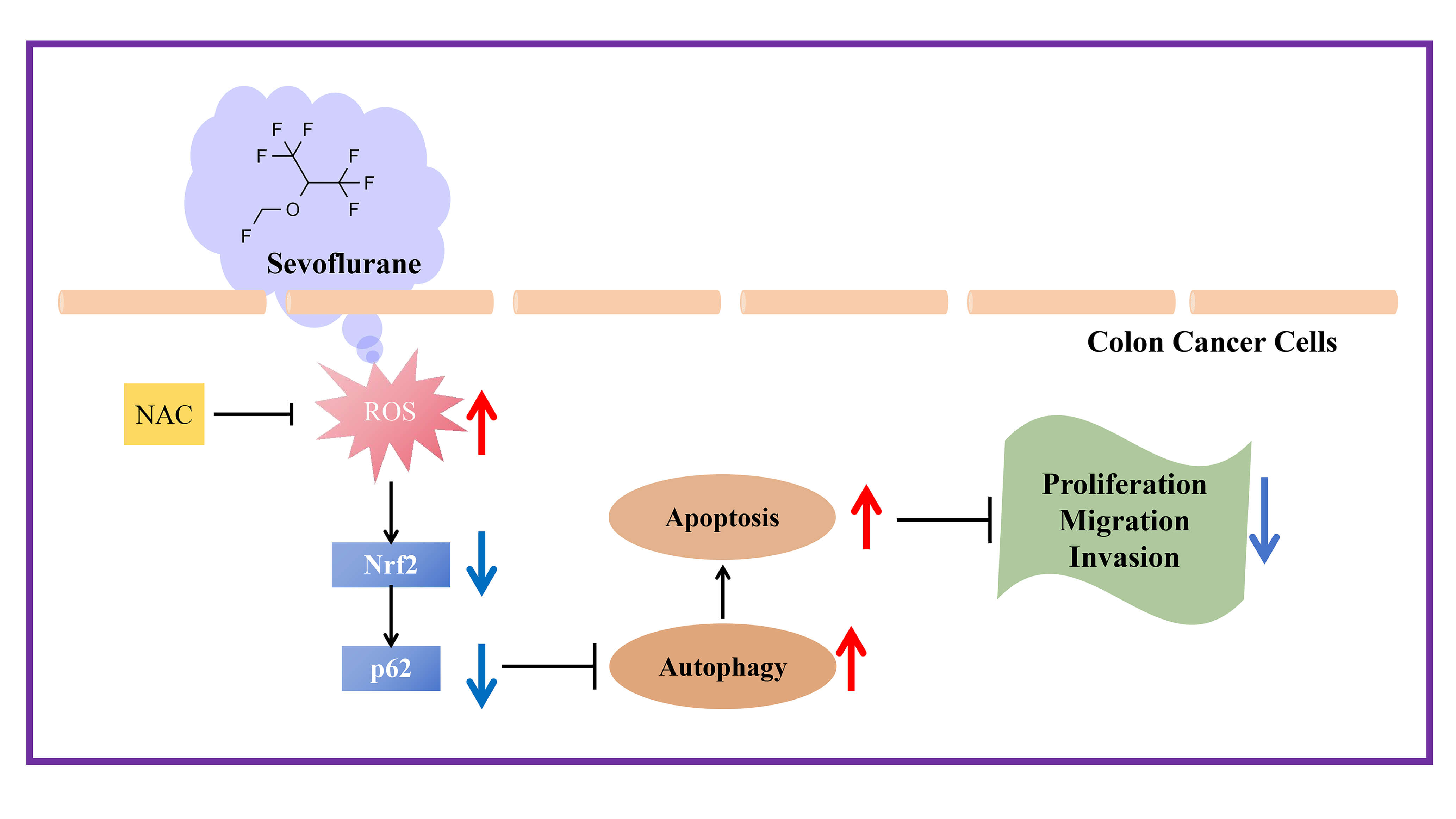

 Login
Login Register
 Submit a Paper
 Propose a Special lssue
 Download PDF
 Downloads
 Citation Tools
