Seven-Gene Signature and Immune Microenvironment as Determinants of Survival Rate in Colorectal Carcinoma
Vincenzo Rallo1,#, Matteo Massidda1,#, Xiaofen Wen2,3, Manila Deiana1, Andrea Maschio1, Jiaxin Shen2,4, Maria Chiara Ninniri5, Daniela Piras6, Ciriaco Carru2, Donatella Coradduzza2, Maria Rosaria Muroni5, Paolo Cossu-Rocca5, Antonio Mario Scanu5, Andrea Angius1,*, Maria Rosaria De Miglio5
1 Institute of Genetic and Biomedical Research (IRGB), National Research Council (CNR), Monserrato, Italy
2 Department of Biomedical Sciences, University of Sassari, Sassari, Italy
3 Department of Medical Oncology, Cancer Hospital of Shantou University Medical College, Shantou, China
4 Department of Hematology, The First Affiliated Hospital of Shantou University Medical College, Shantou, China
5 Department of Medicine, Surgery and Pharmacy, University of Sassari, Sassari, Italy
6 Complex Structure Epidemiology and Cancer Registry North Sardinia, ATS Sardinia, Sassari, Italy
* Corresponding Author: Andrea Angius. Email: 
# These authors contributed equally to this work
(This article belongs to the Special Issue: Advances and Innovations in Colorectal Cancer Research and Treatment)
Oncology Research https://doi.org/10.32604/or.2026.077466
Received 09 December 2025; Accepted 30 March 2026; Published online 12 August 2026
Abstract
Backgrounds: Colorectal cancer (CRC) prognosis remains difficult due to molecular heterogeneity and interaction between tumor cells and the immune microenvironment. This study aimed to identify transcriptomic and immune-cell patterns associated with overall survival (OS) and to develop an integrated prognostic model to improve risk stratification.
Methods: RNA-sequencing was performed on 131 primary CRC samples and matched normal tissues. Differentially expressed genes (DEGs) were identified and functionally characterized through gene ontology, Kyoto Encyclopedia of Genes and Genomes (KEGG) enrichment, and protein–protein interaction (PPI) network analysis. Immune-cell composition was estimated using CIBERSORTx deconvolution and evaluated for its association with OS. Prognostic DEGs were screened using univariate Cox regression and Least Absolute Shrinkage and Selection Operator (LASSO) analysis to construct a risk score. The model was validated in the Cancer Genome Atlas Database (TCGA)-COAD (colon cancer) and READ (rectal cancer) cohorts. A nomogram integrating molecular and clinicopathological variables were generated.
Results: A total of 5589 DEGs were identified between CRC and normal tissues, enriched in pathways related to cell cycle, Tumor Protein P53 (TP53), WNT Family Member (WNT), Janus kinase/signal transducer and activator of transcription 3 (JAK/STAT), calcium signaling, metabolism, and immune regulation. PPI analysis highlighted ten upregulated hub genes involved in mitotic spindle formation and chromosomal stability. Immune infiltration analysys indicated that higher proportions of plasma cells (
p = 6.9 × 10
−4), naïve B cells (
p = 0.019), resting CD4
+ memory T cells (
p = 0.02), M0 macrophages (
p = 0.0077), and activated dendritic cells (
p = 1.89 × 10
−5) were associated with improved OS, whereas monocytes (
p = 0.012), neutrophils (
p = 0.041), activated mast cells (
p = 0.0066), and M2 macrophages (
p = 0.014) were linked to poorer survival. A seven-gene signature including aspartate beta-hydroxylase (ASPH), bradykinin receptor B1 (BDKRB1), calcium voltage-gated channel auxiliary subunit beta 1 (CACNB1), C-C motif chemokine receptor 8 (CCR8), cyclic nucleotide gated channel subunit alpha 3 (CNGA3), microtubule associated protein 1A (MAP1A) and oxytocin receptor (OXTR) stratified patients into high- and low-risk groups with significant OS differences. The model demonstrated strong predictive performance (AUC: 0.84 at 1 year) and was validated in TCGA cohorts. Multivariate analysis confirmed the risk score as an independent prognostic factor. The integrated nomogram accurately predicted 1-, 3-, and 5-year survival (C-index = 0.757; 95% CI 0.724–0.791).
Conclusions: We developed and validated a seven-gene immune-related prognostic signature that, combined with clinicopathological parameters, provides a robust tool for individualized survival prediction and may guide precision management in CRC patients.
Graphical Abstract
Keywords
Colorectal cancer; transcriptome; immune microenvironment; hub genes; prognostic classifier
 Open Access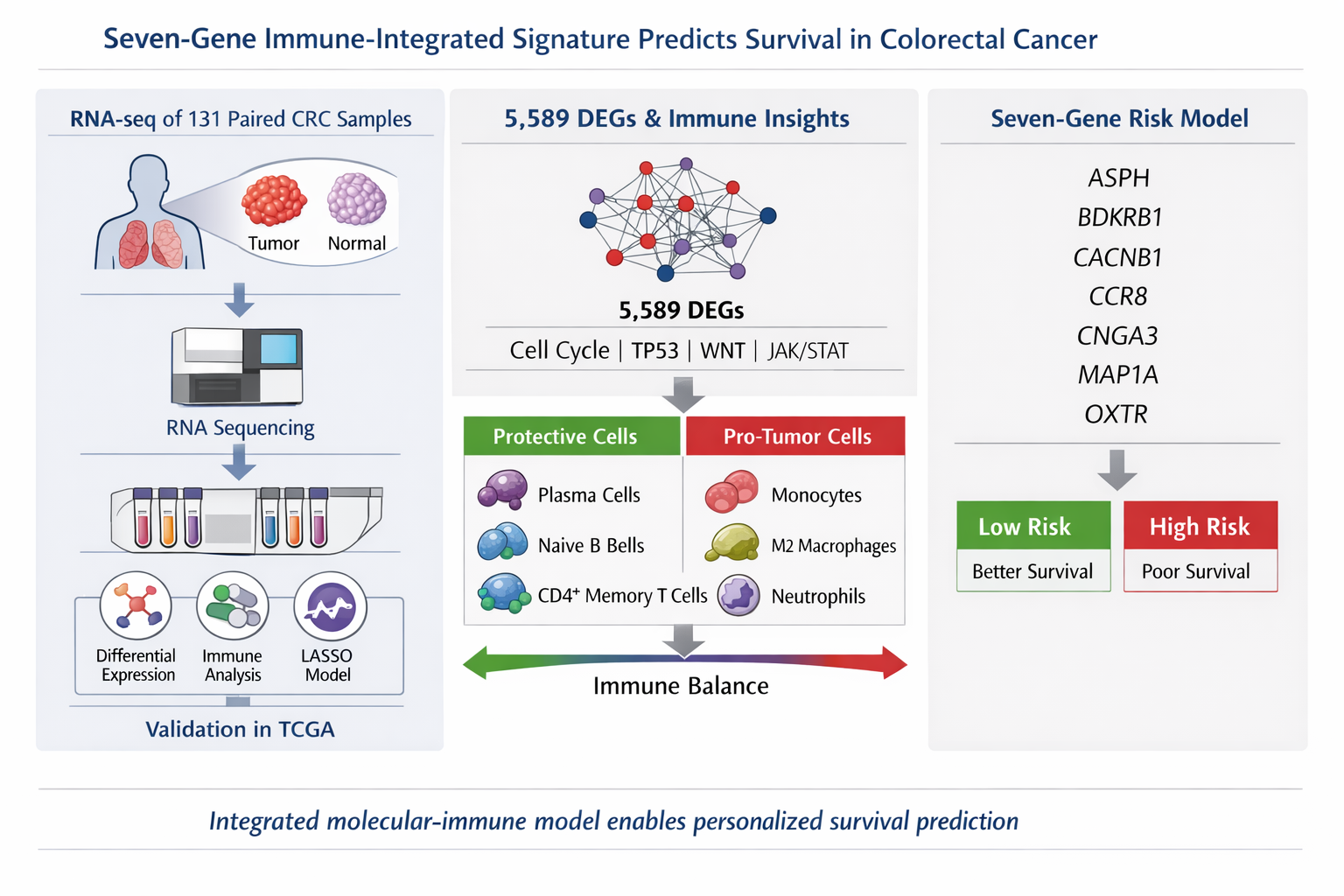

 Login
Login Register
 Submit a Paper
 Propose a Special lssue
 Download PDF
 Supplementary Material File
 Downloads
 Citation Tools
