 Open Access
ISSN:1555-256X (print)
ISSN:1555-2578 (online)
Publication Frequency:Monthly




Fluid Dynamics and Materials Processing is an essential reading for all those concerned with complex fluids, multiphase flows and the intersection of fluid dynamics with materials processing and/or with the more general field of engineering optimization. It features original theoretical, computational, and experimental investigations. All subjects where a material, at a certain stage of its “life”, is in a fluid state, behaves as a fluid (e.g. many types of granular media) or interacts with a fluid should be considered relevant to FDMP. Relevant examples include (but are not limited to) the most modern and advanced processes for the production of inorganic (semiconductors, metal alloys, foams, plastics, polymers, ceramic materials, cement, asphalt and resins of various kinds), organic (protein crystals, drugs and medicines) materials and "living" (in vitro) biological tissues. We are especially interested in those studies where emphasis is put on the fluid-dynamic conditions under which a material is operated. However, FDMP also welcomes manuscripts dealing with more fundamental aspects such as the rheological behavior of multiphase systems or the convective currents that are produced in a fluid as a result of the thermal, chemical and/or mechanical stimuli typically applied in various processing or manufacturing methods (e.g. thermal gradients, shaking, mixing, etc). Some attention is devoted as well to all those problems of “structure/fluid” interaction that have extensive background applications in important fields such as marine, chemical, aeronautical and aerospace engineering and the oil sector, i.e. all those cases where fluid-dynamic analysis is instrumental in guiding the design/optimization of the considered systems (or related components) and the selection of the required “materials”.
Emerging Source Citation Index (Web of Science): 0.7; Scopus Citescore (Impact per Publication 2024): 1.5; SNIP (Source Normalized Impact per Paper 2024): 0.350; Engineering Index (Compendex); EBSCO; Google Scholar; Proquest; Portico, etc...
 Open Access
ARTICLE
FDMP-Fluid Dynamics & Materials Processing, Vol.22, No.5, 2026, DOI:10.32604/fdmp.2026.076988 - 27 May 2026
(This article belongs to the Special Issue: Analysis of High-Speed Flows using Advanced Computational Methods)
Abstract Separated flow at a blunt base remains a critical topic in both automotive and aerospace engineering, particularly in the context of high-speed and supersonic vehicles such as modern fighter aircraft. In the separated region, characterized by a recirculation zone, the local pressure is typically lower than the ambient back pressure. This reduced base pressure can account for up to 70 percent of the total drag acting on an axisymmetric body. The present study focuses on regulating the base pressure within the recirculation region to reduce base drag and thereby enhance the operational range of rockets,… More >
Open Access
ARTICLE
FDMP-Fluid Dynamics & Materials Processing, Vol.22, No.5, 2026, DOI:10.32604/fdmp.2026.080128 - 27 May 2026
Abstract Uniformity in solid-liquid mixing is a critical aspect for mass and heat transfer efficiency in multiphase reactors. This highlights the necessity for rigorous quantitative approaches capable of resolving spatial heterogeneity across multiple scales. In this work, a coupled discrete element method-volume of fluid (DEM-VOF) framework is employed to simulate the suspension dynamics of 20,000 particles, each 2 mm in diameter, within a liquid medium. To achieve a quantitative and multiscale characterization of three-dimensional particle distributions, Ripley’s L function, rooted in spatial statistics, is introduced and systematically applied. Its validity and robustness are further corroborated through… More >
Open Access
ARTICLE
FDMP-Fluid Dynamics & Materials Processing, Vol.22, No.5, 2026, DOI:10.32604/fdmp.2026.081350 - 27 May 2026
(This article belongs to the Special Issue: Theoretical Foundations and Applications of Multiphase Flow in Pipeline Engineering)
Abstract Slug flow poses significant dynamic challenges in multiphase pipeline transport, particularly in complex offshore and Floating Liquefied Natural Gas systems, where conventional one- and two-dimensional models fail to capture the intricate three-dimensional interfacial topologies and transient liquid-film dynamics. To overcome this limitation, the present study develops a three-dimensional transient numerical model based on the coupled level-set and volume-of-fluid (CLSVOF) method within a large eddy simulation (LES) framework, and validates it against high-frequency measurements obtained from a double parallel conductance probe experimental platform. The proposed model successfully resolves phase velocity slip and interfacial morphological evolution, predicting More >
Open Access
ARTICLE
FDMP-Fluid Dynamics & Materials Processing, Vol.22, No.5, 2026, DOI:10.32604/fdmp.2026.080001 - 27 May 2026
(This article belongs to the Special Issue: Fluid Mechanics & Thermodynamics in Renewable Energy and HVAC Systems)
Abstract Lithium-ion batteries are widely deployed in electric vehicles, yet their performance and safety are strongly constrained by elevated operating temperatures, which may accelerate degradation and, in extreme cases, trigger thermal runaway. This study numerically investigates the thermal performance of a Tesla valve-based cold plate for battery thermal management, with the aim of enhancing heat dissipation efficiency through multi-parameter collaborative optimization. An initial screening is conducted using orthogonal experimental design to evaluate the effects of shunt angle (30°–50°), number of unit pairs (3–7), channel asymmetry ratio (0–0.5), and branch channel width (2–4 mm) on maximum temperature… More >
Open Access
ARTICLE
FDMP-Fluid Dynamics & Materials Processing, Vol.22, No.5, 2026, DOI:10.32604/fdmp.2026.081863 - 27 May 2026
(This article belongs to the Special Issue: Fluid and Thermal Dynamics in the Development of Unconventional Resources IV)
Abstract Gas binding fault (GBF) represents a critical operating condition in centrifugal pumps, characterized by severe performance degradation due to gas–liquid interactions within the flow passages. To elucidate the underlying mechanisms, this study employs a coupled Lattice Boltzmann Method and Large Eddy Simulation (LBM–LES) framework to analyze the hydro–mechanical-electrical behavior of a centrifugal pump under varying inlet gas volume fractions (IGVF, β). It is shown that, at low gas content (β ≈ 3%), dispersed bubbles primarily accumulate along the blade suction surface and near the impeller outlet. As β increases to 6%, gas structures migrate toward… More >
Open Access
ARTICLE
FDMP-Fluid Dynamics & Materials Processing, Vol.22, No.5, 2026, DOI:10.32604/fdmp.2026.079152 - 27 May 2026
Abstract Background: Conjugate heat transfer in supercritical hydrocarbon fuels within microchannels is strongly influenced by sharp thermophysical property variations and chemical reactions, posing significant challenges for accurate numerical prediction. To address this, a high-fidelity solver is developed within the OpenFOAM framework, incorporating detailed reaction mechanisms and demonstrating robust stability under steady supercritical conditions. In particular, to mitigate numerical oscillations and accuracy loss in the pseudo-critical region, a high-order variable-property transport model, based on an eight-segment, seventh-order polynomial formulation, is introduced and integrated in the solver. This model is tightly coupled with the Peng–Robinson equation of state and… More >
Open Access
ARTICLE
FDMP-Fluid Dynamics & Materials Processing, Vol.22, No.5, 2026, DOI:10.32604/fdmp.2026.076554 - 27 May 2026
Abstract Balancing heat transfer performance with material cost and refrigerant charge remains a key challenge in split air conditioning systems. To address this issue, the present study proposes a finned-tube heat exchanger with a variable-diameter configuration, combining 5.2 mm and 7.3 mm tubes for use with R290 refrigerant. Three hybrid arrangements are examined against a conventional baseline with uniform 7.3 mm tubes, differing in the number and spacing of the 5.2 mm tubes integrated within the heat exchanger layout, thereby enabling targeted structural and thermal optimization of the indoor unit. An integrated methodology, based on a… More >
Open Access
ARTICLE
FDMP-Fluid Dynamics & Materials Processing, Vol.22, No.5, 2026, DOI:10.32604/fdmp.2026.081184 - 27 May 2026
(This article belongs to the Special Issue: Fluid and Thermal Dynamics in the Development of Unconventional Resources IV)
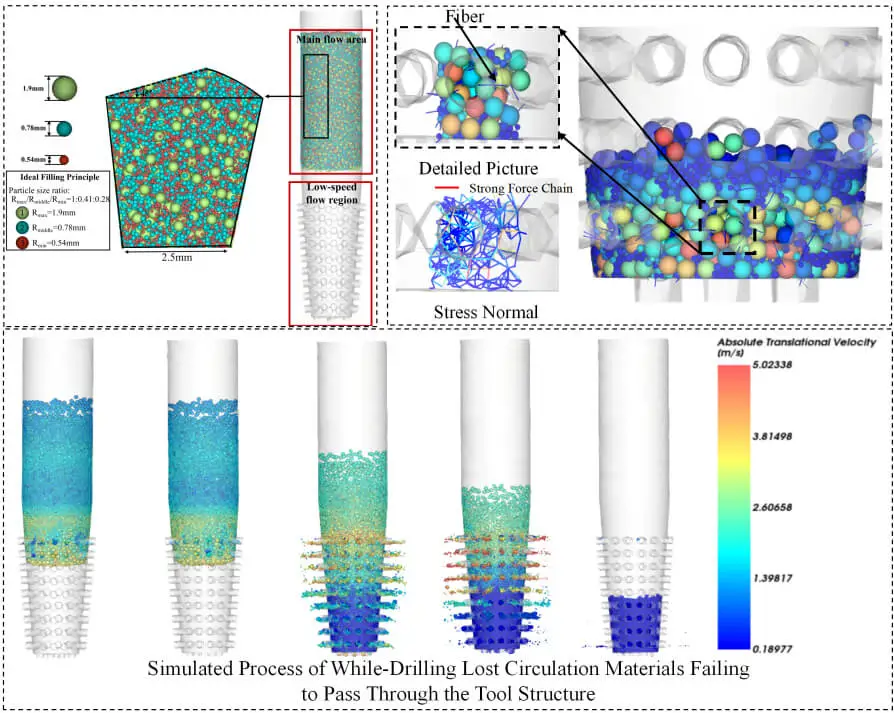
Abstract The passability (transport behavior) of while-drilling lost circulation materials (LCMs) through directional tools is strongly influenced by material composition and particle characteristics. In this study, a coupled computational fluid dynamics–discrete element method (CFD–DEM) model is developed to systematically evaluate the effects of particle size distribution, concentration, morphology, and fiber inclusion on LCM transport behavior. Visualization experiments conducted using a transparent screen section demonstrate good agreement with the simulated pressure-drop evolution, supporting the validity of the model. The results reveal that increasing particle size from 1.2–1.6 mm to above 2.8 mm shifts the system from a More >
Graphic Abstract
Open Access
ARTICLE
FDMP-Fluid Dynamics & Materials Processing, Vol.22, No.5, 2026, DOI:10.32604/fdmp.2026.079253 - 27 May 2026
(This article belongs to the Special Issue: Theoretical Foundations and Applications of Multiphase Flow in Pipeline Engineering)
Abstract Current prediction methods for wellbore temperature and pressure in gas storage injection–production wells are commonly based on the simplifying assumption of pure methane, thereby neglecting the multi-component nature of real natural gas and limiting predictive accuracy. To overcome this shortcoming, this study develops a comprehensive model for the coupled temperature and pressure fields in wellbores transporting multi-component natural gas mixtures. The proposed framework explicitly accounts for compositional effects by integrating key thermophysical properties, including density, viscosity, compressibility factor, and Joule–Thomson coefficient, into the governing flow equations, thereby enhancing the fidelity of the ensuing injection and More >
Open Access
REVIEW
FDMP-Fluid Dynamics & Materials Processing, Vol.22, No.5, 2026, DOI:10.32604/fdmp.2026.080326 - 27 May 2026
(This article belongs to the Special Issue: Theoretical Foundations and Applications of Multiphase Flow in Pipeline Engineering)
Abstract The global transition toward sustainable energy systems underscores the strategic importance of methane (CH4)–carbon dioxide (CO2) mixtures in cryogenic applications. In Liquefied Natural Gas (LNG) processing and Carbon Capture, Utilization, and Storage (CCUS) networks, such mixtures are routinely exposed to low-temperature environments where phase stability becomes critical. Under these conditions, the unintended formation of solid CO2 (dry ice) within pipelines poses significant engineering challenges, including flow blockage and potential equipment damage. Ensuring flow assurance therefore demands a rigorous understanding of the coupling between thermodynamic phase transitions and complex hydrodynamic behavior. This paper presents a comprehensive review of More >
Open Access
ARTICLE
FDMP-Fluid Dynamics & Materials Processing, Vol.22, No.5, 2026, DOI:10.32604/fdmp.2026.078553 - 27 May 2026
(This article belongs to the Special Issue: Theoretical Foundations and Applications of Multiphase Flow in Pipeline Engineering)
Abstract Erosion-corrosion in refining and chemical plant pipelines remains a persistent integrity concern, particularly in straight sections located downstream of elbows, which are rarely prioritized in inspection programs that typically focus on elbows and tees despite their well-known vulnerability. In these downstream regions, developing flow structures can sustain wall impingement and liquid film formation, leading to progressive material loss that is often underestimated in practice. This work examines a representative industrial pipeline through a combined approach based on computational fluid dynamics (CFD) simulations and controlled experimental validation to resolve the hydrodynamic behavior in the straight pipe… More >

 Login
Login Register
 Submit a Paper
 Propose a Special lssue