 Open Access
ISSN:1555-256X (print)
ISSN:1555-2578 (online)
Publication Frequency:Monthly



Fluid Dynamics and Materials Processing is an essential reading for all those concerned with complex fluids, multiphase flows and the intersection of fluid dynamics with materials processing and/or with the more general field of engineering optimization. It features original theoretical, computational, and experimental investigations. All subjects where a material, at a certain stage of its “life”, is in a fluid state, behaves as a fluid (e.g. many types of granular media) or interacts with a fluid should be considered relevant to FDMP. Relevant examples include (but are not limited to) the most modern and advanced processes for the production of inorganic (semiconductors, metal alloys, foams, plastics, polymers, ceramic materials, cement, asphalt and resins of various kinds), organic (protein crystals, drugs and medicines) materials and "living" (in vitro) biological tissues. We are especially interested in those studies where emphasis is put on the fluid-dynamic conditions under which a material is operated. However, FDMP also welcomes manuscripts dealing with more fundamental aspects such as the rheological behavior of multiphase systems or the convective currents that are produced in a fluid as a result of the thermal, chemical and/or mechanical stimuli typically applied in various processing or manufacturing methods (e.g. thermal gradients, shaking, mixing, etc). Some attention is devoted as well to all those problems of “structure/fluid” interaction that have extensive background applications in important fields such as marine, chemical, aeronautical and aerospace engineering and the oil sector, i.e. all those cases where fluid-dynamic analysis is instrumental in guiding the design/optimization of the considered systems (or related components) and the selection of the required “materials”.
Emerging Source Citation Index (Web of Science): 1.3; Scopus Citescore (Impact per Publication 2025): 2.1; SNIP (Source Normalized Impact per Paper 2025): 0.463; Engineering Index (Compendex); EBSCO; Google Scholar; Proquest; Portico, etc...
 Open Access
ARTICLE
FDMP-Fluid Dynamics & Materials Processing, Vol.22, No.8, 2026, DOI:10.32604/fdmp.2026.087218 - 04 September 2026
(This article belongs to the Special Issue: Multiscale Fluid–Solid Interactions in Geomaterials and Low-Carbon Processing in Civil Engineering)
Abstract Hydro-mechanical (HM) simulations of porous-media systems—such as those used in geotechnical engineering, groundwater flow, formation consolidation, and underground-structure safety assessment—become computationally expensive when large material- and load-parameter spaces must be explored for design optimization, uncertainty quantification, or real-time decision support. Although data-driven surrogate models can accelerate such analyses, it remains unclear whether explicitly conditioning a history-based predictor on physical parameters offers a meaningful advantage over learning directly from the temporal evolution of the physical fields. This study systematically benchmarks five physical-parameter conditioning strategies—token concatenation, feature-wise linear modulation (FiLM), weak FiLM, adaptive instance normalization (AdaIN), and… More >
Open Access
ARTICLE
FDMP-Fluid Dynamics & Materials Processing, Vol.22, No.8, 2026, DOI:10.32604/fdmp.2026.084998 - 04 September 2026
(This article belongs to the Special Issue: Analysis of High-Speed Flows using Advanced Computational Methods)
Abstract This study investigates the influence of a passive cavity flow-control strategy on base pressure in suddenly expanded supersonic flows through computational fluid dynamics (CFD) simulations. The flow configuration consists of a convergent-divergent (CD) nozzle discharging into an enlarged duct with an area ratio of 2.89. Simulations were performed for Mach numbers of 1.2, 1.4, 1.6, and 1.8, while the cavity was positioned upstream of the expansion at cavity locations corresponding to length-to-diameter ratios (L/D) ranging from 0.5 to 2.0 in increments of 0.5. The effects of nozzle pressure ratio (NPR), Mach number, duct length-to-diameter ratio,… More >
Open Access
ARTICLE
FDMP-Fluid Dynamics & Materials Processing, Vol.22, No.8, 2026, DOI:10.32604/fdmp.2026.083129 - 04 September 2026
Abstract This study examines transient heat and mass transfer characteristics in a Casson-based hybrid nanofluid (Au–Cu/water) flowing over a time-dependent stretching elastic surface in the presence of porous media and viscous dissipation. The mathematical model further incorporates the effects of magnetic fields, thermal radiation, chemical reactions, and velocity slip conditions to capture realistic transport phenomena encountered in advanced thermal systems. Through suitable similarity transformations, the governing partial differential equations are reduced to a system of nonlinear ordinary differential equations, which are solved numerically using the MATLAB bvp4c solver. To identify optimal operating conditions, Response Surface Methodology… More >
Open Access
ARTICLE
FDMP-Fluid Dynamics & Materials Processing, Vol.22, No.8, 2026, DOI:10.32604/fdmp.2026.084304 - 04 September 2026
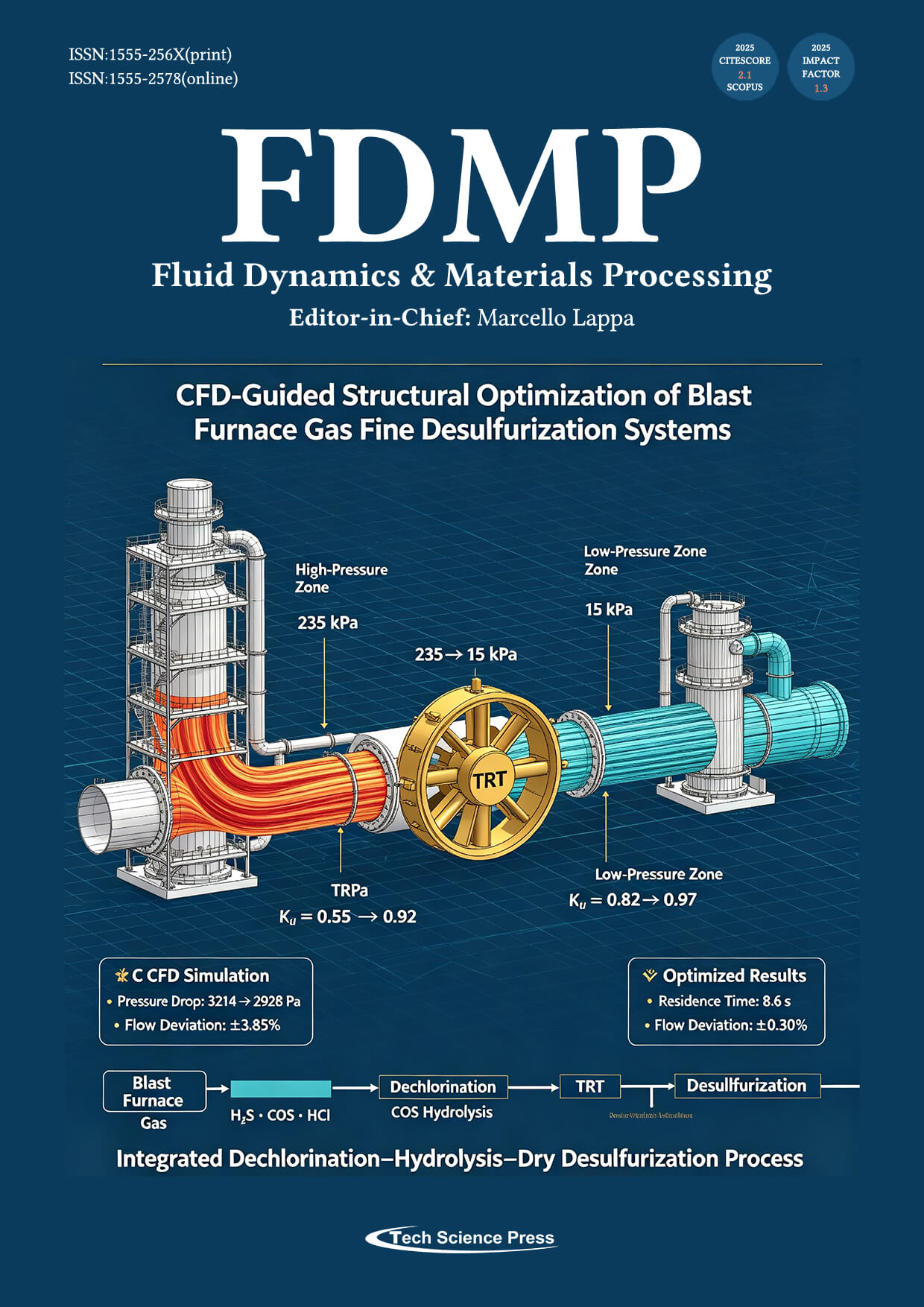
Abstract Flow maldistribution and local short-circuiting within blast furnace gas fine desulfurization systems can substantially impair desulfurization performance while increasing hydraulic losses and energy consumption. To elucidate the underlying flow mechanisms, a three-dimensional computational fluid dynamics (CFD) model accounting for the pressure variation across the top gas recovery turbine (TRT) was developed to investigate the flow characteristics under both high- and low-pressure operating conditions. Guided by the numerical analysis, an integrated structural optimization strategy, combining inlet deflector plates with the sealing of perforated plates adjacent to partition regions, was proposed. The optimized configuration significantly enhanced flow… More >
Open Access
ARTICLE
FDMP-Fluid Dynamics & Materials Processing, Vol.22, No.8, 2026, DOI:10.32604/fdmp.2026.086215 - 04 September 2026
Abstract This study investigates the physicochemical characteristics, particle deposition behavior, and plugging mechanisms of produced fluids from drainage-gas recovery wells in high-salinity gas reservoirs, using a representative well from the Tarim Oilfield as a case study for a broad class of production systems affected by liquid-phase pipeline plugging. A comprehensive experimental methodology was adopted, combining physicochemical characterization, filtration and static sedimentation experiments, dynamic deposition tests, scanning electron microscopy coupled with energy-dispersive X-ray spectroscopy (SEM-EDS), and X-ray diffraction (XRD). This combined experimental approach was employed to identify the dominant deposition mechanisms and determine the particle-size fractions most… More >
Open Access
REVIEW
FDMP-Fluid Dynamics & Materials Processing, Vol.22, No.8, 2026, DOI:10.32604/fdmp.2026.084236 - 04 September 2026
(This article belongs to the Special Issue: Analysis of High-Speed Flows using Advanced Computational Methods)
Abstract Surface pressure distribution is one of the primary factors governing the aerodynamic performance, stability, controllability, and structural loading of high-speed aerospace vehicles. Accurate prediction of surface pressure is therefore essential for the design, optimization, and safe operation of flight systems ranging from supersonic aircraft to hypersonic vehicles and atmospheric re-entry platforms. Over the past several decades, extensive theoretical, computational, and experimental research has sought to characterize pressure distributions over canonical configurations, including wedges, cones, and delta wings, across a broad spectrum of flow conditions. This review provides a critical and comprehensive assessment of the current… More >
Open Access
ARTICLE
FDMP-Fluid Dynamics & Materials Processing, Vol.22, No.8, 2026, DOI:10.32604/fdmp.2026.086917 - 04 September 2026
Abstract This study presents a novel grooved-tooth rotary cavitation generator (GRCG) and systematically investigates its hydrodynamic cavitation and wastewater treatment response through a combination of three-dimensional transient numerical simulations and experimental validation. The simulations, based on the Realizable k-ε turbulence model and the Zwart-Gerber-Belamri cavitation model, are used to examine the influence of radial clearance (L) and rotational speed (N) on cavitation development. The numerical predictions are validated through Escherichia coli inactivation and Rhodamine B degradation experiments. The results show that decreasing the radial clearance and increasing the rotational speed markedly enhance cavitation intensity. At L = 1 More >
Open Access
ARTICLE
FDMP-Fluid Dynamics & Materials Processing, Vol.22, No.8, 2026, DOI:10.32604/fdmp.2026.087023 - 04 September 2026
Abstract This study investigates the erosion behavior of metal mesh sand-control screens under representative operating conditions and develops an empirical model for predicting erosion rate and screen service life. Single-layer metal mesh screens were tested using a Multifunctional Spin Hydrodynamics (MSH) rotating apparatus under systematically varied liquid velocity, sand concentration, and particle impact angle. The influence of each operating parameter on erosion was quantified using a one-factor-at-a-time experimental design, while the underlying wear mechanisms were characterized by scanning electron microscopy (SEM) and optical microscopy. The results show that liquid velocity is the dominant factor controlling erosion, More >
Open Access
ARTICLE
FDMP-Fluid Dynamics & Materials Processing, Vol.22, No.8, 2026, DOI:10.32604/fdmp.2026.086018 - 04 September 2026
Abstract This study elucidates the mechanisms governing sand production during multi-thermal fluid huff-and-puff in unconsolidated sandstone heavy oil reservoirs and develops a temperature-pressure coupled prediction model for accurately quantifying sand production. Orthogonal laboratory experiments were conducted on reservoir samples from a representative case (Block X, Oilfield L), to compare the mechanical response and sand production behavior under multi-thermal fluid and conventional steam stimulation. The relative importance of the governing parameters was quantified using analysis of variance (ANOVA), and an exponential prediction model incorporating the coupled effects of temperature and pressure was established. The results reveal that… More >

 Login
Login Register
 Submit a Paper
 Propose a Special lssue