 Open Access
ARTICLE
Bio-Derived Tannin-Modified Phenolic Carbon Cryogels with Optimized Microstructure for Supercapacitors Application
Zhiying Lin1, Boju Deng1, Qianqian Zhang1, Jingming Chen2, Xinqiang Ye3, Yuling Lan1, Jiuping Rao1,*, Mizi Fan4, Weigang Zhao1,*
1 College of Material Engineering, Fujian Agriculture and Forestry University, 63 Xiyuangong Road, Fuzhou, 350002, China
2 Fujian Super Tech Advanced Material Co., Ltd., No. 5 Industrial Second Road, Liancheng Industrial Zone, Longyan, 366299, China
3 Fujian Yongan Forestry (Group) Co., Ltd., No. 819 Yanjiang East Road, Yong’an, 366000, China
4 College of Engineering, Design and Physical Sciences, Brunel University, Uxbridge, London, UB8 3PH, UK
* Corresponding Author: Jiuping Rao. Email:  ; Weigang Zhao. Email:
(This article belongs to the Special Issue: Renewable Nanostructured Porous Materials: Synthesis, Processing, and Applications)
Journal of Renewable Materials https://doi.org/10.32604/jrm.2025.02025-0096
Received 30 April 2025; Accepted 01 July 2025; Published online 23 July 2025
Abstract
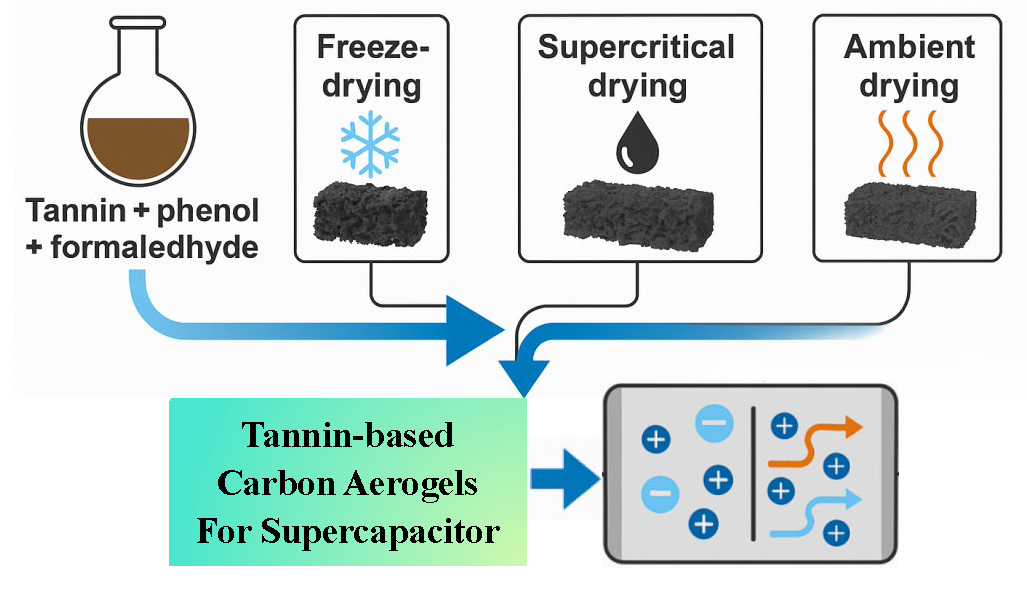
Bio-derived carbon cryogels have garnered significant interest as promising electrode materials for supercapacitors due to their high specific surface area (SSA), hierarchical porosity, and eco-friendly synthesis methods. In this study, a tannin-modified phenolic hydrogel was synthesized using a sustainable tannin–phenol precursor system and subsequently subjected to three distinct drying methods-freeze-drying (FD), supercritical drying (SCD), and ambient pressure drying (APD)-to systematically evaluate their influence on structural integrity, porosity, and electrochemical behavior. Among these, the sample obtained via freeze-drying (TPUF-FD) maintained the most intact porous network, minimizing structural collapse during sublimation of ice under vacuum. This preservation of hierarchical micro- and mesopores facilitated enhanced ion diffusion, leading to the highest SSA and favorable nitrogen/oxygen functionalities that contribute to both electric double-layer capacitance and pseudocapacitance. The TPUF-FD electrode exhibited a high specific capacitance of 127.6 F g
−1 at 0.5 A g
−1, maintaining 107.0 F g
−1 at 10 A g
−1, which corresponds to a rate retention of 83.9%. When assembled into a symmetric device, the supercapacitor achieved an energy density of 8.47 Wh kg
−1 at a power density of 562.5 W kg
−1. Notably, the device retained 100% of its initial capacitance after 9000 charge–discharge cycles at 10 A g
−1 with excellent coulombic efficiency (108.3%). These results underscore the crucial role of freeze-drying in preserving both the microstructural features and surface chemistry of biomass-derived carbon cryogels, which enhances ion accessibility and contributes to the stable, high-performance supercapacitor applications.
Graphical Abstract
Keywords
Tannin-derived carbon cryogels; freeze-drying; porous structure engineering; biomass-based electrode materials; supercapacitors; electrochemical performance

 Login
Login Register
 Submit a Paper
 Propose a Special lssue
 Download PDF
 Downloads
 Citation Tools
