A Review of Natural-Oil Soot-Derived Carbon Nanoparticles: Significance, Synthesis, and Applications
Naile Karakehya1,2,*
1 Department of Environmental Protection Technologies, Eskişehir Vocational School, Eskişehir Osmangazi University, Eskişehir, 26040, Türkiye
2 Advanced Materials Technologies Application and Research Center (IMATEK), Eskişehir Osmangazi University (ESOGU), Eskişehir, 26040, Türkiye
* Corresponding Author: Naile Karakehya. Email: 
Journal of Renewable Materials https://doi.org/10.32604/jrm.2025.02025-0131
Received 02 July 2025; Accepted 15 August 2025; Published online 11 September 2025
Abstract
In the early years of the Industrial Revolution, the extensive use of fossil resources and energy-intensive production methods was widely accepted, even celebrated, as signs of progress. However, growing concerns over environmental degradation, resource depletion, and climate change have necessitated a transition toward more sustainable and environmentally responsible production strategies. Within this context, wick-and-oil flame synthesis has emerged as a simple, energy-efficient, and cost-effective method that utilizes natural oils as both fuel and renewable carbon sources for the generation of carbon nanoparticles, particularly carbon nano-onions. This review presents a comprehensive overview of this emerging synthesis approach, highlighting its potential to transform the perception of carbon soot from a pollutant to a valuable nanomaterial. The method’s scalability, minimal equipment requirements, and compatibility with green chemistry principles position it as a promising alternative to more complex or fossil-dependent routes, especially in resource-limited settings. In this review, a key focus is given to the physicochemical properties of the soot, including particle morphology, structure, and surface characteristics, which are examined in detail, along with relevant post-synthesis strategies. Particular attention is given to the application performance of natural-oil-derived carbon nanoparticles across multiple domains such as electrochemical energy storage, surface engineering, environmental remediation, and sensor technologies. In each case, the advantages and current limitations of these materials are discussed in light of competing state-of-the-art technologies. However, several research gaps remain, including a limited understanding of the structure–function relationship, insufficient control over purity and size distribution, and challenges in integrating these materials into scalable manufacturing systems.
Graphical Abstract
Keywords
Wick-and-oil flame synthesis; soot formation; carbon nano-onions; natural-oils; sustainability
 Open Access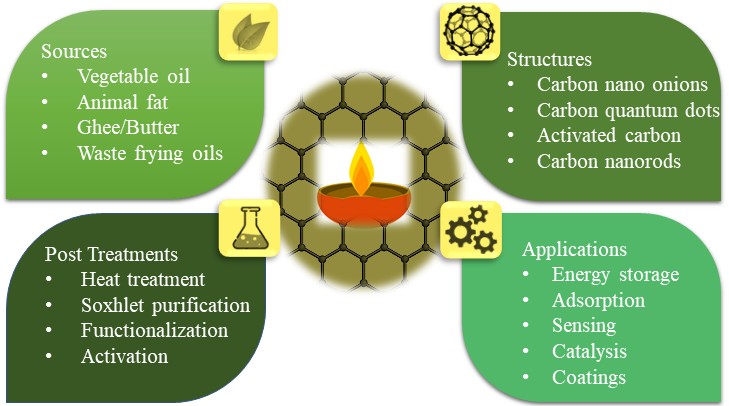

 Login
Login Register
 Submit a Paper
 Propose a Special lssue
 Download PDF
 Downloads
 Citation Tools
