
 Login
Login Register
 Submit a Paper
 Propose a Special lssue
 Open Access
REVIEW

Recent Developments in Super-Hydrophobicity and Fire-Resistance of Tannin-Based Non-Isocyanate Polyurethane Resins for Wood-Based Composites
1 Department of Forest Products, Faculty of Forestry and Environment, IPB University, Bogor, 16680, Indonesia
2 Research Center for Biomass and Bioproducts, National Research and Innovation Agency, South Tangerang, 15314, Indonesia
3 Department of Forestry, Faculty of Agriculture, University of Lampung, Bandar Lampung, 35145, Indonesia
4 Donghwa Enterprise Research and Development Center, Incheon, 22300, Republic of Korea
5 Research Collaboration Center for Biomass and Biorefinery, BRIN and Universitas Padjadjaran, 45363, Indonesia
* Corresponding Authors: Rita Kartika Sari. Email: ; Muhammad Adly Rahandi Lubis. Email:
(This article belongs to the Special Issue: Renewable and Biosourced Adhesives-2023)
Journal of Renewable Materials 2026, 14(3), 4 https://doi.org/10.32604/jrm.2025.02025-0114
Received 16 June 2025; Accepted 05 September 2025; Issue published 25 March 2026
 View Full Text
 Download PDF
Abstract
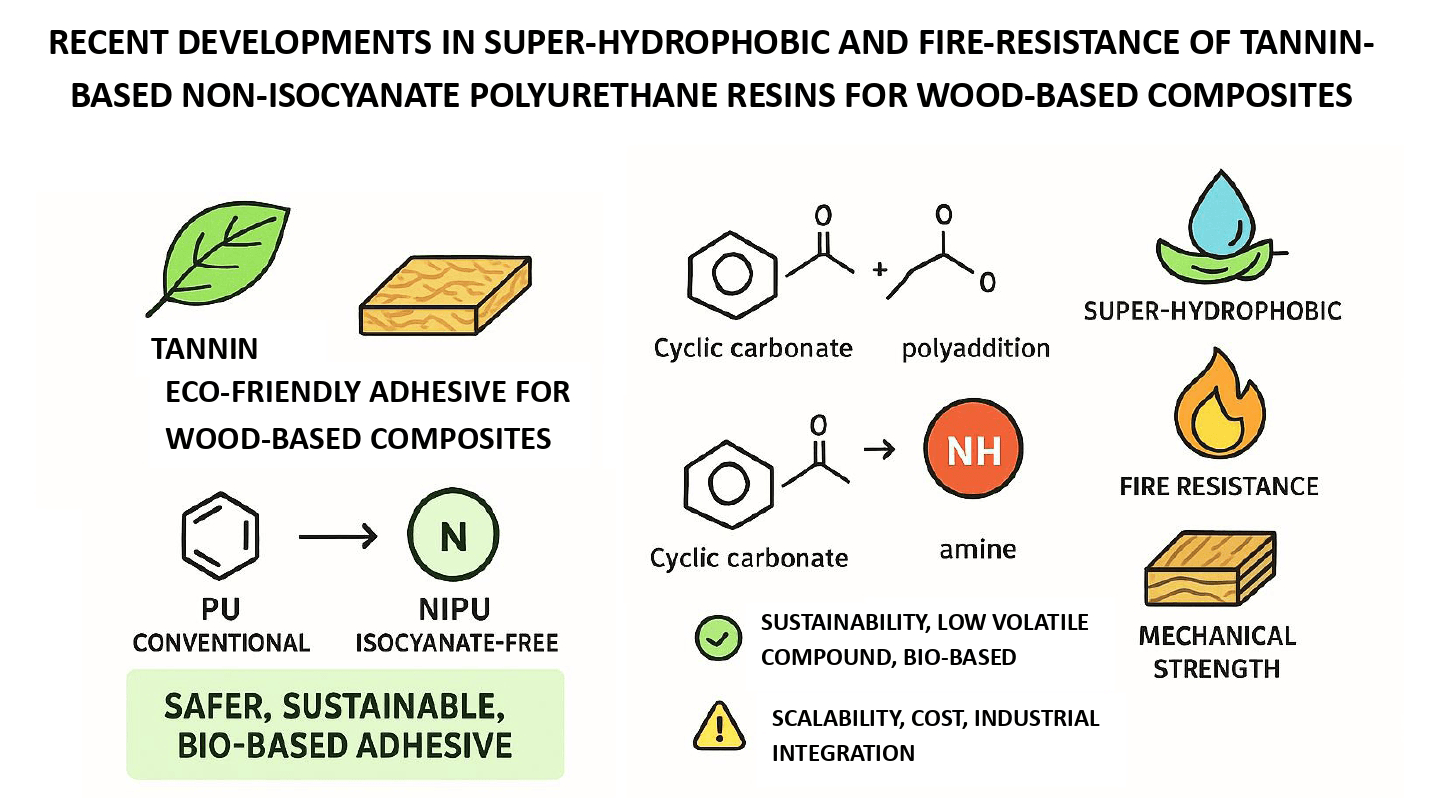
Recent advancements in developing tannin-based non-isocyanate polyurethane (NIPU) resins have unlocked new possibilities for sustainable and eco-friendly wood adhesives. Unlike conventional polyurethane, NIPUs eliminate hazardous isocyanates, offering safer alternatives for industrial applications. Tannin, a naturally occurring polyphenolic compound, plays a pivotal role in enhancing these resins’ fire-resistance and super-hydrophobic properties. This review highlights key developments in synthesizing tannin-based NIPU, focusing on various polymerization techniques such as polyaddition, polycondensation, ring-opening polymerization, and rearrangement. These strategies contribute to improved mechanical strength, thermal stability, and resistance to water absorption. Recent studies demonstrate that tannin-based NIPU adhesives meet or exceed international internal bonding strength, elasticity, and durability standards. Their application in wood-based composites like oriented strand boards (OSB) has shown promising results, offering improved resistance to moisture and superior dimensional stability. Furthermore, the cross-linked polymer network, supported by chemical modifications like the introduction of fluoroalkyl groups, significantly enhances hydrophobicity and fire retardancy. Despite these advancements, challenges remain in terms of scalability, cost, and integration with existing manufacturing processes. Future research should focus on optimizing reaction conditions, improving raw material availability, and developing industrial-scale production methods. This review underscores the potential of tannin-based NIPU resins as a viable and sustainable alternative for various wood composite applications.Graphic Abstract
Keywords
Cite This Article
 Copyright © 2026 The Author(s). Published by Tech Science Press.
This work is licensed under a Creative Commons Attribution 4.0 International License , which permits unrestricted use, distribution, and reproduction in any medium, provided the original work is properly cited.
 Downloads
 Citation Tools
