
 Login
Login Register
 Submit a Paper
 Propose a Special lssue
 Open Access
REVIEW

Recent Advances in Natural Polysaccharide-Based Materials for Wound Healing: Chitosan, Konjac Glucomannan and Cellulose
1 School of Public Health, Shaanxi University of Chinese Medicine, Xianyang, China
2 Administration for Drug and Instrument Supervision and Inspection of PLAJLSF, Beijing, China
3 College of Pharmacy, Shaanxi University of Chinese Medicine, Xianyang, China
* Corresponding Author: Liangliang Duan. Email:
# The authors contributed equally to this work and should be considered as co-first authors
Journal of Renewable Materials 2026, 14(4), 3 https://doi.org/10.32604/jrm.2026.02025-0124
Received 27 June 2025; Accepted 26 December 2025; Issue published 24 April 2026
 View Full Text
 Download PDF
Abstract
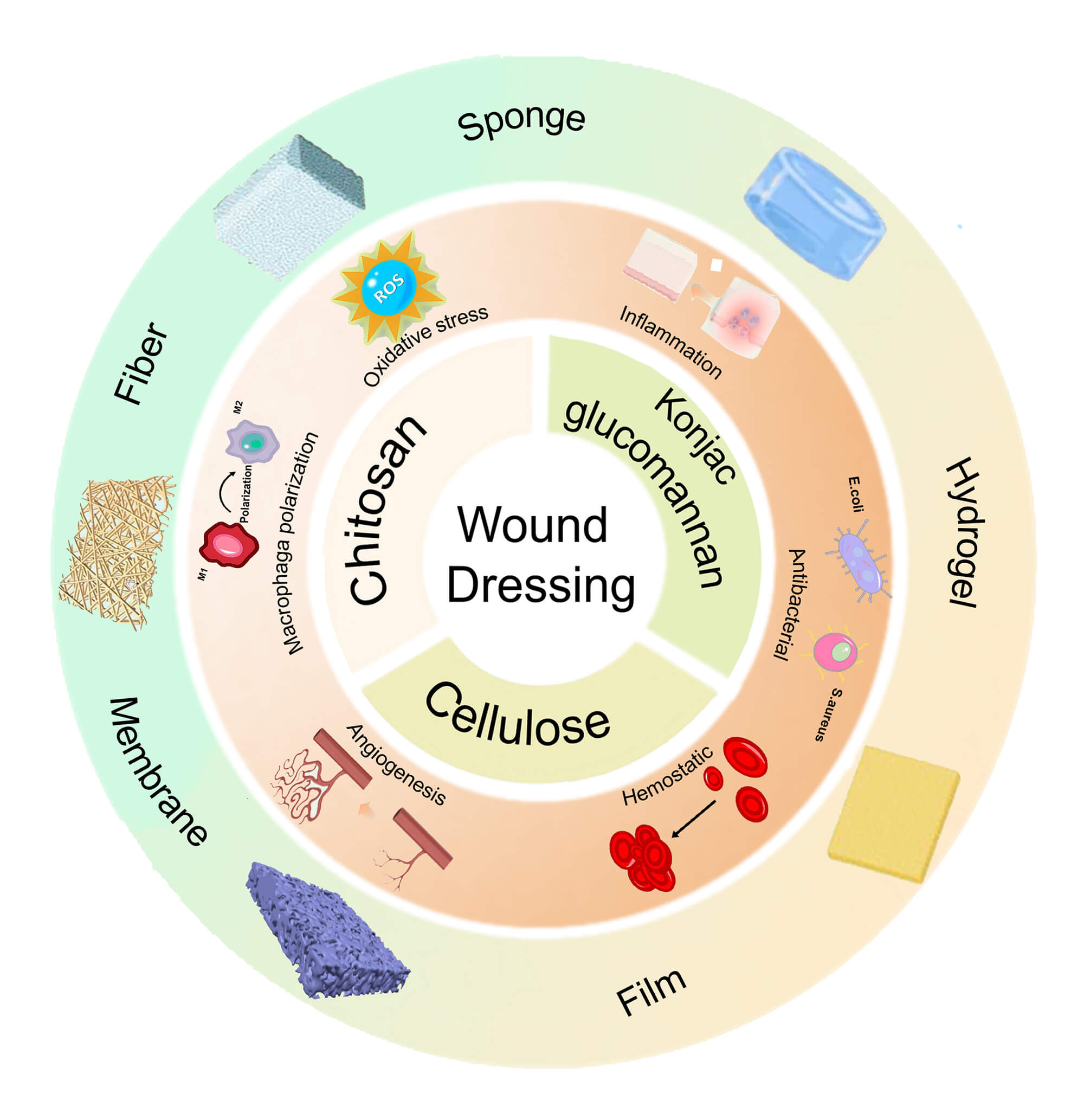
Wound healing is a complex and dynamic process essential for restoring the integrity of damaged skin. It requires wound dressings that actively regulate the wound microenvironment by preventing infection, maintaining moisture balance, allowing gas exchange, and managing exudate. Natural polysaccharides, such as konjac glucomannan (KGM), chitosan, and cellulose, are well suited to this role because of their biocompatibility, biodegradability, and intrinsic bioactivity. Extensive research has focused on developing polysaccharide-based wound dressings with enhanced functionality to promote healing. This review examines recent scientific research published mostly in the past five years on the development and application of chitosan, KGM and cellulose-based macromolecules for wound dressing fabrication, including hydrogels, sponges, fibers, and other forms. It explores how their structure-property-function relationships connect primary composition and inter-component interactions (e.g., hydrogen bonding, ionic complexation, covalent crosslinking) to key performance metrics (antibacterial efficacy, hemostatic activity, moisture management such as swelling and water vapor transmission rate, and mechanical robustness). The advantages and disadvantages of various methods for preparing materials of the same type using the same polysaccharide are also discussed with quantitative comparisons across studies to provide clear insights into the healing effects of different wound dressings. For relatively mature cellulose-based wound dressings, we integrate their therapeutic efficacy, functional mechanisms, clinical evidence and marketed products with typical indications. Additionally, we summarize the advantages and limitations of these polysaccharides in wound healing, while identifying future trends and challenges that should guide the rational design of polysaccharide-based wound dressings.Graphic Abstract
Keywords
Cite This Article
 Copyright © 2026 The Author(s). Published by Tech Science Press.
This work is licensed under a Creative Commons Attribution 4.0 International License , which permits unrestricted use, distribution, and reproduction in any medium, provided the original work is properly cited.
 Downloads
 Citation Tools
