Sustainable Particleboards Using Lignosulfonate-Modified MUF Adhesives for Enhanced Bond Strength and Reduced Formaldehyde Emissions
Pavlo Bekhta1,2,*, Iryna Lytvyn1
1 Department of Wood-Based Composites, Cellulose and Paper, Ukrainian National Forestry University, Lviv, Ukraine
2 Department of Wood Science and Technology, Mendel University in Brno, Brno, Czech Republic
* Corresponding Author: Pavlo Bekhta. Email: 
(This article belongs to the Special Issue: Advances in Eco-friendly Wood-Based Composites: Design, Manufacturing, Properties and Applications – Ⅱ)
Journal of Renewable Materials https://doi.org/10.32604/jrm.2026.02026-0035
Received 28 February 2026; Accepted 29 April 2026; Published online 08 May 2026
Abstract
The modification of melamine–urea–formaldehyde (MUF) adhesives with lignosulfonates (LS) represents a promising strategy for developing more sustainable wood-based panels. However, the influence of the counterion type remains poorly understood. In this study, the effect of lignosulfonate counterions on adhesives performance and properties of MUF-bonded particleboards was investigated, with a focus on sodium (NaLS) and magnesium (MgLS) lignosulfonates incorporated at 2.5%, 5.0%, and 7.5%. Adhesives performance was characterized by measuring dry solids content, dynamic viscosity, gelation time, and pH. The produced particleboards were evaluated in terms of density, bending strength, modulus of elasticity, internal bond strength (IB), thickness swelling after 24 h of water immersion, and formaldehyde emission (FE). The statistical significance of the results was evaluated using analysis of variance (ANOVA), and the effect size was expressed as partial eta-squared (ηp
2). The counterion type was identified as the most influential factor affecting both IB (ηp
2 = 0.602) and FE (ηp
2 = 0.691), revealing a clear trade-off between mechanical performance and environmental impact. NaLS maintained favorable resin rheology (210–235 mPa·s) and pH stability (8.1–8.8), resulting in enhanced mechanical properties, with bending strength reaching up to 14.0 MPa. In contrast, MgLS acted as an effective formaldehyde scavenger, significantly reducing FE to 1.06 mg/m
2·h (a 34% decrease compared to neat MUF), although at the expense of increased adhesive viscosity (275 mPa·s) and accelerated curing (81 s). The reduced formaldehyde emission observed for MgLS is attributed to the reactivity of lignin phenolic hydroxyl groups toward formaldehyde, potentially enhanced by coordination effects of Mg
2+ ions, although this mechanism requires further verification. Overall, the results demonstrate that counterion selection in lignosulfonate-modified MUF adhesives provides an effective approach to tailor particleboard properties, enabling a controlled balance between bond strength and formaldehyde emission depending on application requirements. NaLS optimizes mechanical bonding, while MgLS provides superior environmental performance. Incorporation of sodium and magnesium lignosulfonates into MUF resins enables more sustainable and renewable adhesive systems without loss of particleboard performance.
Graphical Abstract
Keywords
Particleboards; lignosulfonate counterions; melamine-urea formaldehyde resin; sodium lignosulfonate; magnesium lignosulfonate; formaldehyde release; physical and mechanical properties
 Open Access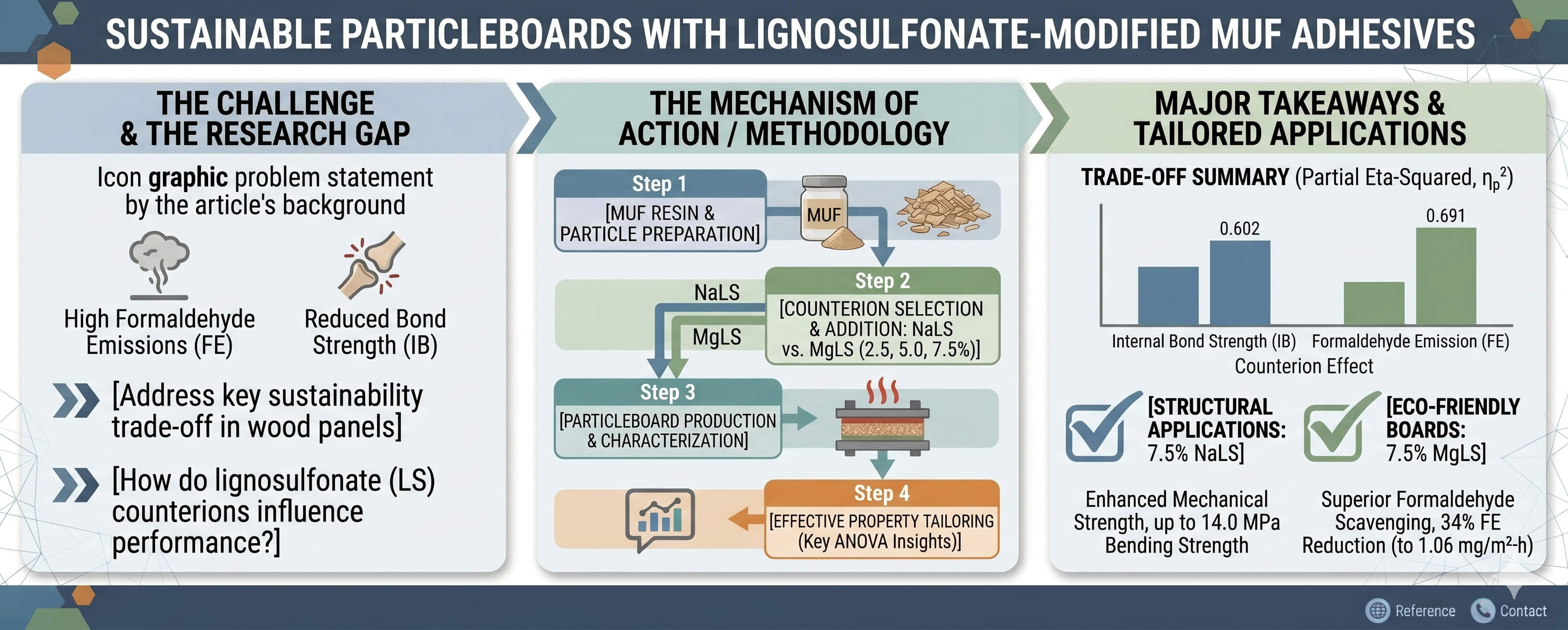

 Login
Login Register
 Submit a Paper
 Propose a Special lssue
 Download PDF
 Downloads
 Citation Tools
