Home / Journals / JRM / Online First / doi:10.32604/jrm.2026.02026-0056
Special Issues
Table of Content

Open Access

ARTICLE

Biobenzoxazines Generated in Hardened Tannin-Hexamine Wood Adhesives

Antonio Pizzi*
LERMAB-ENSTIB, University of Lorraine, 27 rue Philippe Seguin, Epinal, France
* Corresponding Author: Antonio Pizzi. Email: email

Journal of Renewable Materials https://doi.org/10.32604/jrm.2026.02026-0056

Received 16 April 2026; Accepted 16 June 2026; Published online 06 July 2026
Abstract

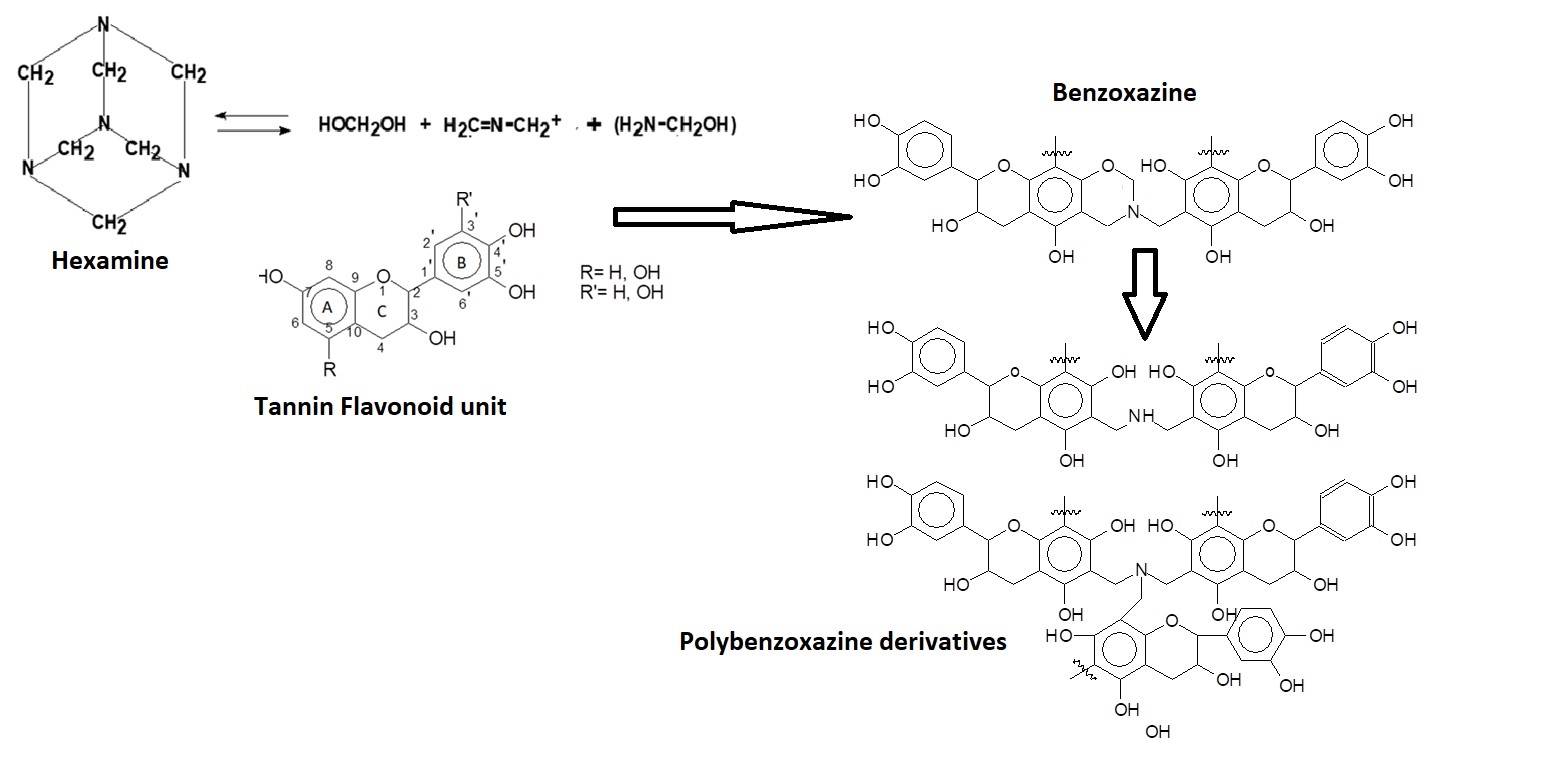
Cross Polarization Magic Angle Spinning Carbon 13 Nuclear Magnetic Resonance (CP-MAS 13C NMR) analysis of commercial procyanidin (pine bark) and delphinidin (pecan nut membranes) condensed flavonoid tannin extracts reacted with hexamethylenetetramine (hexamine) have shown that due to the highly reactive imino-amino methylene species formed before its degradation reaches the generation of formaldehyde, benzylamine bridges between the flavonoid units are formed. This study shows that tannin-based biobenzoxazines are also generated at the same time, with both benzylamines and benzoxazines bridges being in more marked proportions, the more reactive the tannin reacted with hexamethylenetetramine is. This is not the case for slower reacting condensed tannins where aminated bridges are not noticeable either because they are present in the great minority or are even totally absent. This also indicates that tannin-based benzoxazines can be prepared in water solution, at faster reaction times with their proportion increasing with the proportions of hexamine coreactant used, and not only by fusion of phenolic material with hexamine.

Graphical Abstract

Biobenzoxazines Generated in Hardened Tannin-Hexamine Wood Adhesives

Keywords

Biobenzoxazines; tannins; hexamethylenetetramine; generation in water
  • 126

    View

  • 19

    Download

  • 0

    Like

Share Link