Renewable Polymeric Tissue Scaffolding: Trends in Structural Development
Huan Long1, Emmanuel Abu-Danso1,2,*, Mônica Rufino Senra1,3, Leonid Ionov4, Jussi V. K. Kukkonen2, Holger Ruckdäschel1,5,*
1 Department of Polymer Engineering, University of Bayreuth, Bayreuth, Germany
2 Department of Environmental and Biological Sciences, University of Eastern Finland, Kuopio, Finland
3 Instituto de Macromoléculas Eloisa Mano, Federal University of Rio de Janeiro, Rio de Janeiro, Brazil
4 Faculty of Engineering Sciences, University of Bayreuth, Bayreuth, Germany
5 Neue Materialien Bayreuth GmbH, Bayreuth, Germany
* Corresponding Author: Emmanuel Abu-Danso. Email:  ; Holger Ruckdäschel. Email:
Journal of Renewable Materials https://doi.org/10.32604/jrm.2026.02025-0198
Received 03 December 2025; Accepted 29 May 2026; Published online 13 July 2026
Abstract
Polymeric scaffolds are now widely used in biomedical engineering to reconstruct tissues as well as other corrective medical applications. They are designed to promote the proliferation of the host cell and provide load-bearing capabilities. Through tailored fabrication methods and material compatibility, polymeric scaffolds can be applied either temporarily or permanently, and successful applications have resulted in commercialized products. Currently, there is a high interest in tissue scaffolds that combine both effective mechanical performance with efficient surface response functionalities. In this work, we performed an in-depth comparative analysis of tissue scaffolds made from renewable parent materials, their production routes, and performance at laboratory scale, patents, and commercialized products. From the literature reviewed, natural polymer-based scaffolds demonstrate superior vascularization whereas the partially biosourced constructs exhibit mechanical advantage. These suggest that combining optimized features from both material classes could yield scaffolds with enhanced stress-strain properties, high vascularization and porosity. To tailor scaffold performance, we found that the flexibility of 3-Dimensional (3D) printing particularly precision laser writing technology, offers a more efficient fabrication approach as it enables the production of hierarchical scaffold capable of performing different functions across different size scales. We found a gap in (i) the knowledge of leveraging the similarities between plant and animal cellularized systems, (ii) the use of self-healing and shape-memory smart materials, and (iii)
ex vivo culturing in bioreactor systems and subsequent seeding. To date, most tissue scaffold engineering research work remains at the laboratory scale, therefore, more effort is needed in upscaling, as well as in research and development. Diverse methodologies and materials still need to be explored for fit-for-purpose tissue scaffolds that can meet future needs.
Graphical Abstract
Keywords
Tissue engineering; renewable polymeric scaffold; microstructure; upscaling
 Open Access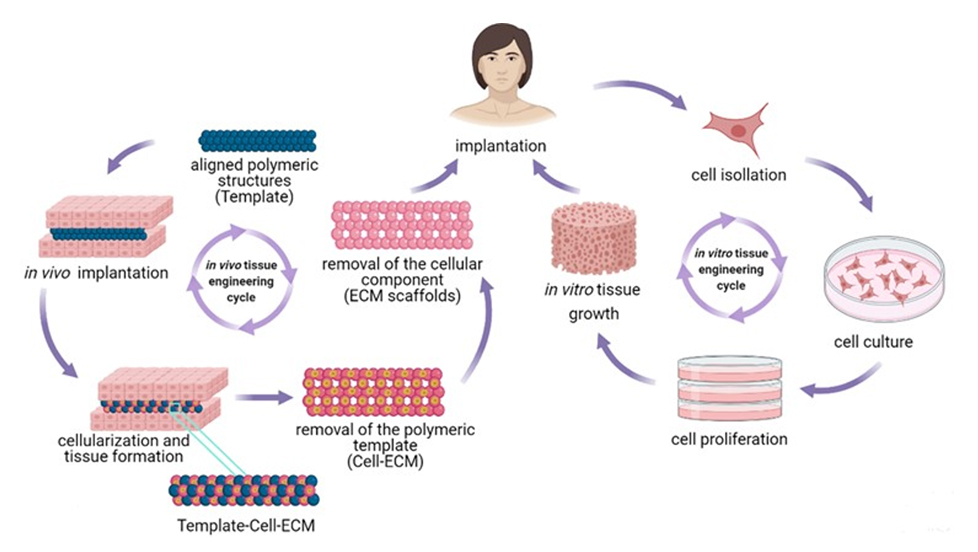

 Login
Login Register
 Submit a Paper
 Propose a Special lssue
 Download PDF
 Downloads
 Citation Tools
