Thermodynamic Approach to Migration Stability of Biosourced Plasticizers via Hysteresis Analysis
Irina N. Vikhareva*
Nanotechnology Research & Education Centre, South Ural State University, Lenin Prospect 76, Chelyabinsk, Russia
* Corresponding Author: Irina N. Vikhareva. Email:  ,
, 
Journal of Renewable Materials https://doi.org/10.32604/jrm.2026.02026-0042
Received 15 March 2026; Accepted 07 July 2026; Published online 27 July 2026
Abstract
The development of efficient and migration-resistant plasticizers from renewable resources is an important challenge for the modern polymer industry. This work presents a thermodynamic approach for the rapid screening of novel bio-based plasticizers-esters of dicarboxylic acids. Using differential scanning calorimetry (DSC), the temperatures and enthalpies of melting and crystallization of the individual esters were determined, and the hysteresis of phase transition parameters was calculated as a predictive indicator. It is shown that bio-based butoxyethyl esters are characterized by low temperature hysteresis ΔT ~ 20°C and enthalpy hysteresis close to zero, indicating weak intermolecular interactions and equilibrium crystallization. In contrast, phenoxyethyl esters exhibit pronounced hysteresis with ΔT up to 76°C and significant variations in the ΔH
hyst parameter. The negative value of ΔH
hyst for decylphenoxyethyl adipate (−63.4 J/g) indicates a thermodynamic predisposition towards the formation of highly ordered structures. To validate the thermodynamic predictions, the bio-based plasticizers were incorporated into a model polyvinyl chloride (PVC) matrix and studied by dynamic mechanical analysis (DMA). DMA data confirmed that phenoxyethyl esters with high ΔT values induce microphase separation in the PVC matrix, manifested as two distinct mechanical loss peaks, which correlates with an increased risk of migration. However, due to specific interactions with PVC, these esters impart enhanced modulus and thermal stability to the composites. Bio-based butoxyethyl esters, which form homogeneous systems, are, in contrast, optimal candidates for creating migration-resistant materials requiring high elasticity. The proposed thermodynamic criteria represent an effective tool for the rational design and selection of bio-based plasticizers depending on the required property profile.
Graphical Abstract
Keywords
Ester; hysteresis; crystallization; migration; melting; plasticizer; polymer; phase transition; enthalpy
 Open Access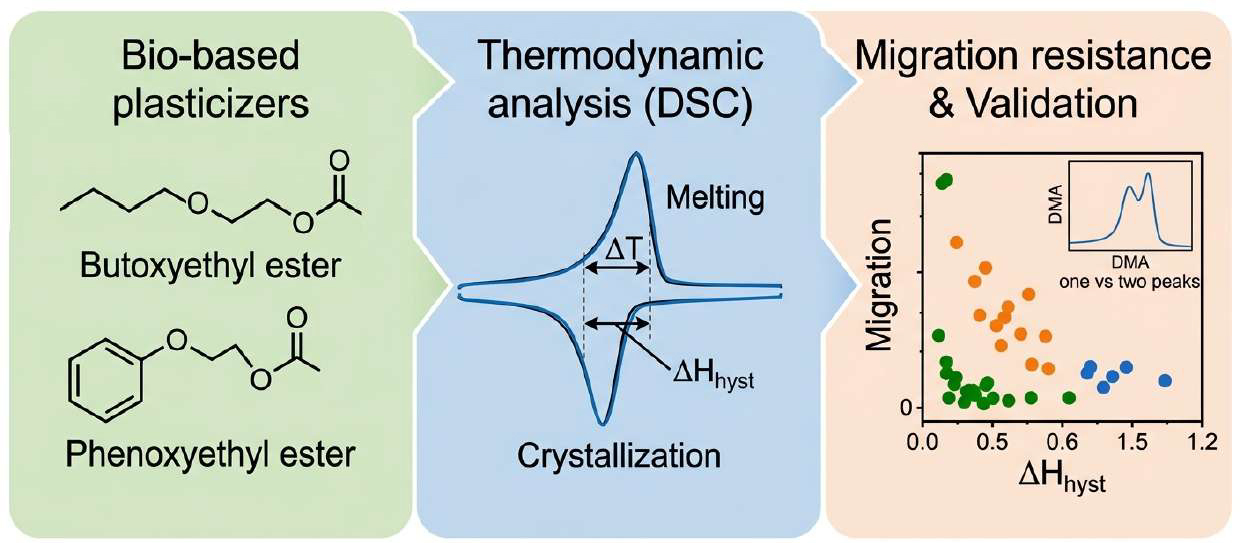

 Login
Login Register
 Submit a Paper
 Propose a Special lssue
 Download PDF
 Downloads
 Citation Tools
