Experimental Investigation of Morphological, Physical, and Thermo-Mechanical Properties of Flax/Epoxy Composites for Automotive Applications
Matilde Oliveira1, Vítor Neves2, Mariana Banea1,*
1 CICECO—Aveiro Institute of Materials, Department of Materials and Ceramic Engineering, University of Aveiro, Aveiro, Portugal
2 FTComposites, Lda., Rua Princesa Santa Joana N° 52, Quinta do Gato, Aveiro, Portugal
* Corresponding Author: Mariana Banea. Email: 
Journal of Renewable Materials https://doi.org/10.32604/jrm.2026.02026-0063
Received 03 May 2026; Accepted 03 August 2026; Published online 18 August 2026
Abstract
Natural fibre-reinforced composites are increasingly being considered as sustainable alternatives to synthetic composites for lightweight automotive applications. The aim of this study was to evaluate the influence of flax fibre architecture and areal weight on the mechanical, morphological, and thermal performance of epoxy-based composites. Laminates were manufactured by vacuum bagging using twill 2/2 and biaxial flax fabrics with areal weights of 200, 250, 350, and 400 g/m
2. Mechanical properties were assessed through tensile, flexural, and Charpy impact tests, while fracture mechanisms were analysed by scanning electron microscopy (SEM). Thermal behaviour was evaluated using thermogravimetric analysis (TGA) and differential scanning calorimetry (DSC). The results showed that fibre architecture and areal weight significantly affected composite performance. Twill 2/2 laminates exhibited the highest tensile (90.86 MPa) and flexural strengths (117.6 MPa). The highest impact strength was obtained for the biaxial fabric (LB) configuration (482 J/m). Composites reinforced with 200 g/m
2 fabrics showed the highest stiffness, with a Young’s modulus of 8.31 GPa and a flexural modulus of 3.88 GPa. SEM analysis revealed good fibre-matrix adhesion and fibre pull-out as the dominant failure mechanisms. TGA indicated a two-stage degradation process, with major decomposition occurring between 300°C and 400°C and peak degradation temperatures between 340°C and 360°C. DSC analysis confirmed thermal stability typical of epoxy-based composites. Overall, the results demonstrate that flax fibre architecture and areal weight play a critical role in tailoring composite properties, highlighting their potential for sustainable lightweight automotive components.
Graphical Abstract
Keywords
Flax fibre; natural fibre composites; sustainability; automotive industry; fibre architecture; thermo-mechanical behaviour
 Open Access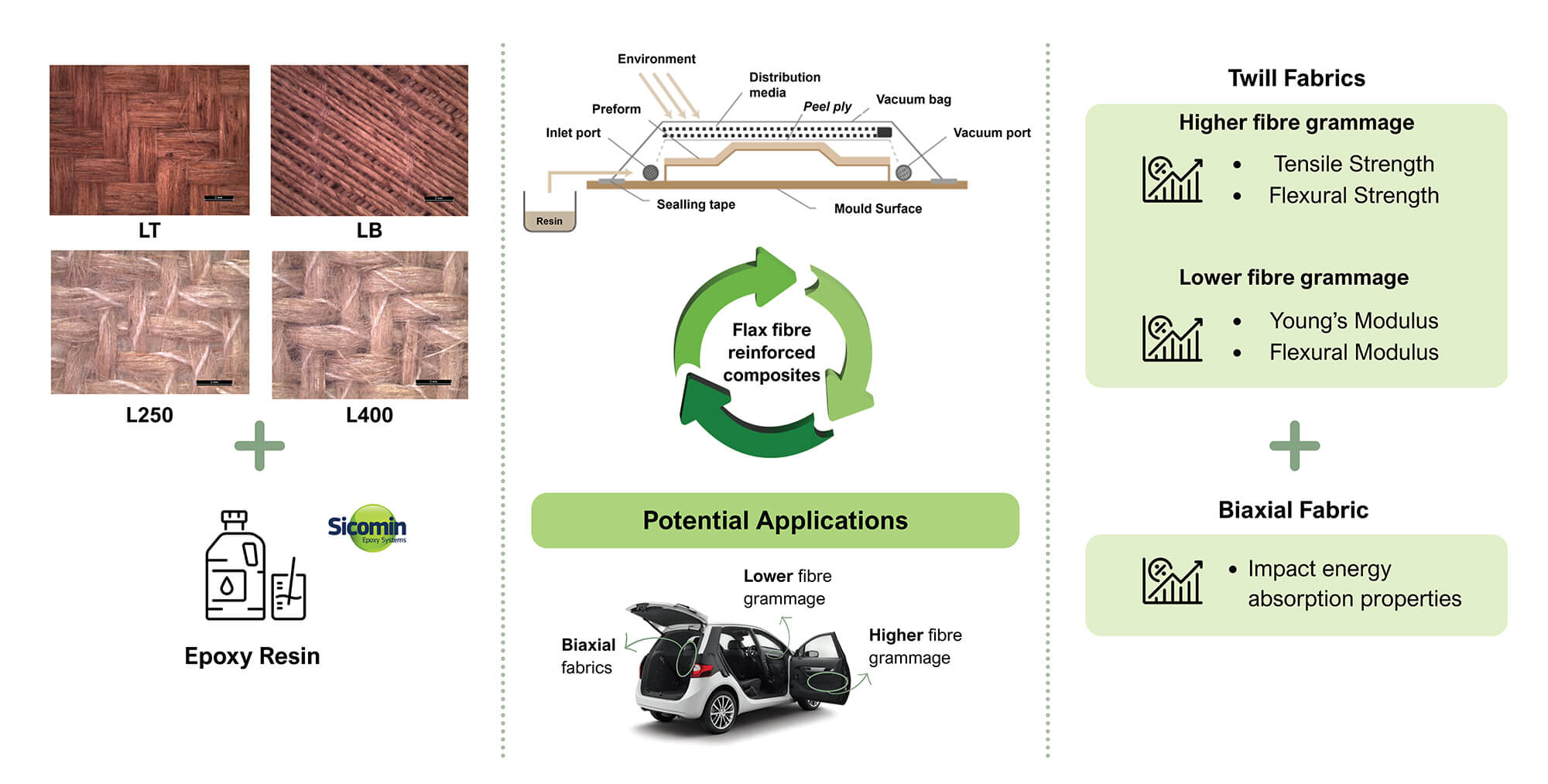

 Login
Login Register
 Submit a Paper
 Propose a Special lssue
 Download PDF
 Downloads
 Citation Tools
