Valorization of Agricultural Lignocellulosic Residues into Mycelium-Based Biofoams: Processing-Structure–Property Relationships and Cushioning Performance
Supachai Pisuchpen1,*, Tanyawan Suwandecha1, Ponusa Jitphuthi1, Somporn Nilmanee1, Wirongrong Tongdeesoontorn2, Thatsanee Luangharn3
1 Centre of Excellence in Bio-Based Materials and Packaging Innovation, Faculty of Agro-Industry, Prince of Songkla University, Hat Yai, Songkhla, Thailand
2 Research Center of Innovative Food Packaging and Biomaterials Unit, School of Agro-Industry, Mae Fah Luang University, Chiang Rai, Thailand
3 Centre of Excellence in Fungal Research, Mae Fah Luang University, Chiang Rai, Thailand
* Corresponding Author: Supachai Pisuchpen. Email: 
Journal of Renewable Materials https://doi.org/10.32604/jrm.2026.02026-0036
Received 03 March 2026; Accepted 25 August 2026; Published online 07 September 2026
Abstract
The environmental burden of petroleum-based cushioning materials has driven the search for sustainable, bioderived alternatives. This study developed mycelium-based biofoams from locally available agro-industrial residues, rubberwood sawdust, and grass jelly pulp using
Pleurotus ostreatus,
Lentinus squarrosulus, and
Ganoderma lucidum. The effects of nutritional supplementation, substrate morphology, and processing conditions on growth behavior and material performance were systematically investigated. Nutritional supplementation significantly enhanced fungal colonization, with bran increasing the growth rate of
L. squarrosulus to 17.0 mm/day and promoting dense, interconnected hyphal networks. Substrate morphology governed the resulting foam structure and properties: surface wood sawdust (SW) produced compact biofoams with higher density (up to 0.31 g/cm
3), low thickness swelling (~2%), and increased hydrophobicity (contact angle up to 104°), whereas grass jelly pulp generated lower-density materials (0.14–0.18 g/cm
3) with greater shrinkage and moisture sensitivity. Processing conditions further influenced the performance. Hot pressing (150°C, 3–4 MPa) enhanced densification and increased compressive strength to 0.42 MPa, whereas cold-pressed biofoams derived from fine and coarse core wood sawdust (CWS and CWL) achieved a more balanced combination of structural uniformity, mechanical integrity, and cushioning efficiency, with cushion factor values of 4.3–5.0. These values fall within the functional range of conventional cushioning materials, indicating a comparable energy absorption capability. This study demonstrates that mycelium-based biofoams can be rationally engineered through the integrated control of biological (fungal species and nutrition), structural (substrate type), and processing parameters. These findings provide a scalable and sustainable strategy for developing biodegradable cushioning materials with tunable properties for packaging applications.
Graphical Abstract
Keywords
Mycelium; biofoams; sustainable materials; cushioning materials; cushion factor; packaging
 Open Access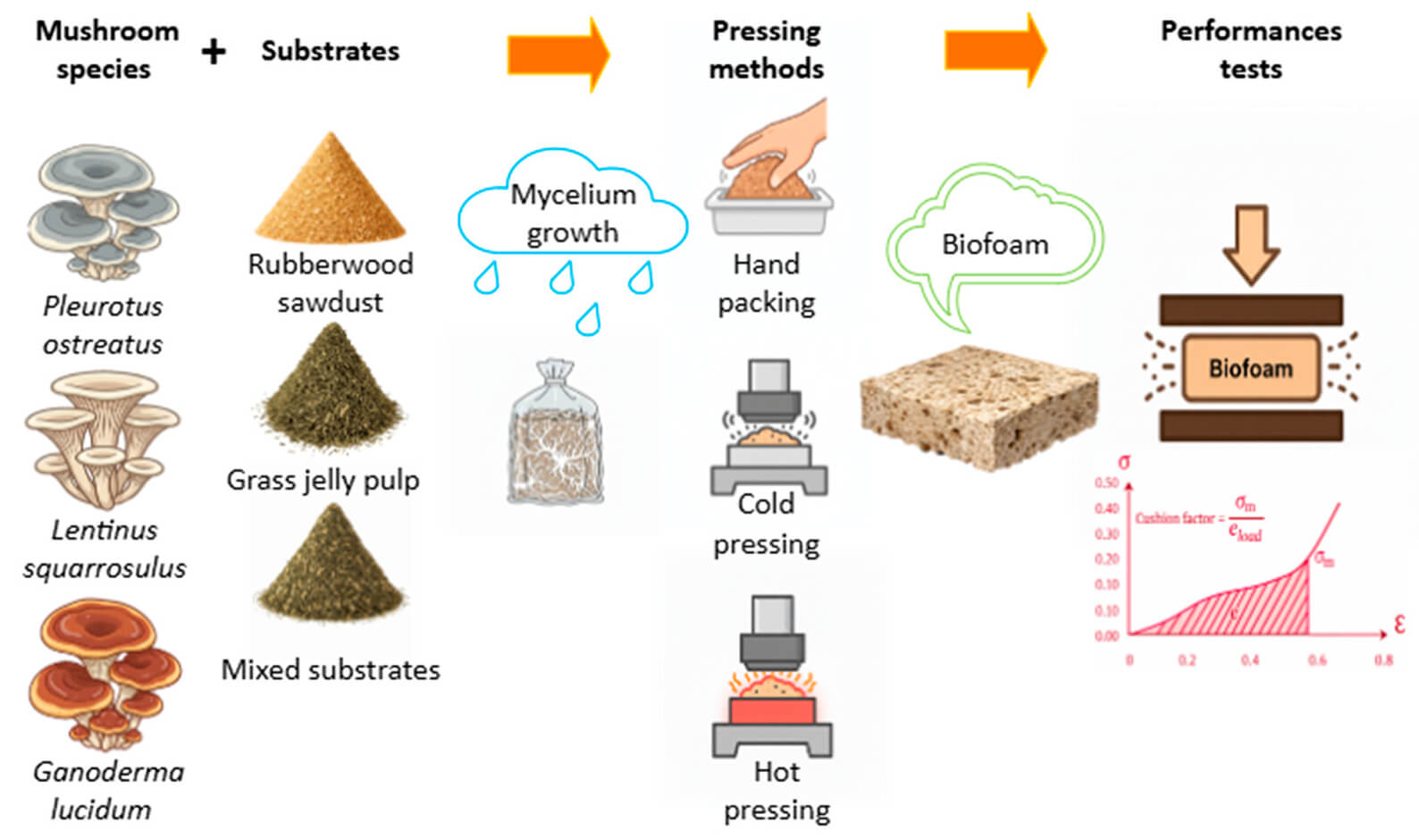

 Login
Login Register
 Submit a Paper
 Propose a Special lssue
 Download PDF
 Downloads
 Citation Tools
