Phytic Acid Crosslinked Chitosan Adhesive for Wood Composites with Enhanced Water Resistance and Flame Retardancy
Weijia Yang1, Yongli Yang1, Wenhe Bi1, Mengdi Chen1, Zhongqiang Che1, Bertrand Charrier2, Hisham Essawy3, Antonio Pizzi4, Xiaojian Zhou1,*, Xinyi Chen1,*
1 Yunnan Provincial Key Laboratory of Wood and Bamboo Biomass Materials, Southwest Forestry University, Kunming, China
2 Institut des Sciences Analytiques et de Physico-Chimie pour l’Environnement et les Matériaux-Xylomat, CNRS/Univ. Pau & Pays Adour, UMR5254, Mont-de-Marsan, France
3 National Research Centre, Department of Polymers and Pigments, Cairo, Egypt
4 LERMAB, University of Lorraine, 27 rue Philippe Seguin, Epinal, France
* Corresponding Author: Xiaojian Zhou. Email:  ; Xinyi Chen. Email:
Journal of Renewable Materials https://doi.org/10.32604/jrm.2026.02026-0050
Received 08 April 2026; Accepted 31 July 2026; Published online 21 August 2026
Abstract
Developing high-performance bio-based wood adhesives to replace conventional petroleum-based adhesives is an urgent issue in the field of wood adhesives. However, existing bio-based adhesives suffer from complex fabrication processes, poor water resistance, and a lack of functionality. Herein, a phytic acid/chitosan adhesive featuring both water resistance and flame retardancy was developed through the one-step dissolution of chitosan. Phosphate esterification and phosphoramidation reactions occurred during hot pressing, as evidenced by FT-IR and XPS analyses, forming a three-dimensional crosslinked network composed of P-O-C and P-N bonds. This crosslinked network effectively enhanced the mechanical properties and water resistance of the resulting adhesive. When 6 g of phytic acid was added, the wet shear strength of the three-layer plywood specimens reached 1.01 MPa, demonstrating excellent water resistance and bonding performance that satisfied the requirements of GB/T 9846-2015 (≥0.7 MPa). Meanwhile, the CS-PA adhesive was applied to bond different wood units (e.g., wood particles). The resulting particleboard exhibited an internal bond strength of 0.66 MPa, a modulus of rupture of 4.16 MPa, and a modulus of elasticity of 920.43 MPa, along with markedly reduced thickness swelling, reflecting a clear improvement in water resistance. In addition, the particleboard achieved a limiting oxygen index (LOI) of up to 54.1% solely through the inherent flame retardancy of the adhesive components, indicating excellent flame-retardant performance. This work offers a straightforward and efficient route for developing high-performance, flame-retardant, environmentally friendly, bio-based wood adhesives.
Graphical Abstract
Keywords
Chitosan; phytic acid; wood adhesive; flame retardant; water resistance
 Open Access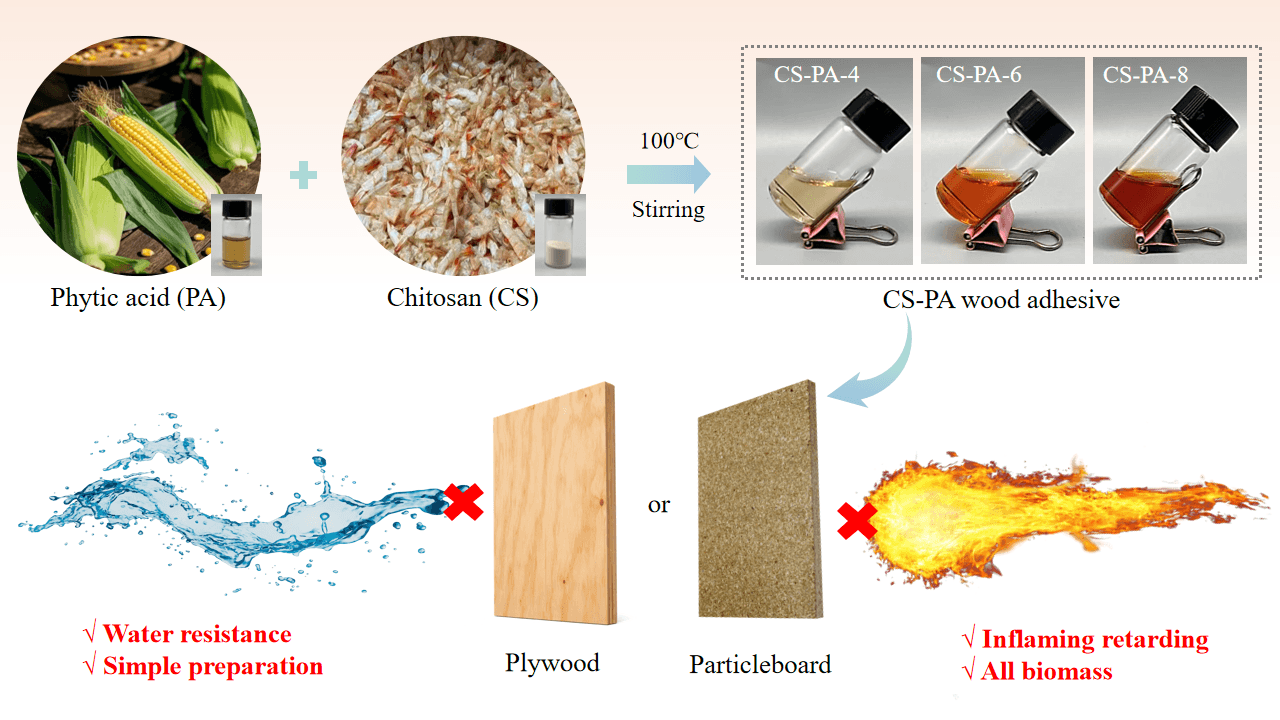

 Login
Login Register
 Submit a Paper
 Propose a Special lssue
 Download PDF
 Supplementary Material File
 Downloads
 Citation Tools
