VEGFC as a prognostic cytokine biomarker linking lymph node metastasis to immune suppression in breast cancer
Hsing-Ju Wu1,2, Yu-Chieh Tsai3,*, Hung-Yu Lin2,4,*
1 Department of Nursing, Jenteh Junior College of Medicine, Nursing and Management, Miaoli, Taiwan
2 Research Assistant Center, Show Chwan Memorial Hospital, Changhua, Taiwan
3 Department of Surgery, Show Chwan Memorial Hospital, Changhua, Taiwan
4 Department of Post-Baccalaureate Medicine, College of Medicine, National Chung Hsing University, Taichung, Taiwan
* Corresponding Author: Yu-Chieh Tsai. Email:  ; Hung-Yu Lin. Email:
European Cytokine Network https://doi.org/10.32604/ecn.2026.079012
Received 12 January 2026; Accepted 11 April 2026; Published online 06 May 2026
Abstract
Backgrounds: Lymph node metastasis is a critical determinant of breast cancer prognosis, yet the specific microenvironmental cytokines driving this process remain elusive. This study aims to identify key prognostic cytokines linking nodal metastasis to tumor microenvironment (TME) remodeling and to evaluate their clinical utility.
Methods: A predefined panel of 176 microenvironmental genes was evaluated using differential expression analysis and the Least Absolute Shrinkage and Selection Operator (LASSO) algorithm on the TCGA-BRCA cohort to identify optimal predictors of nodal metastasis. Prognostic value was assessed via Kaplan-Meier, subgroup, and multivariate Cox regression analyses, and validated across five independent GEO datasets. Immune infiltration and therapeutic potential were evaluated using Gene Set Enrichment Analysis (GSEA), CIBERSORT deconvolution, pharmacogenomic screening, and molecular docking simulations.
Results: Vascular Endothelial Growth Factor C (VEGFC) emerged as the top biomarker significantly upregulated in node-positive tumors. Multivariate analysis confirmed that
VEGFC acts as a robust, independent predictor of poor relapse-free survival (RFS). Notably, subgroup analyses revealed this prognostic penalty is exceptionally pronounced in hormone receptor-positive Luminal A and B subtypes. Mechanistically, elevated
VEGFC is strongly associated with an immunosuppressive “cold” TME, characterized by reduced cytotoxic CD8+ T-cell infiltration and enriched M2-macrophage polarization across multiple algorithms. Furthermore, pharmacogenomic analyses and docking simulations indicated potential sensitivity to PI3K/AKT inhibitors in
VEGFC-high tumors.
Conclusions: VEGFC is a robust, independent precision biomarker specifically indicating poor prognosis in Luminal breast cancers. It is significantly associated with an immune-excluded TME, suggesting that targeting the
VEGFC axis may offer a novel strategy to reverse immune evasion.
Graphical Abstract
Keywords
Breast cancer; vascular endothelial growth factor C (VEGFC); lymph node metastasis; machine learning; immune suppression; tumor microenvironment (TME); AZD6482
 Open Access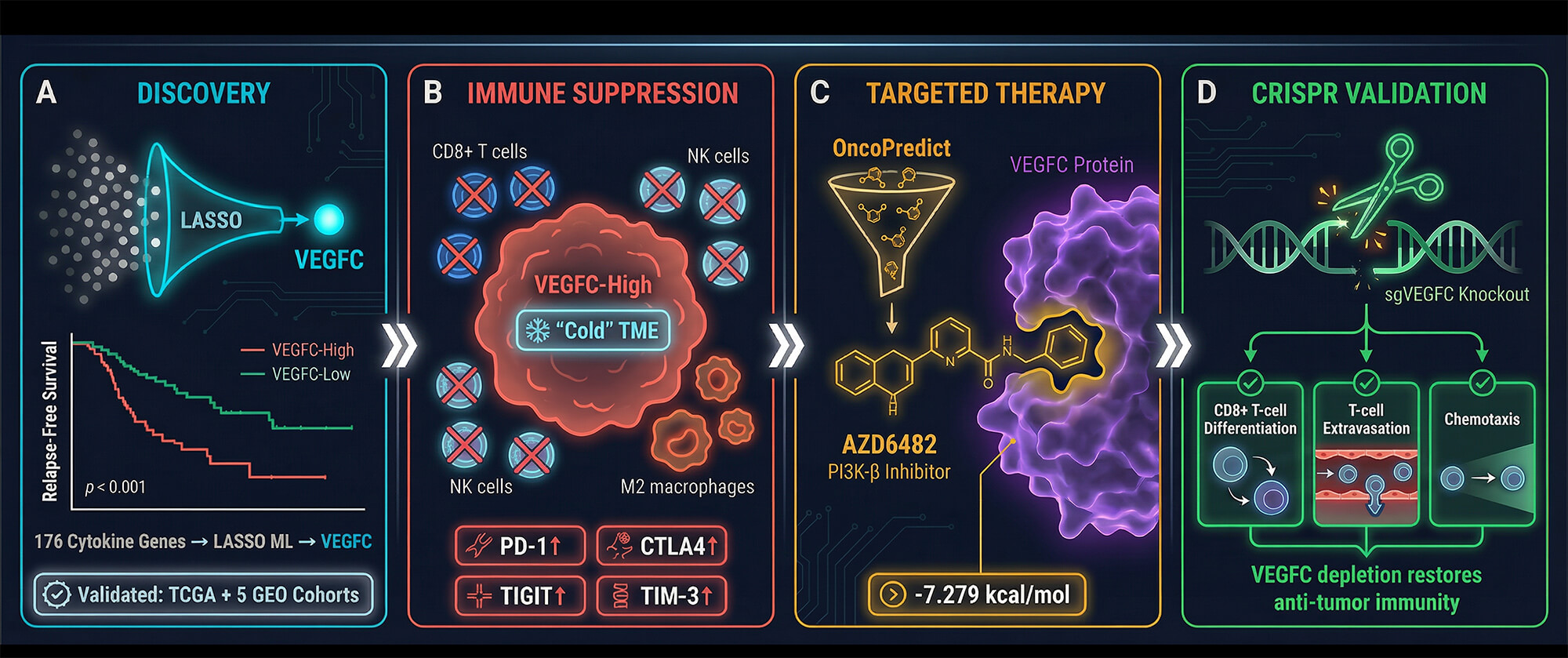

 Login
Login Register
 Submit a Paper
 Propose a Special lssue
 Download PDF
 Supplementary Material File
 Downloads
 Citation Tools
