Guest Editor(s)
Prof. Mario A. Pagnotta
Email: pagnotta@unitus.it
Affiliation: Department of Agricultural and Forest scieNcEs,
Tuscia University, Viterbo, 01100, Italy
Homepage:
Research Interests: molecular markers, conservation genetics, plant biology, molecular genetics, genetic diversity, genetics, PCR, primer, genotyping, cloning

Summary
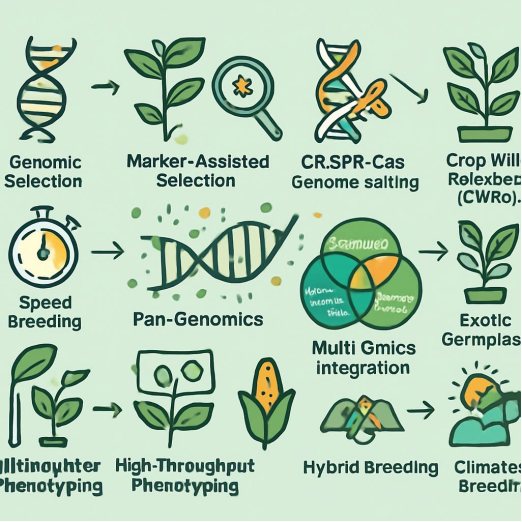
Crop production is increasingly challenged by climate change and the shift toward low-input systems, which require more efficient water use to minimize environmental impacts while maintaining food security. Therefore, it is essential to improve crop tolerance to simultaneous abiotic and biotic stresses, providing a more accurate reflection of real-world agricultural conditions. Smart, future-ready breeding programs must systematically integrate traits that strengthen crop resilience and adaptability to these emerging challenges to ensure sustainable agriculture. Significant progress in crop genetics and breeding has been driven by recent technological innovations that enhance the precision, speed, and effectiveness of developing improved crop varieties. Modern breeding strategies now integrate genomic, phenotypic, and computational tools to accelerate the identification of beneficial traits and their deployment into elite germplasm. Genomic Selection, Marker-Assisted Selection, CRISPR–Cas Genome Editing, Speed Breeding, Pan-Genomics and Pangenome-Based Breeding, etc., are some of the new tools in crop genetics and breeding. The present special issue will deal with themes and strategies to improve the knowledge and selection of germplasm for sustainable agriculture.
Graphic Abstract
Keywords
genomic selection, marker-assisted selection, CRISPR–cas genome editing, speed breeding, pan-genomics and pangenome-based breeding, high-throughput phenotyping, integration of multi-omics (genomics, transcriptomics, metabolomics, proteomics), use of crop wild relatives (CWRS) and exotic germplasm, hybrid breeding improvements, climate-smart breeding
Published Papers

 Login
Login Register
 Submit a Paper
 Propose a Special lssue