Guest Editor(s)
Prof. Dr. Zoran S. Ilić
Email: zorans.ilic@pr.ac.rs
Affiliation: Faculty of Agriculture Priština in Lešak, University of Priština in Kosovska Mitrovica , Lešak,38219, Serbia
Homepage:
Research Interests: pre-harvest and post-harvest physiology and technology
production of vegetables, quality and storage, organic production, biodiversity, plants in a polluted environment etc.
grafting vegetables,
medical and culinary herbs, EOs, antioxidant, antimicrobial

Prof. Dr. Ljiljana P. Stanojević
Email: stanojevic@tf.ni.ac.rs
Affiliation: Faculty of Technology, University of Niš, Bulevar Oslobođenja 124, Leskovac, 16000, Serbia
Homepage:
Research Interests: phytochemical analysis, plant biochemistry, essential oils, phenolic compounds, natural product chemistry and technology, phytochemicals, antioxidant activity, extraction, biological activities, medicinal and aromatic

Assoc. Prof. Lidija Milenković
Email: lidija.milenkovic@pr.ac.rs
Affiliation: Faculty of Agriculture, University of Priština in Kosovska Mitrovica, Lešak, 38219, Serbia
Homepage:
Research Interests: vegetable production, organic production, vegetable grafting, medical–aromatic herbs, quality, essential oil, antioxidant activity
Summary
Plants synthesize primary and secondary metabolites essential for a wide array of functions. Primary metabolites—such as amino acids, proteins, carbohydrates, nucleic acids, and lipids—are directly involved in growth and development. In contrast, secondary metabolites, produced via specialized metabolic pathways, comprise compounds generated in response to environmental stressors. They also facilitate adaptation to abiotic factors in the external environment.
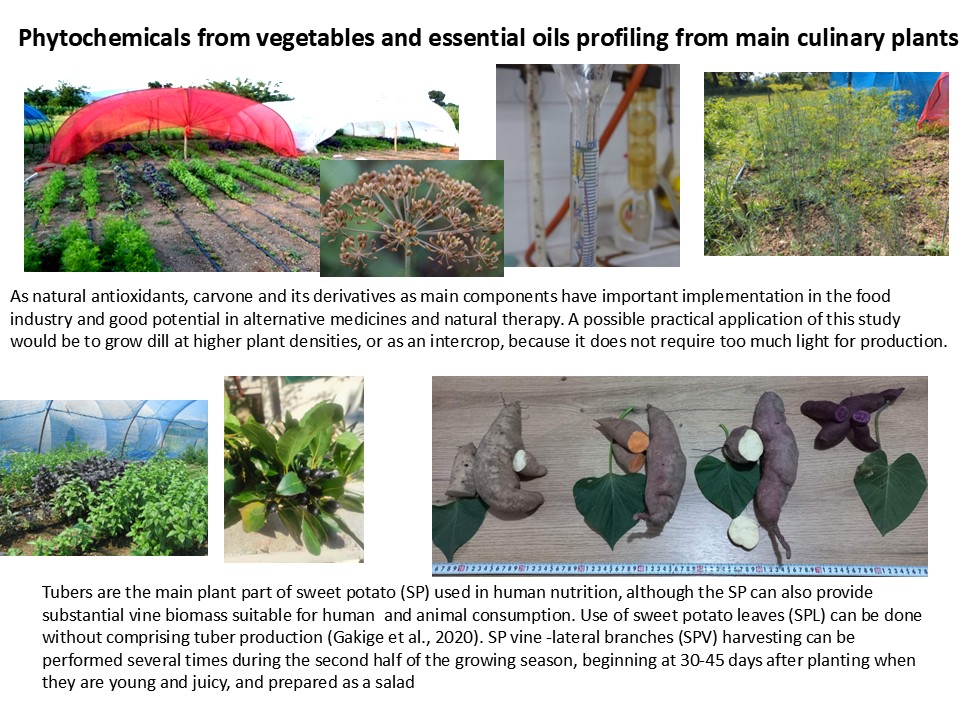
Biodiversity of vegetables, aromatic and medical plants and their chemical composition can be a potential source of natural bioactive compounds (phenolic content with antioxidant and antimicrobial potential) for applications in human health and food preservation. The variation in the chemical composition of aromatic plants (applies to both wild and cultivated species) determines their culinary and medical value. The essential oils (EOs) synthesized by numerous plant species from different botanical families vary considerably in their chemical composition and biological activity.
The future research study would be based on the importance of rational use-collection of vegetables and wild plants from spontaneous flora and optimized production techniques for cultivated aromatic and medical plants (using adequate agricultural techniques with crop shading and adequate plant density) with the goal of obtaining an increased content of high-quality essential oil. This investigation on topics such as the extraction and purification of medicinal compounds can be an effective means of obtaining safe pharmaceutical products.
- The effect of climate change on plant growth and development
- Diversity of aromatic plants chemical profiles and antioxidant activities
- Light modification affects plant nutritional content and essential oil composition
Graphic Abstract
Keywords
vegetables, aromatic plants, medicinal plants, wild plants, phytonutriens, essentiall oil, content, composition, polyphenols, antioxidant
Published Papers

 Login
Login Register
 Submit a Paper
 Propose a Special lssue