Effectiveness of manual detorsion in the treatment of testicular torsion: systematic review and meta-analysis
Sinan Kılıç*
Department of Pediatric Surgery, Faculty of Medicine, Okan University, Istanbul, 34959, Turkiye
* Corresponding Author: Sinan Kılıç. Email:  ,
, 
Canadian Journal of Urology https://doi.org/10.32604/cju.2025.072049
Received 18 August 2025; Accepted 16 December 2025; Published online 06 January 2026
Abstract
Objectives: Testicular torsion is the most common surgical cause of an acute scrotum. Manuel detorsion renewed attention as a practical initial treatment, particularly in the COVID-19 pandemic. This study aims to systematically review and meta-analyze the current literature to determine whether manual detorsion offers a viable alternative to immediate surgery in improving testicular salvage rates.
Methods: A systematic review and meta-analysis were conducted in accordance with PRISMA guidelines and registered with PROSPERO (CRD420251039489). Studies including ≥30 male patients comparing manual detorsion and surgical exploration were included. Searches were performed in PubMed/MEDLINE, Scopus, TR Index, and Web of Science. Risk of bias was assessed using a predefined scoring system based on methodology, sample size, and follow-up objectivity. Data were synthesized using RevMan 5.4 to calculate pooled risk ratios.
Results: Eight retrospective studies involving a total of 670 patients were included. Patients were divided into a manual detorsion group (G1,
n = 394) and a surgical exploration group (G2,
n = 316). Success rates of manual detorsion ranged from 15% to 76%, while orchiectomy rates were lower in G1 (0% to 10.3%) compared to G2 (0% to 43.8%). The pooled success rate of manual detorsion was 75.7%. Although orchiectomy rates appeared numerically lower in the manual detorsion group (3.8% vs. 29.2%), the pooled analysis did not demonstrate a statistically significant overall difference between the two groups (risk ratio [RR] = 1.23; 95% CI: 0.82–1.84;
p = 0.31).
Conclusion: Manual detorsion appears time-saving and effective maneuver. To our knowledge, this is the first meta-analysis focused exclusively on manual detorsion, and it supports its consideration as an initial management strategy in selected clinical scenarios.
Graphical Abstract
Keywords
testicular torsion; manual detorsion; orchiopexy; testicular atrophy
 Open Access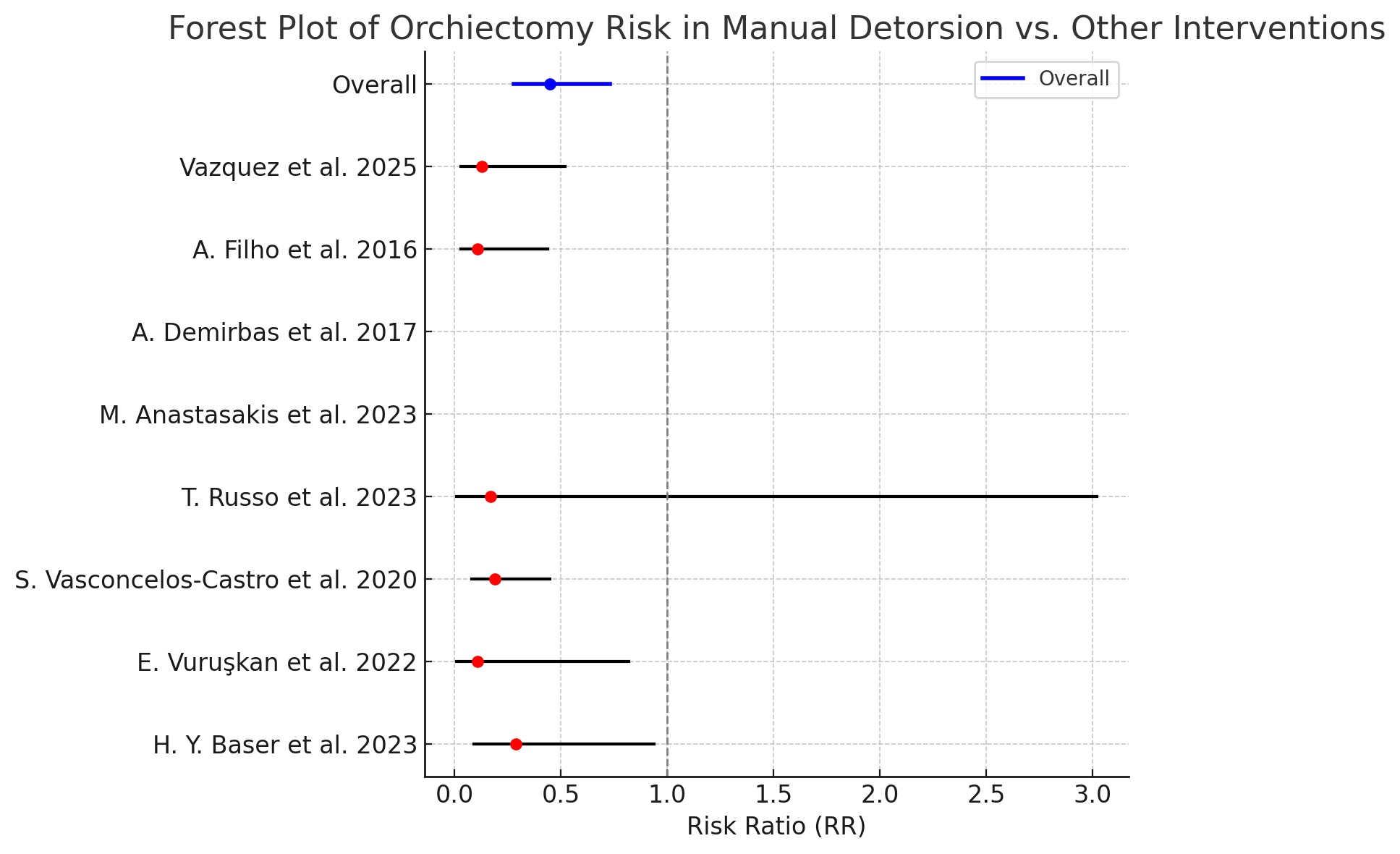

 Login
Login Register
 Submit a Paper
 Propose a Special lssue
 Download PDF
 Supplementary Material File
 Downloads
 Citation Tools
