
Home / Journals / PHYTON / Online First / doi:10.32604/phyton.2026.075718
Special Issues
Table of Content

Open Access

ARTICLE

Metabolite Profiling and Skin Anti-Aging Potential of Astragalus sarcocolla: Antioxidant, Enzyme Inhibitory, and Computational Insights

Shaimaa R. Ahmed1,*, Omnia M. Hendawy2, Sumera Qasim2, Hanan Khojah3, Ambreen Malik Uttra4
1 Department of Pharmacognosy, College of Pharmacy, Jouf University, Sakaka, Aljouf, Saudi Arabia
2 Department of Pharmacology, College of Pharmacy, Jouf University, Sakaka, Aljouf, Saudi Arabia
3 Department of Pharmacognosy, College of Pharmacy, Nursing and Medical Sciences, Riyadh Elm University, Riyadh, Saudi Arabia
4 Department of Pharmacology, College of Pharmacy, University of Sargodha, Sargodha, Pakistan
* Corresponding Author: Shaimaa R. Ahmed. Email: email
(This article belongs to the Special Issue: Plant-Derived Natural Products: Phytochemical Diversity and Functional Properties)

Phyton-International Journal of Experimental Botany https://doi.org/10.32604/phyton.2026.075718

Received 06 November 2025; Accepted 16 January 2026; Published online 23 January 2026
Abstract

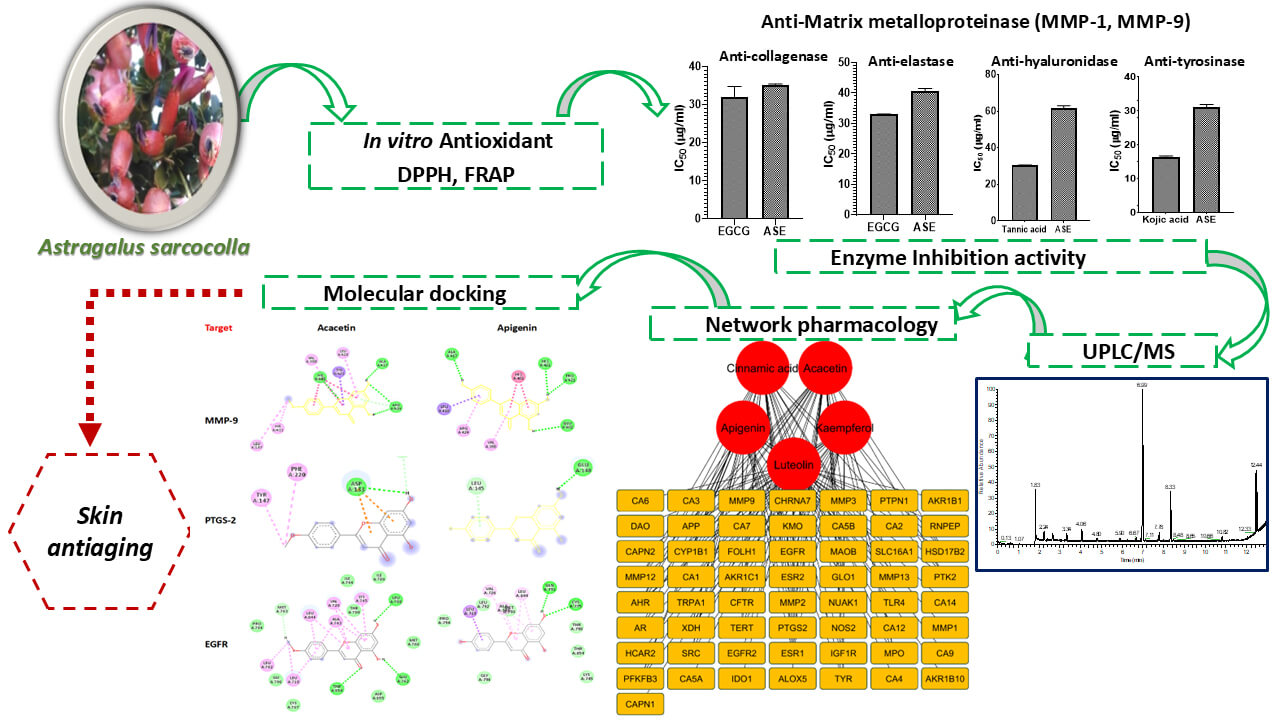
The study evaluated the skin anti-aging activity of Astragalus sarcocolla leaves extract (ASE) by assessing its antioxidant and inhibitory effect activity on matrix metalloproteinase (MMP), collagenase, elastase, hyaluronidase, and tyrosinase in relation to its chemical composition. Ultra Performance Liquid Chromatography-Mass Spectrometry (UPLC-MS) identified 27 metabolites (15 flavonoids, 8 phenolic acids and their derivatives, and 4 coumarins). ASE showed strong antioxidant capacity in DPPH (IC50 value of 26.05 µg/mL) and FRAP (2433 µM FeSO4/g extract) assays. The extract inhibited MMP-1 and MMP-9 in a concentration-dependent manner and suppressed collagenase, elastase, hyaluronidase, and tyrosinase activities (IC50 = 35.038, 40.748, 61.389, and 30.980 µg/mL, respectively). A network pharmacology study was conducted to uncover the mechanisms responsible for skin anti-aging effects, and molecular docking further evaluated interactions of key metabolites with hub targets. Twenty-one bioactive metabolites, selected based on oral bioavailability and drug-likeness, highlighted cinnamic acid, acacetin, luteolin, kaempferol, and apigenin as key compounds. MMP-9, ESR1, PTGS-2, and EGFR were identified as main targets. Docking studies revealed that acacetin and apigenin have stronger binding affinities to MMP-9, PTGS-2, and EGFR than other constituents. These findings suggest that ASE may serve as a natural multi-target skin anti-aging remedy with potential cosmetic applications.

Graphical Abstract

Metabolite Profiling and Skin Anti-Aging Potential of <i>Astragalus sarcocolla</i>: Antioxidant, Enzyme Inhibitory, and Computational Insights

Keywords

Astragalus sarcocolla; metabolite profiling; aging; metalloproteinase; network pharmacology
  • 212

    View

  • 62

    Download

  • 0

    Like

Share Link



