Proximal/Distal ureteral diameter ratio as a predictor of spontaneous passage in <10 mm ureteral stones
İbrahim Üntan1,*, Nuh Aldemir2
1 Department of Urology, School of Medicine, Ahi Evran University, Kirsehir, Turkiye
2 Department of Urology, Medipol University, Esenler Hospital, Istanbul, Turkiye
* Corresponding Author: İbrahim Üntan. Email: 
(This article belongs to the Special Issue: Advances in Endoscopic Management of Urolithiasis)
Canadian Journal of Urology https://doi.org/10.32604/cju.2026.076805
Received 27 November 2025; Accepted 29 January 2026; Published online 06 March 2026
Abstract
Background: Ureteral stones are a common cause of acute renal colic, and while most small stones pass spontaneously, reliable predictors of passage are needed to optimize patient selection for conservative management. This study aims to evaluate the role of radiologic, clinical and laboratory parameters—particularly the proximal/distal (P/D) ureteral diameter ratio—in predicting spontaneous passage of <10 mm ureteral stones.
Materials and Methods: This retrospective cohort study included 277 patients diagnosed with ureteral calculi <10 mm on non-contrast computed tomography between September 2022 and September 2025. Pregnant patients, solitary kidney cases, congenital anomalies, active urinary infection, and incomplete computed tomography (CT) data were excluded. Proximal and distal ureteral diameters were measured 1 cm above and below the stone on axial CT images, and their ratio (P/D ratio) was calculated. Stones located at the ureterovesical or ureteropelvic junction were excluded from ratio analysis due to anatomic constraints. Spontaneous passage within 4 weeks was confirmed by follow-up ultrasonography in all patients. Patients were grouped into passage (n = 204) and no-passage (n = 73). Mann–Whitney U and chi-square tests were used for group comparisons. Predictive performance was assessed by receiver operating characteristic (ROC) analysis.
Results: The spontaneous passage rate was 73.6%. Age, sex, and body mass index did not differ significantly between groups (
p ≥ 0.05). Stone size (
p < 0.001), location (
p = 0.003), CT Hounsfield Unit (HU) (
p < 0.001), and P/D ureteral diameter ratio (
p < 0.001) were significantly associated with passage. Distal and ≤5 mm stones demonstrated markedly higher spontaneous passage rates. Median HU was lower in the passage group (487.00 [348.75–707.00]) than in the no-passage group (648.00 [467.00–846.00]). The P/D ratio was significantly lower in the passage group (2.90 [2.21–3.50]) compared with the no-passage group (4.20 [3.05–5.33]). Alpha-blocker use was not associated with passage (
p = 0.232). ROC analysis demonstrated that stone size (area under the curve [AUC] 0.773) and P/D ratio (AUC 0.757) were the strongest predictors, outperforming HU (AUC 0.645) and location (AUC 0.617).
Conclusions: Stone size, location, HU value, and the proximal/distal ureteral diameter ratio are significant markers associated with spontaneous passage of <10 mm ureteral stones. Lower HU values, distal location, smaller stone size, and a reduced P/D ratio favor spontaneous passage. The P/D ratio, a simple and practical CT-derived measurement, showed superior discriminative ability compared with HU and may assist clinicians in selecting appropriate candidates for conservative management.
Graphical Abstract
Keywords
ureterolithiasis; spontaneous stone passage; proximal/distal ureteral diameter ratio; computed tomography; Hounsfield unit; renal colic
 Open Access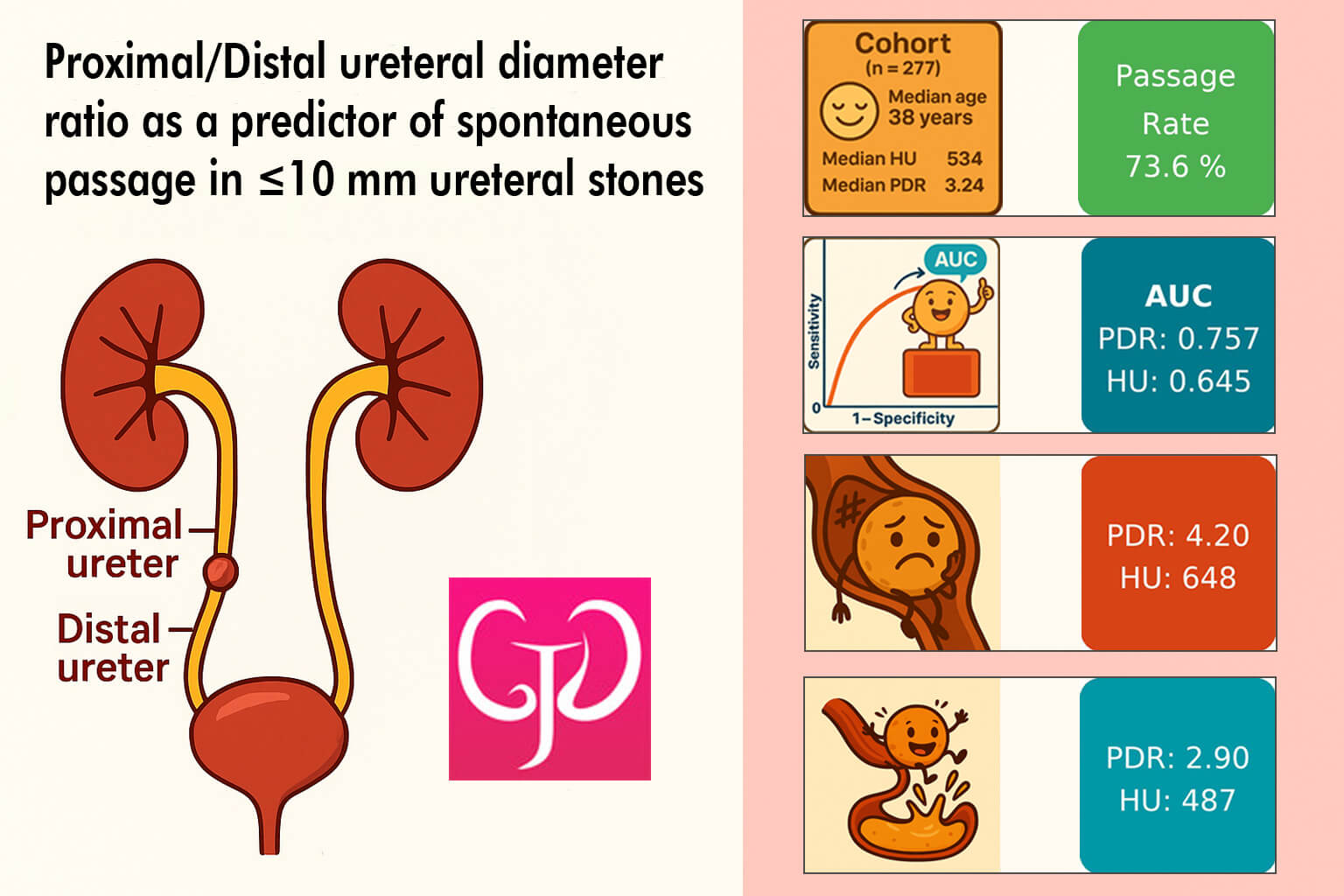

 Login
Login Register
 Submit a Paper
 Propose a Special lssue
 Download PDF
 Downloads
 Citation Tools
