Guest Editor(s)
Dr. Brandon Lucke-Wold
Email: brandon.luckewold@gmail.com
Affiliation: Department of Neurosurgery & Brain Injury Research Center, University of Florida, Gainesville, United States
Homepage:
Research Interests: urologic care, subarachnoid hemorrhage, endovascular procedures, acute ischemic stroke
Mr. Hunter Hutchinson
Email: hunterjh13@outlook.com
Affiliation: College of Medicine & Department of Neuroscience, University of Florida, Gainesville, United States
Homepage:
Research Interests: urologic care, subarachnoid hemorrhage, endovascular procedures, acute ischemic stroke
Summary
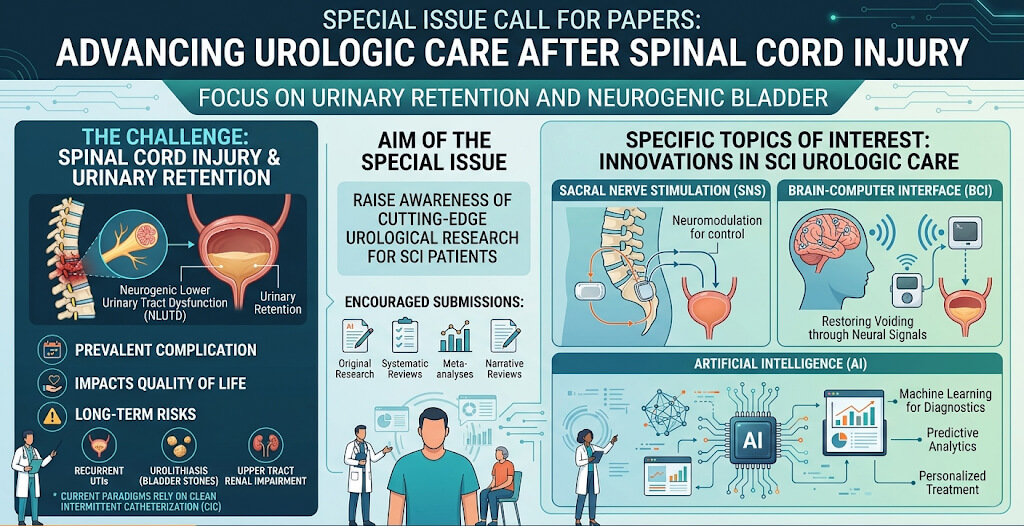
Urinary retention is a prevalent and debilitating complication of spinal cord injuries (SCI) caused by neurogenic lower urinary tract dysfunction. It significantly impacts patient quality of life and poses long-term health risks, including recurrent urinary tract infections, urolithiasis, and progressive upper tract renal impairment. Despite considerable advancements in urologic care and surgery, managing urinary retention after SCI is still a challenge, with many current paradigms relying on clean intermittent catheterization.
The aim of this special issue is to raise awareness of cutting-edge urological research and its application to patients with spinal cord injuries. We encourage authors to submit original research, systematic reviews, meta-analyses, and narrative reviews focusing on urologic care of patients with SCI. Specific topics of interest include sacral nerve stimulation, brain computer interface, and the application of artificial intelligence to urologic care of SCI.
Graphic Abstract
Keywords
spinal cord injury (sci), urinary retention, neurogenic lower urinary tract dysfunction (nlutd), neurogenic bladder, clean intermittent catheterization (cic), lower urinary tract symptoms (luts), sacral neuromodulation, urological rehabilitation, renal preservation, minimally invasive urologic interventions

 Login
Login Register
 Submit a Paper
 Propose a Special lssue