Cold-Induced Accumulation of Low-Molecular-Weight Dehydrins in Etiolated Wheat Seedlings: Relationship with Oxidative Stress Protection and Frost Tolerance
Tetiana O. Yastreb1, Pavel Vítámvás2, Ilja T. Prášil2, Zdeněk Cit2, Ivan V. Shakhov1, Yuriy E. Kolupaev1,3,*
1 Yuriev Plant Production Institute, National Academy of Agrarian Sciences of Ukraine, Kharkiv, Ukraine
2 Czech Agrifood Research Center, Prague, Czech Republic
3 Department of Plant Protection, Poltava State Agrarian University, Poltava, Ukraine
* Corresponding Author: Yuriy E. Kolupaev. Email: 
(This article belongs to the Special Issue: Plant Responses to Stress Factors)
Phyton-International Journal of Experimental Botany https://doi.org/10.32604/phyton.2026.079882
Received 30 January 2026; Accepted 04 March 2026; Published online 19 March 2026
Abstract
Low temperature is a major abiotic stress factor inducing the accumulation of dehydrins in plants. Dehydrins are hydrophilic, heat-stable proteins implicated in plant stress responses; however, their synthesis under cold conditions during the early stages of wheat development has not been sufficiently studied. This study investigated the relationship between cold-induced dehydrin accumulation in etiolated seedlings and frost tolerance in wheat cultivars differing in their level of frost tolerance. Three-day-old seedlings of high frost-tolerant (high-FT) cultivars (Antonivka, Doskonala, and Nordika) and low frost-tolerant (low-FT) cultivars (Tobak, Tonnage, and Altigo) of
Triticum aestivum L. were hardened at +3°C for six days. Dehydrin accumulation was analyzed by electrophoretic separation, while frost tolerance was assessed based on seedling survival following freezing at −4, −9, and −12°C. Cold-induced oxidative damage was evaluated by determining malondialdehyde (MDA) content in seedling shoots after freezing at −4°C. In control seedlings, dehydrins were barely detectable in all cultivars. Cold hardening at +3°C induced pronounced accumulation of dehydrins with molecular masses of approximately 46, 49.6, and 68 kDa in both high-FT and low-FT cultivars. In contrast, low-molecular-weight dehydrins (14–16 kDa) were detected predominantly in high-FT cultivars. Seedling survival after freezing at −12°C showed a strong positive correlation with total dehydrin content (
r = 0.82). Even stronger correlations were observed between the content of low-molecular-weight dehydrins (14–16 kDa) and seedling survival after freezing at −9 and −12°C (
r = 0.84 and 0.94, respectively). An inverse correlation was found between 14–16 kDa dehydrin content and MDA accumulation following freezing at −4°C (
r = −0.87). These results indicate that low-molecular-weight dehydrins play an important role in protecting etiolated wheat seedlings from cold-induced oxidative stress and may serve as reliable biochemical markers of frost tolerance.
Graphical Abstract
Keywords
Cold stress; dehydrins; frost tolerance; oxidative stress;
Triticum aestivum L.; wheat seedlings
 Open Access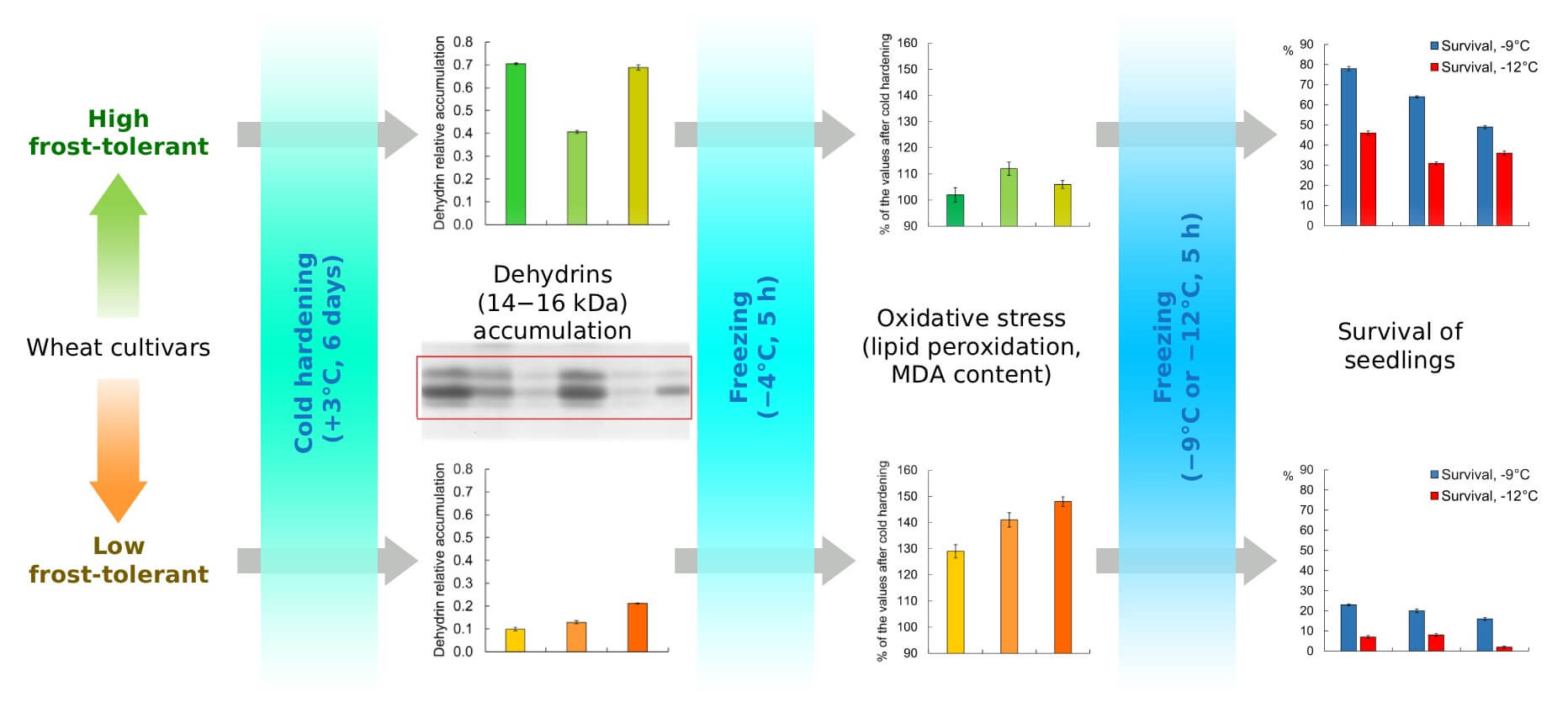

 Login
Login Register
 Submit a Paper
 Propose a Special lssue
 Download PDF
 Supplementary Material File
 Downloads
 Citation Tools
