Guest Editor(s)
Prof. Dr. M. S. Reddy
Email: prof.m.s.reddy@gmail.com
Affiliation: Department Of Entomology & Plant Pathology, Auburn University, Auburn, The United States of America
Homepage: www.drmsreddy.com
Research Interests: PGPR, biostimulants, microbiome, plant-pathogen interactions, biocontrol, biotic and abiotic stresses, organic agriculture

Dr. R. Rajeshwari
Email: rajiuhs@gmail.com
Affiliation: Department of Plant Pathology, College of Horticulture, GKVK, Bengaluru-560 065, Karnataka, University of Horticultural Sciences, Karnataka, India
Homepage:
Research Interests: Begomo viruses & Tospo viruses, virus detection & diagnosis, biostimulants & PGPR, induced systemic resistance (ISR), salinity & drought stress tolerance, horticultural crops, sustainable plant protection

Prof. Krishna Sundari Sattiraju
Email: skrishnasundari@gmail.com; s.krishna.sundari@mail.jiit.ac.in
Affiliation: Jaypee Institute of Information Technology, Noida, India
Homepage:
Research Interests: plant–microbe interactions, bioinoculants for sustainable agriculture, mycorrhiza & microbial biodiversity, bioremediation (heavy metals, dyes, pesticides), plant growth-promoting microorganisms (PGPM), rhizoremediation & microbial consortia, molecular mechanisms of pesticide degradation, agricultural waste valorization, soil microbiome research

Summary
Scope and Rationale:
Abiotic stresses such as salinity, drought, and extreme temperatures are major constraints to global crop productivity and agricultural sustainability, particularly under the accelerating impacts of climate change. There is an urgent need for innovative, science-driven solutions that enhance plant resilience while reducing dependence on chemical inputs.
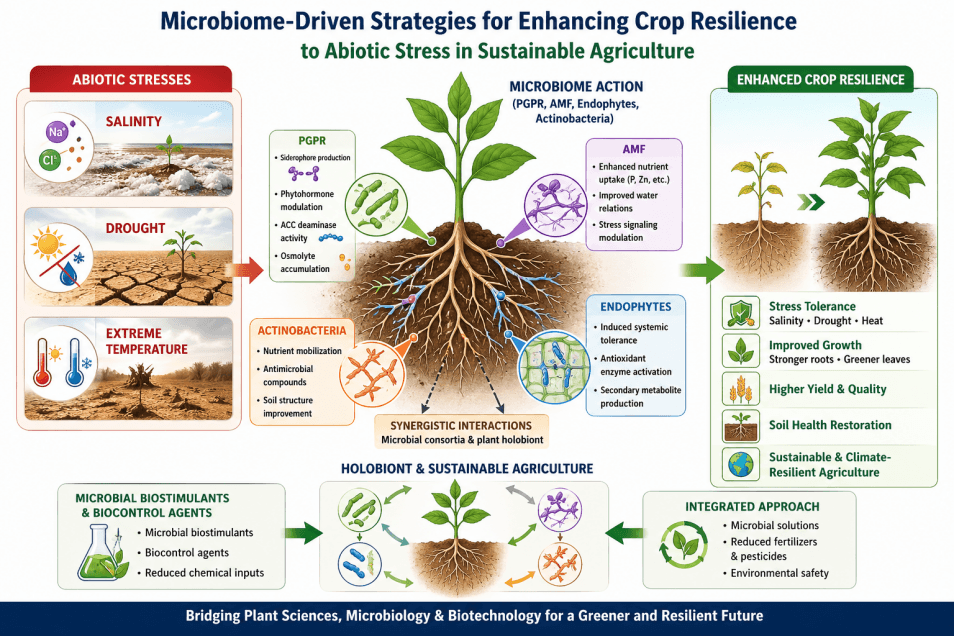
Beneficial soil and endophytic microorganisms—including plant growth-promoting rhizobacteria (PGPR), arbuscular mycorrhizal fungi (AMF), and actinobacteria—offer significant potential to improve plant performance under adverse environmental conditions. These microbial systems function through diverse mechanisms such as siderophore production, osmolyte accumulation, phytohormone regulation, nutrient mobilization, and complex synergistic interactions within the plant holobiont.
In addition, the integration of microbial biocontrol agents provides a dual advantage by mitigating stress-associated diseases while promoting plant health, thereby supporting a transition toward environmentally sustainable crop protection strategies.
This Special Issue aims to bring together cutting-edge research and translational approaches at the interface of plant science, agricultural microbiology, and sustainable biotechnology. It will highlight advances in microbiome-based technologies for improving stress tolerance, restoring soil health, and enhancing crop productivity in climate-resilient agricultural systems.
Topics of Interest:
Submissions are invited on, but not limited to, the following topics of Interest:
· Molecular and physiological mechanisms of PGPR and AMF in enhancing plant tolerance to salinity, drought, and temperature stress
· Synergistic interactions among beneficial microorganisms (bacteria, fungi, and actinobacteria) for abiotic stress mitigation
· Roles of microbial siderophores, phytohormones, and osmoprotectants in stress adaptation and crop yield improvement
· Endophyte-mediated holobiont dynamics and microbiome engineering for sustainable stress management
· Microbial consortia and biocontrol agents for integrated management of abiotic stress and stress-associated diseases
· Integration of microbial biostimulants with reduced chemical inputs (fertilizers and crop protection products)
· Valorization of agricultural and industrial biowaste into microbial formulations and bioactive compounds for stress tolerance
· Field-scale validation, adoption challenges, and scalability of PGPR-based bioinoculants under abiotic stress conditions
Expected Impact:
This Special Issue will provide a comprehensive platform for advancing microbiome-based solutions as key drivers of climate-resilient and sustainable agriculture, contributing to the broader vision of the Second Green Revolution. It will serve researchers, industry stakeholders, and policymakers seeking innovative strategies to address global food security challenges under changing environmental conditions.
Graphic Abstract
Keywords
plant abiotic stress, PGPR, Mycorrhizal fungi, microbial biostimulants, salinity stress, drought tolerance, plant–microbiome interactions, holobiont concept, biocontrol agents, climate-resilient agriculture

 Login
Login Register
 Submit a Paper
 Propose a Special lssue