Home / Journals / PHYTON / Vol.95, No.5, 2026
Special Issues
Table of Content
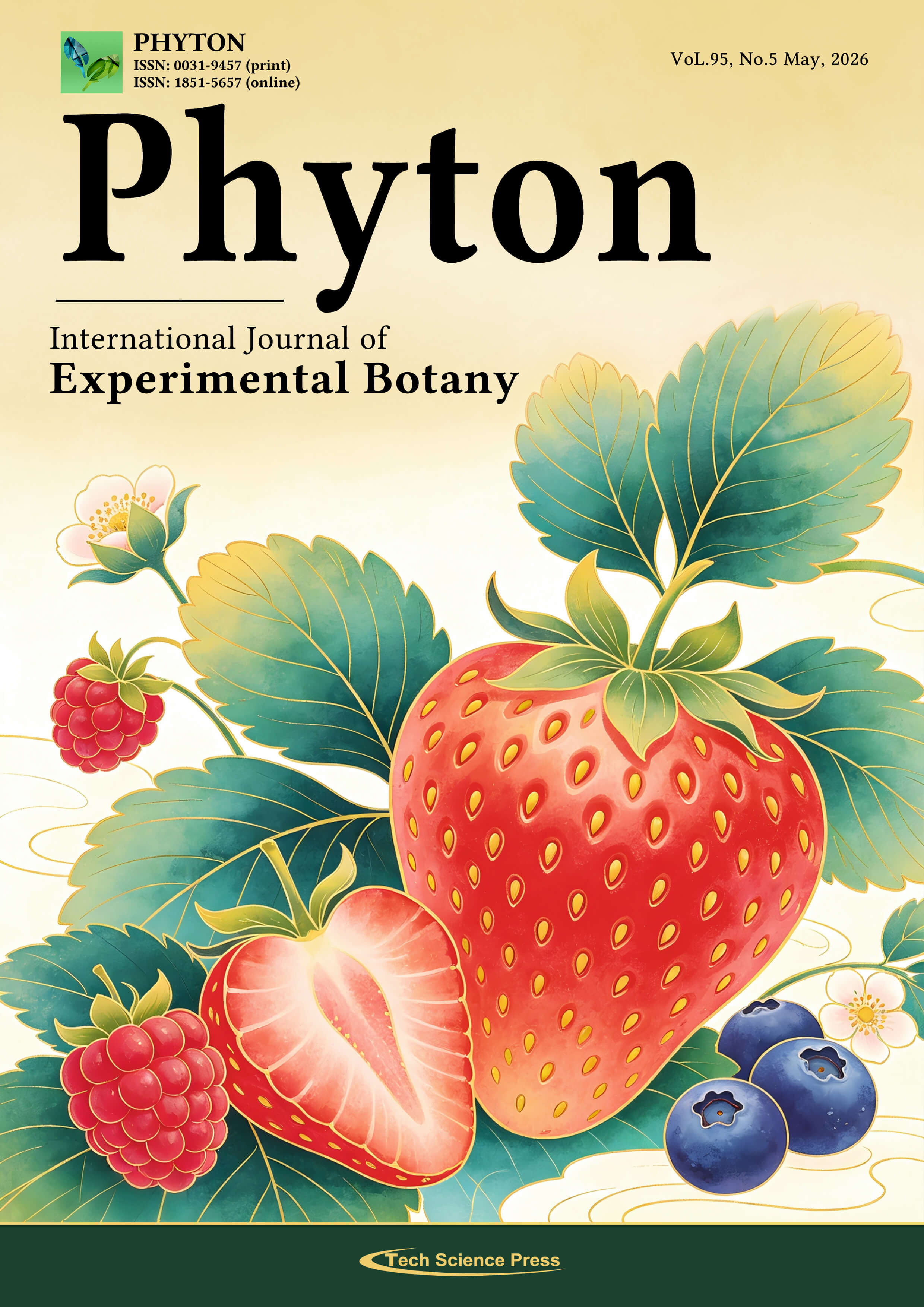
cover

On the Cover

Small berries are recognized for their nutritional richness and economic value. This review synthesizes the growth characteristics and ecological adaptations of strawberry, blueberry, raspberry, and aronia, with an emphasis on protected cultivation of strawberry. Key technical components—including cultivar selection, environmental regulation, water and nutrient management, flowering and fruiting control, and green pest management—are systematically discussed. The findings highlight that trait-based precision management, coupled with sustainable practices and technological innovation, is fundamental to improving productivity, fruit quality, and long-term industry sustainability.
This cover image was created using Al-generated content from "doubao Al". The authorsconfirm that no human likenesses, copyrighted elements, or misleading representationsare included in the image.

View this paper

  • Open AccessOpen Access

    REVIEW

    Growth Characteristics and Sustainable Cultivation Management Techniques of Small Berries: A Review with a Focus on Strawberry under Protected Agriculture

    Yu Yang1,*, Biao Jia1, Xin Ma1,*, Hailing Shang1, Shuai Lou1, Chao Zhang1, Jianming Zhao1, Min Li1, Jiali Bao1, Zhongbo Wang2, Dongjie Jia3
    Phyton-International Journal of Experimental Botany, Vol.95, No.5, 2026, DOI:10.32604/phyton.2026.081047 - 27 May 2026
    (This article belongs to the Special Issue: Integrated Approaches to Crop Yield Enhancement)
    Abstract Small berries, represented by strawberries, blueberries, raspberries, and aronia berries, are increasingly valued worldwide for their rich nutritional content and economic potential. This review systematically outlines the growth characteristics of these berries, with a focused analysis on strawberries-including their ecological adaptations and responses to soil, water, temperature, light, and nutrition. It further elaborates on the integrated technical system for protected strawberry cultivation, covering cultivar selection, seedling propagation, transplanting, water and nutrient management, environmental control, flower and fruit regulation, green pest control, and post-harvest handling. The paper also discusses innovative models for industry development, such as More >

  • Open AccessOpen Access

    REVIEW

    Nanomaterial-Mediated Modulation of Plant Functional Traits and Rhizosphere Processes: Mechanistic Insights into Plant Stress Physiology

    Abdul Ghafoor1,*, Muhammad Munir2,*, Khalid Turk1, Muhammad Tahir3, Umair Riaz4, Adnan Mustafa5
    Phyton-International Journal of Experimental Botany, Vol.95, No.5, 2026, DOI:10.32604/phyton.2026.080990 - 27 May 2026
    (This article belongs to the Special Issue: Application of Nanomaterials in Plants)
    Abstract Agricultural systems increasingly face interacting abiotic and biotic stresses driven by climate change and soil degradation. Plant performance under such conditions is determined by coordinated networks of functional traits governing resource acquisition, allocation, and defense. These traits also structure plant-associated microbiomes, whose activities influence nutrient cycling, stress buffering, and disease suppression. This review synthesizes current evidence that agricultural nanomaterials enhance crop stress resilience primarily by reprogramming plant functional trait networks and, through them, modulating microbiome dynamics. We analyze how nanomaterial physicochemical properties including size, surface chemistry, dissolution behavior, and redox activity determine their bioavailability and… More >

  • Open AccessOpen Access

    REVIEW

    Economic Botany of Salvia officinalis L. with Emphasis on Essential Oil

    Ioana Crișan*
    Phyton-International Journal of Experimental Botany, Vol.95, No.5, 2026, DOI:10.32604/phyton.2026.078817 - 27 May 2026
    (This article belongs to the Special Issue: The Biological Activity of Essential Oils, Volume II)
    Abstract Salvia officinalis (Lamiaceae), commonly called garden sage or Dalmatian sage, is an aromatic species native to the Mediterranean Basin and one of the oldest medicinal herbs. Culinary importance is well attested historically and has continued relevance for contemporary regional gastronomy, particularly in Europe. Traditionally, it has been used for medicinal infusions, to flavor or preserve meat, and in the production of cheese specialties. Today, it is recognized for its commercial and industrial value. This work aims to provide an up-to-date look at the economic botany of this species, with special reference to the essential oil (EO)… More >

  • Open AccessOpen Access

    ARTICLE

    Effect of Selenium, Copper and Manganese Nanocomposites in Polysaccharide Matrices on the Content of Photosynthetic Pigments in Potato Leaf Tissues

    Alla I. Perfileva1, Konstantin V. Krutovsky2,3,4,5,6,*
    Phyton-International Journal of Experimental Botany, Vol.95, No.5, 2026, DOI:10.32604/phyton.2026.078352 - 27 May 2026
    (This article belongs to the Special Issue: Application of Nanomaterials in Plants)
    Abstract The article presents the study of the effect of nanocomposites (NCs) based on selenium (Se), copper (Cu), and manganese (Mn) nanoparticles (NPs) embedded in a matrix of natural polysaccharides—arabinogalactan (AG), carrageenan (CAR), and starch (ST)—on the content of chlorophylls (Chls) and carotenoids in potato tissues in vitro. Potatoes were grown for 28 days on Murashige-Skoog (MS) medium with the addition of a NC, then pigments were isolated from leaf tissues, and their content was determined spectrophotometrically. Both a stimulating effect and an inhibitory effect of different NCs on the pigment content were found. Se and Cu… More >

  • Open AccessOpen Access

    ARTICLE

    The Effects of Planting at Varying Seedling Ages on the Agronomic Traits and Nutritional Components of Stem

    Sijun Bao1, Yingping Chen1,2,3, Xiaoqiang Wei1,2,3, Long Tan1,2,3, Lihui Wang1,2,3,*
    Phyton-International Journal of Experimental Botany, Vol.95, No.5, 2026, DOI:10.32604/phyton.2026.080248 - 27 May 2026
    (This article belongs to the Special Issue: Ethnobotanical Innovations: Exploring Traditional Plant Uses for Modern Solutions)
    Abstract This study aimed to elucidate the effects of varying seedling ages at planting on the agronomic traits and nutrient content of stem lettuce. The early-maturing variety “WS120” and the late-maturing variety “WS1” were employed as experimental materials. Four seedling age treatments were established at 20, 25, 30, and 35 d. By measuring the agronomic traits and nutrient content of the stem lettuce, we employed correlation analysis, principal component analysis, cluster analysis, and the membership function method for a comprehensive evaluation. This study aims to elucidate the optimal planting age for stem lettuce in plateau regions.… More >

  • Open AccessOpen Access

    ARTICLE

    Distribution, Ecology and Invasion Potential of Sorghum halepense (Poaceae) in the Insubric Region (Northern Italy and Southern Switzerland)

    Matteo Gentilini1,2,3, Sofia Mangili2, Alberto Selvaggi4,5, Rodolfo Gentili1,*, Brigitte Marazzi2,3
    Phyton-International Journal of Experimental Botany, Vol.95, No.5, 2026, DOI:10.32604/phyton.2026.078024 - 27 May 2026
    (This article belongs to the Special Issue: Managing Invasive Alien Species: Understanding Impacts for Implementing Ecosystems Restoration)
    Abstract Sorghum halepense (L.) Pers. (Johnson grass, Poaceae) is a worldwide problematic alien species, rapidly expanding its alien range in Europe. This study reconstructed the spread history, and assessed the current distribution, ecological traits, and invasion potential of this species in the Insubric region of northern Italy and southern Switzerland. Herbarium and occurrence data showed that its spread began in the late 19th century and has accelerated recently in the foothill zone, progressing northward and upward. High-cover populations occurred in anthropogenic habitats, especially ruderal and agricultural areas. Morphological analyses revealed statistically significant site-dependent differences in plant height… More >

  • Open AccessOpen Access

    ARTICLE

    Comprehensive Assessment of Low Potassium Tolerance in Mature Chinese Cabbage and Physiological Differences in Responses to Potassium Deficiency

    Meng Zhao1, Shuai Li1, Yuanyuan Zhang2,3, Yunduan Qin2,3, Yu Xu2,3, Chunyang Feng2,3, Kekang Su2,3, Xinlei Guo2,3, Changwei Shen1,*, Jingping Yuan2,3,*
    Phyton-International Journal of Experimental Botany, Vol.95, No.5, 2026, DOI:10.32604/phyton.2026.077668 - 27 May 2026
    (This article belongs to the Special Issue: Advances in Plant Nutrition-Mechanisms, Regulation, and Sustainable Applications)
    Abstract Chinese cabbage (Brassica rapa ssp. pekinensis) is a typical potassium (K)-demanding crop that is highly sensitive to soil K availability. Severe soil potassium deficiency in production fields frequently impairs both yield and quality. Therefore, screening for potassium-efficient varieties is essential for identifying germplasm resources and breeding materials tolerant to low-K conditions. To evaluate genetic variation in potassium utilization efficiency, 12 Chinese cabbage germplasms were assessed under two field conditions: with adequate potassium supply (K2O 165 kg/ha) and without potassium application (K2O 0 kg/ha). Fourteen parameters, including yield, plant growth, potassium content, and potassium accumulation, were measured and compared.… More >

  • Open AccessOpen Access

    ARTICLE

    Alleviation of Salt Stress on the Growth and Active Constituents of Chamomile (Matricaria chamomilla L.) Using Glutathione and Hydrogen Peroxide

    Wessam M. Serag El-Din1,*, Kamal E. Attia1, Taghreed E. Eissa2,*, Tarek M. Noor El-Deen2, Hadeer Darwish1,3, Ghadah H. Al Hawas4,5, Modhi O. Alotaibi6,7
    Phyton-International Journal of Experimental Botany, Vol.95, No.5, 2026, DOI:10.32604/phyton.2026.078357 - 27 May 2026
    (This article belongs to the Special Issue: Crop Stress Mitigation for Enhanced Productivity and Quality)
    Abstract Water salinity is a growing environmental concern that significantly impacts soil health, agricultural productivity, and freshwater sustainability, especially in arid regions. This study evaluated the comparative effects of foliar-applied glutathione (GSH) and hydrogen peroxide (H2O2) on growth, flower yield, essential oil composition, and physiological responses of Matricaria chamomilla L. under water salinity levels. The experiment was conducted during the 2022/2023 and 2023/2024 seasons at the Experimental Farm of El-Quassassin, Ismailia, Egypt, using a factorial randomized complete block design with three replicates. Foliar applications of GSH (1, 2, and 3 mM) and H2O2 (5, 10, and 20 mM)… More >

  • Open AccessOpen Access

    ARTICLE

    Optimization and Sensory Evaluation of the Volatile Oil Extracts from Peucedanum praeruptorum Using Response Surface Methodology and HS-SPME-GC/MS Detection

    Yuxian Liu1,2, Jinzhuo Yao1,2, Bangxing Han1,2,*, Cheng Song1,3,*
    Phyton-International Journal of Experimental Botany, Vol.95, No.5, 2026, DOI:10.32604/phyton.2026.082999 - 27 May 2026
    (This article belongs to the Special Issue: Plant Hormone Signaling and Environmental Cue Integration: Mechanisms and Regulatory Networks)
    Abstract Essential oil is one of the main active ingredients in the medicinal herb Peucedanum praeruptorum. However, limited studies have been conducted on the quality evaluation of this essential oil. Here, we performed an optimization and evaluation of P. praeruptorum volatile oil extraction using response surface methodology. Partial least squares discriminant analysis (PLS-DA) was employed to screen relevant biomarkers. A sensory evaluation of the volatile oil components of P. praeruptorum was conducted across different time periods, and aroma differences were examined. The optimal extraction process involved an extraction time of 4 h, a soaking time of 2 h, a… More >

  • Open AccessOpen Access

    ARTICLE

    Rhizobium Strain S2_8_1 Promotes Ryegrass Regrowth under Soil and Hydroponic Conditions

    Xiaoling Wang1,*, Youyou Wang1, Longkang Ni1, Ruoyu Hao2, Jiawei Cao1, Hongfei Zhao1, Liju Zhou1
    Phyton-International Journal of Experimental Botany, Vol.95, No.5, 2026, DOI:10.32604/phyton.2026.079810 - 27 May 2026
    (This article belongs to the Special Issue: Advances in Plant Nutrition-Mechanisms, Regulation, and Sustainable Applications)
    Abstract (1) Purpose: Sustainable forage production requires strategies that accelerate plant regrowth while reducing reliance on synthetic nitrogen fertilizers. This study aimed to evaluate the potential multifunctionality of a plant growth-promoting microorganism, strain S2_8_1, hypothesized to enhance ryegrass regrowth in association with increased rhizosphere nitrification and cytokinin-related plant responses. (2) Methods: Comparative experiments were conducted using S2_8_1 and a cytokinin producing Streptomyces strain (Shan2) under both soil and hydroponic conditions. Treatments were evaluated for biomass production, soil NO3-N content, nitrification rate, and leaf zeatin riboside (ZR) levels. Multiple linear regression was applied to quantify the relative contributions… More >

  • Open AccessOpen Access

    ARTICLE

    Comprehensive Analyses of the PfGRF Transcription Factor Family and Its Response to Biotic and Abiotic Stresses

    Shaowei Zhang1,2,#, Bingbing Li3,#, Xiaogai Zhao2,#, Guoqiang Fan1,*
    Phyton-International Journal of Experimental Botany, Vol.95, No.5, 2026, DOI:10.32604/phyton.2026.081526 - 27 May 2026
    Abstract Growth regulatory factor (GRF) genes play a crucial role in plant growth and development, reproduction, metabolism, and stress resistance. In this study, we conducted a genome-wide integrated analysis of transcriptome and miRNA expression profiles in Paulownia fortunei challenged by phytoplasma infection, with a specific focus on elucidating the functional landscape of the PfGRF transcription factor (TF) family. A comprehensive investigation was conducted on the PfGRF TF family. A total of 16 PfGRF genes were identified in this study, among which 13 were located on the chromosomes of P. fortunei. They were divided into six groups based on amino acid… More >

  • Open AccessOpen Access

    ARTICLE

    Growth, Nutrient Accumulation, and Root Architecture Responses of Cucumber Plants to Different Graphene Oxide Concentrations

    Zejin Zhang1,2,#, Zhengnan Yan3,#, Xiangyu Ding3, Weiming Ren3, Yarong Zhang3, Haoxu Shen3, Jinxiu Song4, Na Lu5, Ying Liang1,2, Li Tang1,2,*
    Phyton-International Journal of Experimental Botany, Vol.95, No.5, 2026, DOI:10.32604/phyton.2026.083745 - 27 May 2026
    Abstract Graphene oxide (GO) has shown great potential in agricultural applications, however, its concentration-dependent effects on cucumber (Cucumis sativus L.) growth, nutrient absorption, and root architecture remain unclear. In the present study, a hydroponic experiment was conducted with different GO concentrations (0.5, 1.0, and 2.0 mg L−1) and setting the non-GO treatment (0.0 mg L−1) as the control for cucumber plants (cv. Qingbaizao). The results showed that low to moderate concentrations (0.5–1.0 mg L−1) significantly promoted cucumber growth, increased shoot and root biomass, enhanced the accumulation of nitrogen, phosphorus, and potassium, and optimized root architecture by increasing cellulose and… More >

  • Open AccessOpen Access

    ARTICLE

    Water Stress Mitigation in Melon: Effectiveness of Stress Attenuating Agents and Selection of Tolerant Cultivars

    Emerson de Medeiros de Sousa1,#, Salvador Barros Torres2,#, Marciana Bizerra de Morais3,#, Clarisse Pereira Benedito2, Kleane Targino Oliveira Pereira2, Moadir de Sousa Leite2, Maria Valdiglezia de Mesquita Arruda2, Jéssica Christie Dantas de Oliveira Costa2, Roseane Rodrigues de Oliveira2, Giovanna Dias de Sousa2, Cynthia Cavalcanti de Albuquerque3, Marco Porceddu4, Gianluigi Bacchetta4, Francisco Vanies da Silva Sá5,*
    Phyton-International Journal of Experimental Botany, Vol.95, No.5, 2026, DOI:10.32604/phyton.2026.078410 - 27 May 2026
    Abstract Semiarid regions are frequently affected by low water availability, which hinders the development of horticultural species such as melon (Cucumis melo L.). In this context, techniques that enhance drought tolerance are essential for more effective crop management. This study aimed to evaluate the tolerance and antioxidant activity of different melon cultivars using seed pre-treatment with stress-attenuating agents. The experiment was conducted in two stages, both arranged in a completely randomized design with four replicates of 50 seeds. In the first stage, a 3 × 5 factorial scheme was used, combining three levels of water deficit (0.0,… More >

  • Open AccessOpen Access

    ARTICLE

    Modulation of Scion Immunity by Resistant Rootstocks in the Pepper–Ralstonia solanacearum Pathosystem

    Bizhen Lin1,#, Wenzhong Lin2,#, Dongmei Lian1, Susu Yuan1, Weiying Wang1,*
    Phyton-International Journal of Experimental Botany, Vol.95, No.5, 2026, DOI:10.32604/phyton.2026.082698 - 27 May 2026
    (This article belongs to the Special Issue: Plant Pests and Diseases and Biological Control)
    Abstract Grafting is a common strategy to control bacterial wilt (Ralstonia solanacearum) in susceptible crops, including pepper. However, the contribution of resistant rootstocks to scion immunity, beyond physical pathogen exclusion, requires further elucidation. In this study, susceptible ‘HF8’ scions were grafted onto six rootstock genotypes, and their resistance was evaluated via leaf-clip inoculation, which bypasses root-mediated physical barriers. Scions grafted onto resistant rootstocks exhibited restricted pathogen spread and higher survival rates; specifically, the NK4-HF8 combination demonstrated a 100% survival rate, compared to 11% in susceptible-rootstock combinations and 46% in self-grafted controls. Comparative transcriptomic profiling revealed distinct transcriptional… More >

  • Open AccessOpen Access

    ARTICLE

    Nickel Enhances Soybean Growth and Resilience to Iron Stress by Improving Gas Exchange and Antioxidant Metabolism

    Elizeu Monteiro Pereira Júnior, Lorena de Souza Cunha, Andreza Sousa Carmo, Ana Clara Lucarini, Ynglety Cascaes Pereira Matos, Allan Klynger da Silva Lobato, Elaine Maria Silva Guedes Lobato*
    Phyton-International Journal of Experimental Botany, Vol.95, No.5, 2026, DOI:10.32604/phyton.2026.072138 - 27 May 2026
    (This article belongs to the Special Issue: Plant Growth Regulators (PGRs) and Plant Stress)
    Abstract Nickel (Ni) is an essential metallic micronutrient for optimal plant growth and development, regulator of essential metabolic processes, but its interaction with other essential nutrients can result in differences in the absorption of these nutrients, which can disrupt the ionic balance. The objective of this research was to evaluate the physiological performance and growth of soybean plants subjected to Ni levels applied via soil under Fe (iron) excess, determining the behavior of redox metabolism, gas exchange, and photosynthetic pigments. The experiment was conducted in a completely randomized design with a factorial 2 × 3, with… More >

Per Page:

Share Link
