Biochar-Loaded Purpureocillium lilacinum Formulation Enhances Soil Water Retention, Drought Tolerance, and Essential Oil Productivity of Spearmint (Mentha spicata L.)
Doaa Mousa Khalifa1, Motrih Al-Mutiry2, Wael F. Shehata3, Amani O. Abuzaid4, Hidayah Alotaibi5, Makhdora Almuziny4, Gamal A. El-Shaboury6, Sally Negm7, Mohamed Abou-Zeid8,*
1 Soil Physics and Chemistry Department, Soils, Water and Environmental Research Institute (SWERI), Agricultural Research Center (ARC), Giza, Egypt
2 Department of Geography and Environmental Sustainability, College of Humanities and Social Sciences, Princess Nourah Bint Abdulrahman University, Riyadh, Saudi Arabia
3 Department of Agricultural Biotechnology, College of Agriculture and Food Sciences, King Faisal University, Al-Ahsa, Saudi Arabia
4 Department of Biological Sciences, Faculty of Science, King Abdulaziz University, Jeddah, Saudi Arabia
5 Department of Biology, College of Science, Princess Nourah bint Abdulrahman University, Riyadh, Saudi Arabia
6 Department of Biology, College of Science, King Khalid University, Abha, Saudi Arabia
7 Health Specialities, Basic Sciences and Their Applications Unit, Applied College, Mahayil Asir, King Khalid University, Abha, Saudi Arabia
8 Plant Pathology Research Institute, Agriculture Research Center, Giza, Egypt
* Corresponding Author: Mohamed Abou-Zeid. Email: 
Phyton-International Journal of Experimental Botany https://doi.org/10.32604/phyton.2026.087638
Received 28 June 2026; Accepted 28 August 2026; Published online 15 September 2026
Abstract
Water deficit severely constrains the productivity and essential oil yield of medicinal and aromatic crops grown in sandy soils. This study assessed whether a biochar-loaded
Purpureocillium lilacinum formulation could improve soil properties, drought tolerance, growth, mineral nutrition, soil biological activity, and essential oil production of spearmint (
Mentha spicata L.) under full and deficit irrigation. A two-season field experiment was conducted in 2024 and 2025 using a split-plot design arranged in a randomized complete block with three replicates. Irrigation regimes, including 100% and 75% of crop evapotranspiration (ETc), were assigned to main plots, whereas bioformulation treatments, including untreated control, biochar alone, free
P. lilacinum, and biochar-loaded
P. lilacinum, were assigned to subplots. The formulation maintained high viability during storage, with fungal counts declining from 8.30 × 10
7 to 5.10 × 10
7 colony-forming units (CFU) g
−1 after 60 days, while pH and electrical conductivity remained relatively stable. Deficit irrigation reduced soil organic matter, water-holding capacity, available macronutrients, plant growth, chlorophyll content, relative water content, leaf nutrient concentrations, essential oil yield, and dehydrogenase activity, while increasing proline accumulation. Conversely, bioformulation treatments improved most measured traits, with biochar-loaded
P. lilacinum producing the strongest response. This treatment enhanced soil water retention and nutrient availability, reduced bulk density, improved biomass accumulation and physiological status, and maintained high essential oil yield under both irrigation regimes. Overall, biochar-loaded
P. lilacinum represents a promising bioformulation for improving spearmint productivity, drought resilience, soil biological activity, and essential oil performance in sandy soils under deficit irrigation.
Graphical Abstract
Keywords
Biochar;
Purpureocillium lilacinum; spearmint; deficit irrigation; sandy soil; essential oil; drought tolerance; soil dehydrogenase activity
 Open Access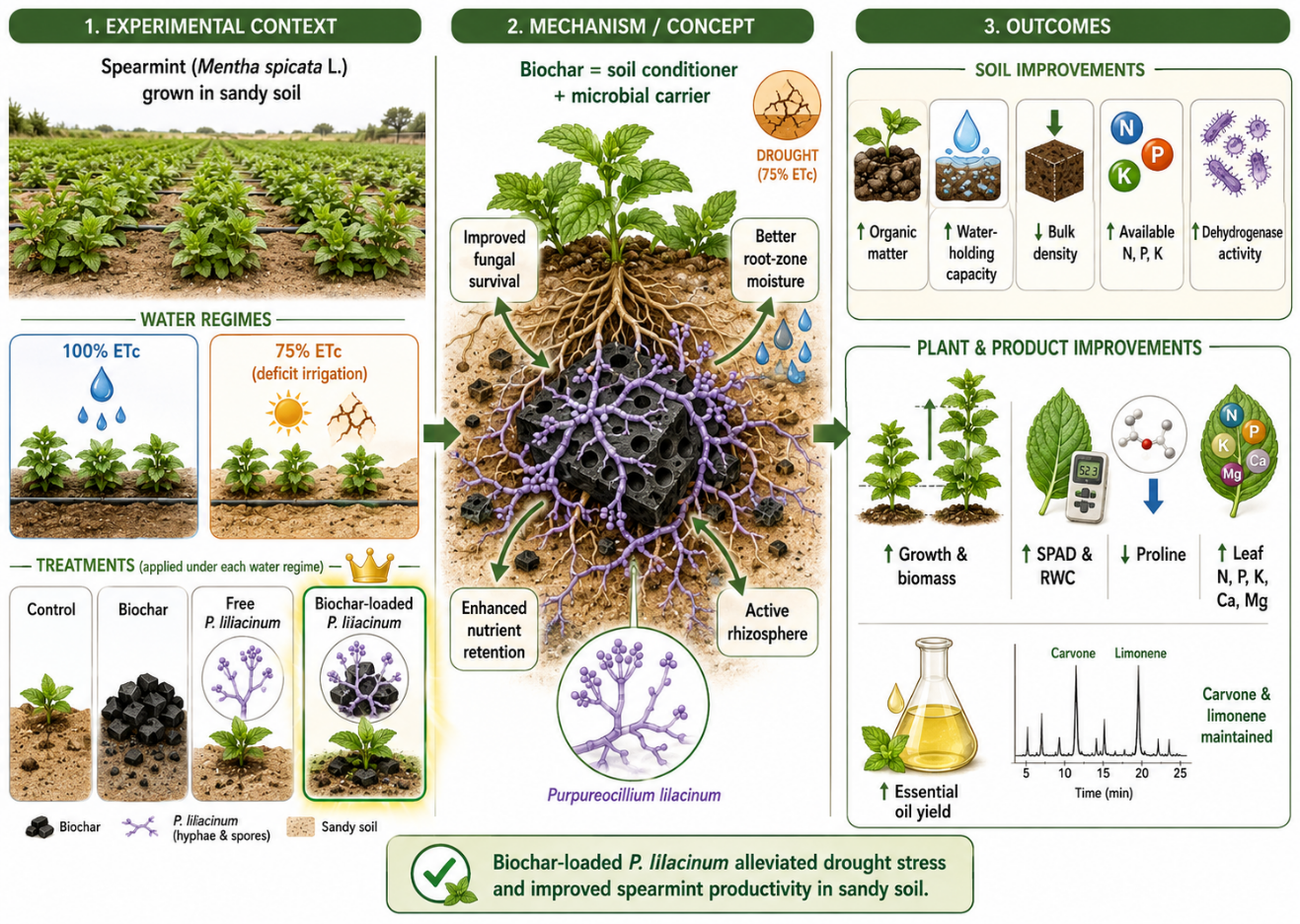

 Login
Login Register
 Submit a Paper
 Propose a Special lssue
 Download PDF
 Downloads
 Citation Tools
