CNPY2 Regulates Macrophage Polarization and Inflammatory Immune Responses via the TLR4/NF-κB Signaling Pathway to Alleviate Osteomyelitis of the Jaw
Rihui Wang1,2,#, Wanlu Li3,#, Canyang Jiang1,2, Jianping Huang1,2, Kangwei Zhou1,2, Yan Jiang4,5, Junyang Zhang1,2, Li Huang1,2,*
1 Department of Oral and Maxillofacial Surgery, the First Affiliated Hospital, Fujian Medical University, Fuzhou, China
2 Department of Oral and Maxillofacial Surgery, National Regional Medical Center, Binhai Campus of the First Affiliated Hospital, Fujian Medical University, Fuzhou, China
3 Department of Stomatology, Fujian Health College, Fuzhou, China
4 Department of Stomatology, the First Affiliated Hospital, Fujian MedicalUniversity, Fuzhou, China
5 Department of Stomatology, National Regional Medical Center, Binhai Campus of the First Affiliated Hospital, Fujian Medical University, Fuzhou, China
* Corresponding Author: Li Huang. Email: 
# These authors contributed equally to this work as the first author
BIOCELL https://doi.org/10.32604/biocell.2026.075875
Received 10 November 2025; Accepted 22 January 2026; Published online 24 February 2026
Abstract
Background: Osteomyelitis of the jaw (OMJ) is a severe infectious bone disease. While Canopy FGF signaling regulator 2 (CNPY2) is known to regulate inflammatory diseases, its role in OMJ remains unclear. The study aimed to investigate the role of CNPY2 in the mandibular joint and its molecular mechanisms.
Methods: An
in vitro OMJ model was generated by stimulating RAW264.7 macrophages with
S. aureus. CNPY2 knockdown and overexpression models were established using siRNA and plasmids. Functional assays assessed cell proliferation, migration, and invasion. Macrophage polarization, cytokine secretion, and osteoclast differentiation were analyzed. The CNPY2-Toll-Like Receptor 4 (TLR4)/Nuclear factor-kappa B (NF-κB) interaction was confirmed by Co-Immunoprecipitation (co-IP) and Western blot.
In vivo, an OMJ mouse model was induced by
S. aureus jaw injection and treated with si-CNPY2 lentivirus. Therapeutic effects were evaluated through histology and protein analysis.
Results: S. aureus stimulation upregulated CNPY2 expression in RAW264.7 cells. Knockdown of CNPY2 inhibited
S. aureus-induced cell proliferation, migration, and invasion, promoted macrophage polarization toward the M2 phenotype, suppressed M1 polarization, and reduced the release of pro-inflammatory cytokines. Additionally, CNPY2 knockdown inhibited
S. aureus-induced osteoclast differentiation (decreased expression of markers such as Nuclear factor of activated T-cells cytoplasmic 1 [NFATc1] and Cathepsin K [CTSK]). Mechanistically, CNPY2 directly interacts with TLR4, and its knockdown suppresses activation of the TLR4/NF-κB axis. In the OMJ mouse model, CNPY2 knockdown significantly reduced inflammatory infiltration in the jaw, inhibited macrophage M1 polarization, and decreased osteoclastogenesis.
Conclusion: CNPY2 exacerbates OMJ by enhancing macrophage M1 polarization, inflammation, and osteoclastogenesis via the TLR4/NF-κB axis. Targeting CNPY2 may offer a therapeutic strategy for
S. aureus-induced OMJ.
Graphical Abstract
Keywords
Canopy FGF signaling regulator 2 (CNPY2); osteomyelitis of the jaw (OMJ); toll-like receptor 4 (TLR4); nuclear factor-kappa B (NF-κB);
Staphylococcus aureus; macrophage
 Open Access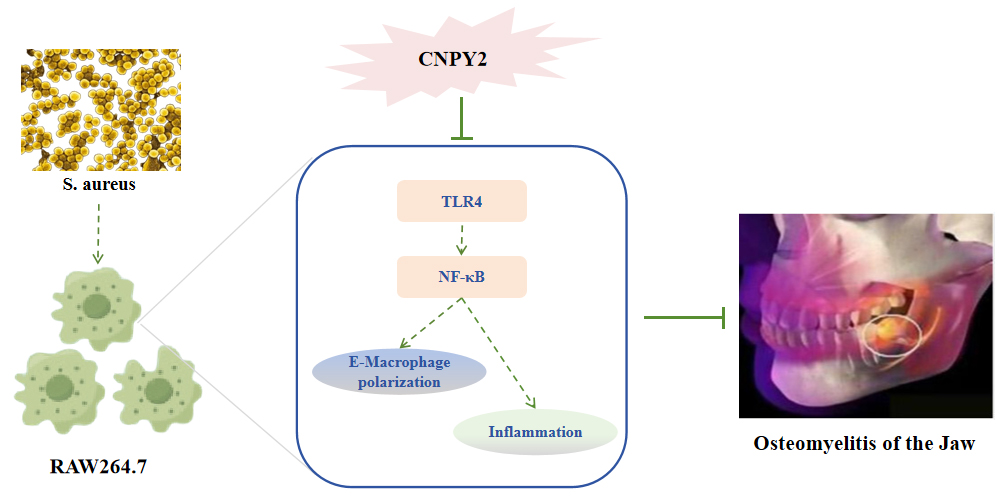

 Login
Login Register
 Submit a Paper
 Propose a Special lssue
 Download PDF
 Downloads
 Citation Tools
