Combined Effects of Plant Biostimulant Strategies on Lettuce Performance under Salinity Stress
Hasret Güneş1,*, Ceren Ayşe Bayram2
1 Department of Plant Protection, Faculty of Agriculture, Adıyaman University, Adıyaman, Türkiye
2 Department of Plant and Animal Production, Adıyaman University Kahta Vocational School, Kahta, Adıyaman, Türkiye
* Corresponding Author: Hasret Güneş. Email: 
Phyton-International Journal of Experimental Botany https://doi.org/10.32604/phyton.2026.089702
Received 23 July 2026; Accepted 09 September 2026; Published online 20 September 2026
Abstract
Soil salinity, intensified by climate change, is a major abiotic constraint limiting crop productivity, and the development of sustainable management strategies is therefore essential for resilient agroecosystems. Plant biostimulants, including arbuscular mycorrhizal fungi (AMFs),
Trichoderma spp., and organic amendments, are recognized as sustainable tools for enhancing plant tolerance to salinity through physiological and biochemical regulation. This study investigated the responses of lettuce (
Lactuca sativa L.) cv. ‘Cospirina’ grown under a non-saline control condition and two salinity levels (50 and 150 mM NaCl) to applications of
Rhizophagus intraradices,
Trichoderma asperellum, vermicompost, and coconut waste, applied individually and in combination. Plant growth attributes (shoot height, root length, stem diameter, fresh and dry biomass), photosynthetic performance, antioxidant enzyme activities (catalase and ascorbate peroxidase), macro element concentrations (P, K, Na, Ca, and Mg), AMF root colonization, soil spore density, soil pH, and electrical conductivity (EC) were assessed. Compared with salt-stressed plants receiving no biostimulant application, integrated applications of AMFs,
Trichoderma, and vermicompost significantly enhanced lettuce performance under salinity stress, resulting in 27–36% increases in shoot length, up to 63–110% increases in fresh and dry biomass, and up to 35–156% increases in antioxidant enzyme (catalase and ascorbate peroxidase) activities. Mycorrhizal inoculation markedly improved root colonization and soil spore density, while combined biostimulant treatments exhibited clear combined effects by improving nutrient uptake efficiency and maintaining physiological stability under saline conditions. These findings indicate that integrated microbial–organic biostimulant strategies represent a promising, sustainable approach for mitigating salinity stress in lettuce.
Graphical Abstract
Keywords
Arbuscular mycorrhizal fungi;
Trichoderma asperellum; antioxidant enzyme activity; nutrient uptake efficiency;
Lactuca sativa L.
 Open Access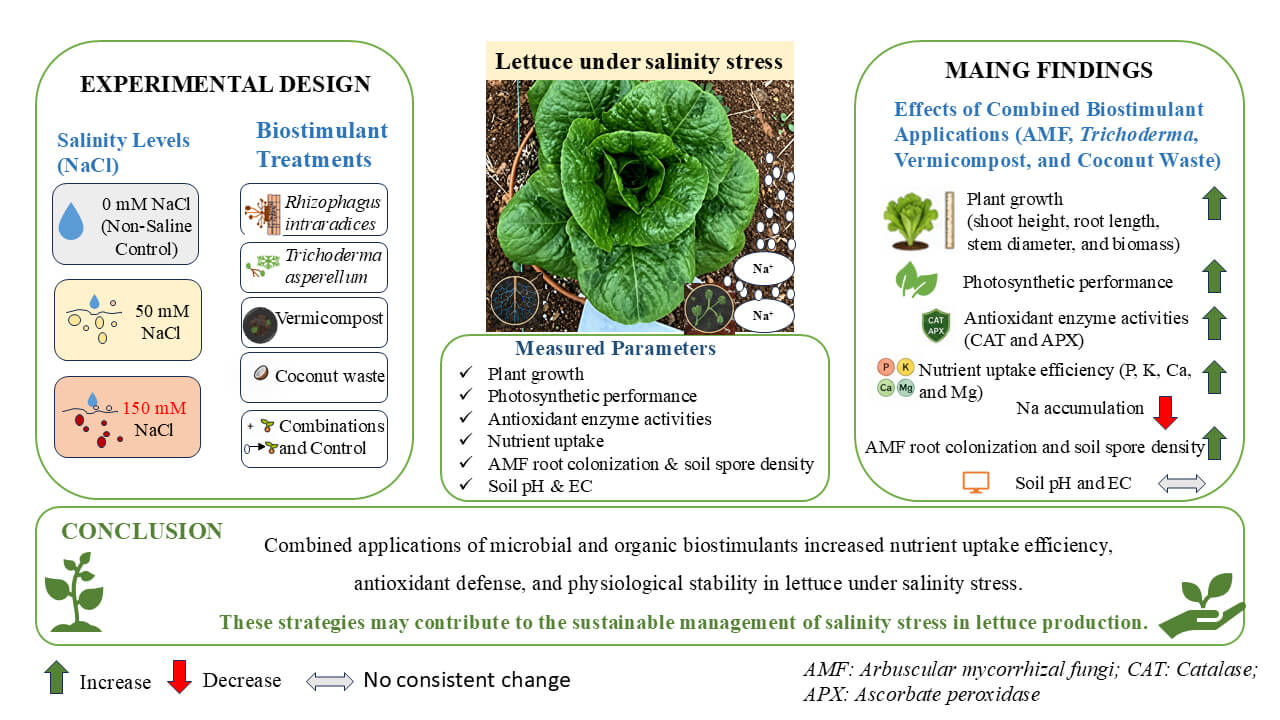

 Login
Login Register
 Submit a Paper
 Propose a Special lssue
 Download PDF
 Downloads
 Citation Tools
