Guest Editor(s)
Prof. Dr. Patrizia Russo
Email: patrizia.russo@uniroma5.it
Affiliation: 1. Department of Human Sciences and Quality of Life Promotion, San Raffaele University, Via di Val Cannuta 247, Italy
2. Clinical and Molecular Epidemiology, Istituto di Ricovero e Cura a Carattere Scientifico (IRCCS) San Raffaele Roma, Via di Val Cannuta 247, Italy
Homepage:
Research Interests: virome, torquetenovirus, lung diseases, biomarkers, survival, smoking

Dr. Carla Prezioso
Email: carla.prezioso@uniroma5.it
Affiliation: 1. Department for the Promotion of Human Sciences and Quality of Life, San Raffaele University, Via di Val Cannuta
247, Italy
2. Laboratory of Microbiology, IRCCS San Raffaele Roma, Via di Val Cannuta 247, Italy
Homepage:
Research Interests: virome, torquetenovirus, lung diseases, biomarkers, respiratory virus, miRNA

Summary
The human virome—comprising eukaryotic viruses, bacteriophages, and endogenous viral elements—is increasingly recognized as a critical modulator of human health and disease. While early studies have largely focused on virome composition and disease associations, emerging evidence indicates that virome components exert profound effects on cellular signaling networks, molecular regulation, and cell fate decisions within host cells.
This Special Issue aims to publish high-quality research that moves beyond descriptive profiling to explicitly elucidate the molecular and cellular mechanisms by which the human virome influences host cell biology. In alignment with the scope of BIOCELL, submissions are expected to be grounded in cellular or subcellular-level mechanistic investigation, with particular emphasis on defined signaling pathways, molecular interactions, and causal relationships linking virome-related factors to cellular phenotypes in health and disease.
Studies relying solely on virome profiling, correlative analyses, or tissue-, organ-, or whole-animal–level observations without validated cellular mechanisms are outside the scope of this Special Issue.
Topics include, but are not limited to:
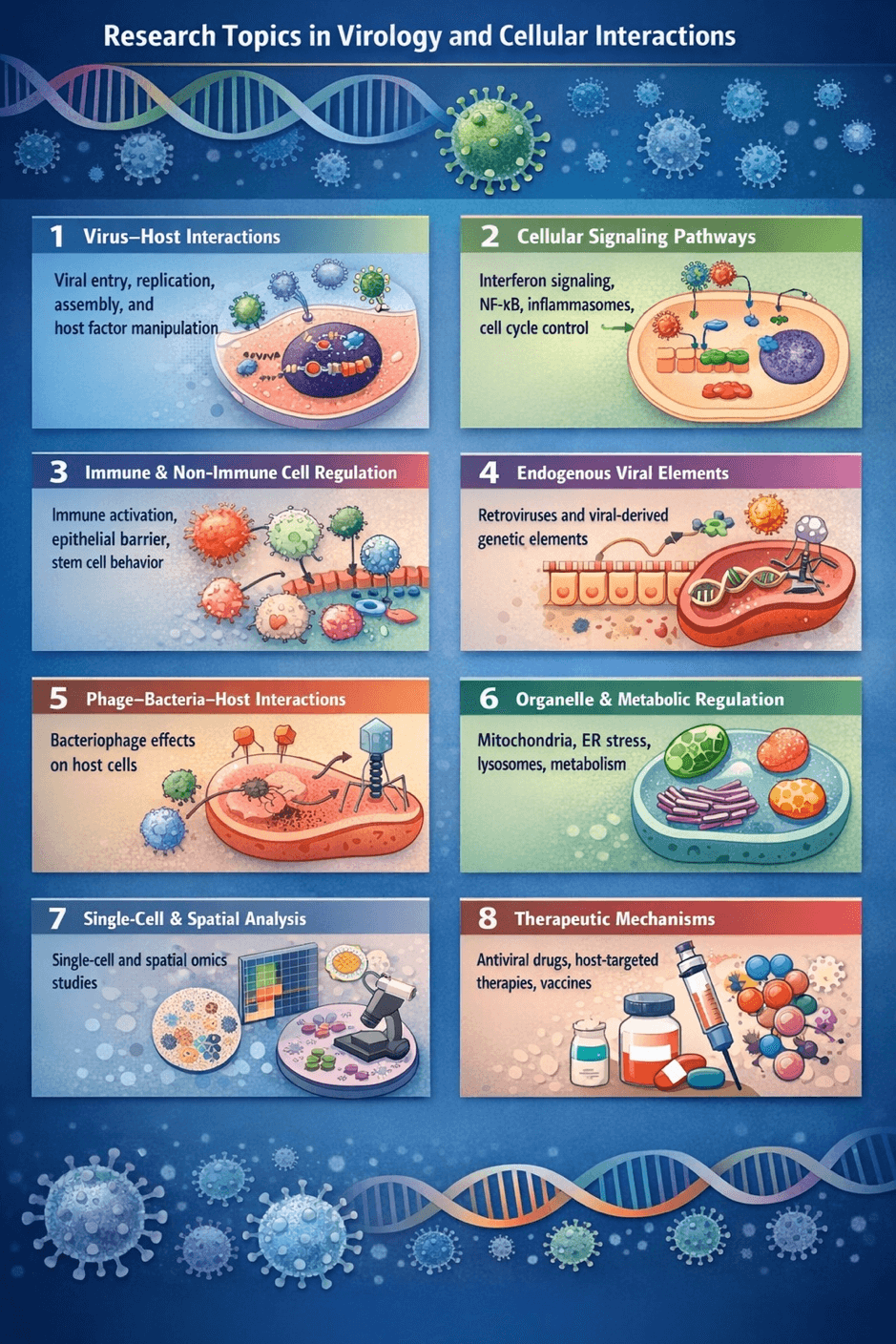
· Virus–host interactions at the cellular and subcellular levels
Mechanistic studies of viral entry, replication, assembly, intracellular trafficking, and host factor manipulation within specific cell types.
· Cellular signaling pathways modulated by the virome
Molecular regulation of interferon signaling, NF-κB, inflammasomes, autophagy, apoptosis, cell cycle control, and related pathways.
· Virome-driven regulation of immune and non-immune cell functions
Mechanistic insights into how virome components alter immune activation, epithelial barrier integrity, stem cell behavior, or cell differentiation.
· Endogenous viral elements and cellular regulation
Roles of endogenous retroviruses and viral-derived genetic elements in chromatin remodeling, transcriptional regulation, and disease-associated cellular phenotypes.
· Phage–bacteria–host cell crosstalk with defined cellular mechanisms
Studies demonstrating how bacteriophages indirectly or directly modulate host cell behavior through specific molecular mediators or signaling pathways.
· Organelle and metabolic regulation by virome components
Mechanistic analyses of mitochondrial function, ER stress, lysosomal activity, and cellular metabolic reprogramming.
· Single-cell and spatial approaches with mechanistic validation
Single-cell or spatial omics studies identifying cell-type-specific virome effects, accompanied by functional perturbation experiments to establish causality.
· Therapeutic and pharmacological mechanisms at the cellular level
Mechanistic studies of antiviral agents, host-targeted therapies, phage-based interventions, or vaccine-induced cellular responses with clearly defined molecular targets and downstream signaling pathways.
Graphic Abstract
Keywords
virome, virus–host interaction, cellular mechanisms, molecular signaling, endogenous viral elements, single-cell analysis, organelle regulation, host–pathogen interactions

 Login
Login Register
 Submit a Paper
 Propose a Special lssue